Quick Answer
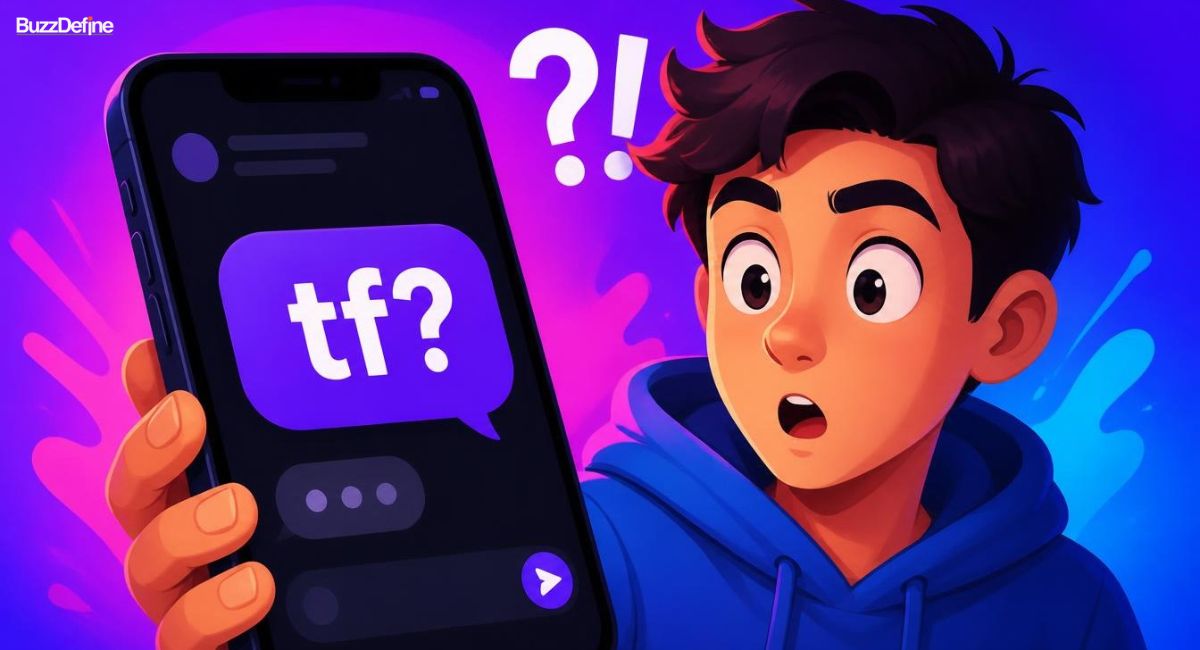
TF is internet slang for “the f***.” People type it in chat to show shock, confusion, or frustration, and it usually follows a question word like “what,” “why,” or “how.” For example, “tf is going on?” means “what the f*** is going on?” It’s casual, so it fits texts with close friends, not work chats. Tone shifts with punctuation and emojis, so read the whole message.
| Meaning | Tone | Safe for work? |
| “the f***” | Shock, confusion, annoyance, or humor | No |
A bare “tf?” showing up on your screen can feel confusing. This guide breaks down the tf meaning in chat, how to read its tone, and what to send back.
TF Full Form & Meaning
TF stands for “the f***.” It’s a short form of a swear phrase, and people type it to add shock, confusion, or emphasis to a message.
You’ll almost never see it floating alone. TF usually sits right after a question word, and that’s the pattern to watch for. It’s also part of a bigger family of slang:
- wtf means “what the f***”
- htf means “how the f***”
- stfu means “shut the f*** up”
- omfg means “oh my f***ing god”
Think of TF as the middle piece. WTF has the question word built in. TF lets you swap in whichever question word fits: what, why, who, how, or where.
| Phrase | What it means | Example |
| what tf | “What the f***?” Surprise or confusion | “what tf is that noise?” |
| why tf | “Why the f***?” Annoyance or disbelief | “why tf did you leave so early?” |
| who tf | “Who the f***?” Confusion about a person | “who tf is texting me at 3 a.m.?” |
| how tf | “How the f***?” Amazement or confusion | “how tf did you finish that already?” |
| where tf | “Where the f***?” Frustration about something missing | “where tf are my keys?” |
According to Dictionary.com, the phrase also works on its own to show disbelief or disgust, but the question word pairing is by far the most common way to see it.
Tone Decoder
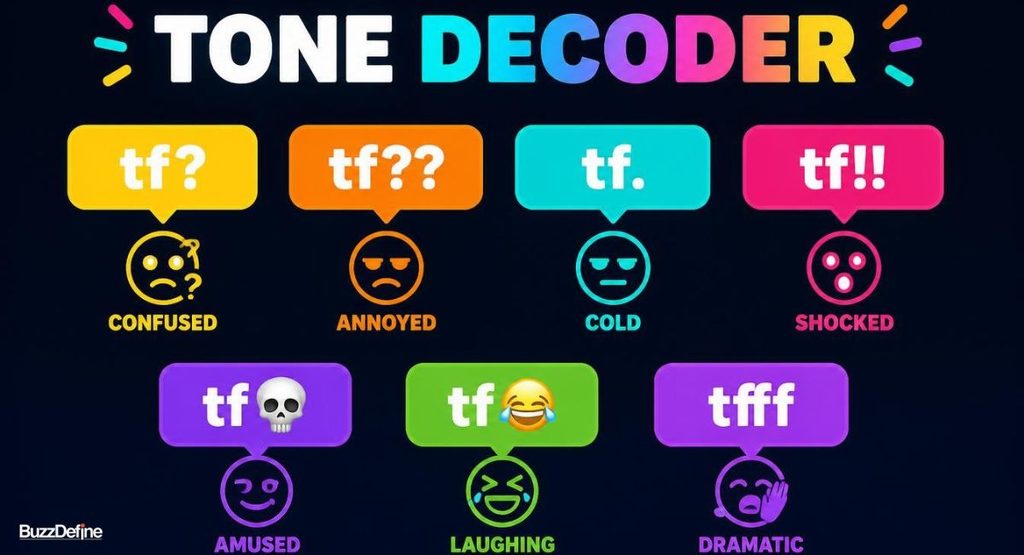
The same “tf” can mean six different things, and punctuation plus emojis tell you which one. Use this table to read the mood before you reply.
| What you see | What it usually means | Feels like |
| tf? | Genuine confusion | “Wait, what?” |
| tf?? | Stronger confusion or disbelief | “I really don’t get this.” |
| tf. | Cold or annoyed | “I’m not happy.” |
| tf!! | Loud shock, good or bad | “I can’t believe it!” |
| tf 💀 | Something is so funny or absurd | “I’m done, that’s wild.” |
| tf 😂 | Playful, laughing | “That’s hilarious.” |
| tfff | Stretched, dramatic shock | “Oh my gosh, seriously?” |
A quick way to read any tf:
- Check the punctuation. A period feels flatter than a question mark.
- Look for an emoji. Laughing emojis soften it.
- Read the message before it. Context beats everything.
Save this table as a screenshot. It’s the fastest cheat sheet for decoding a confusing text.
Real Chat Examples
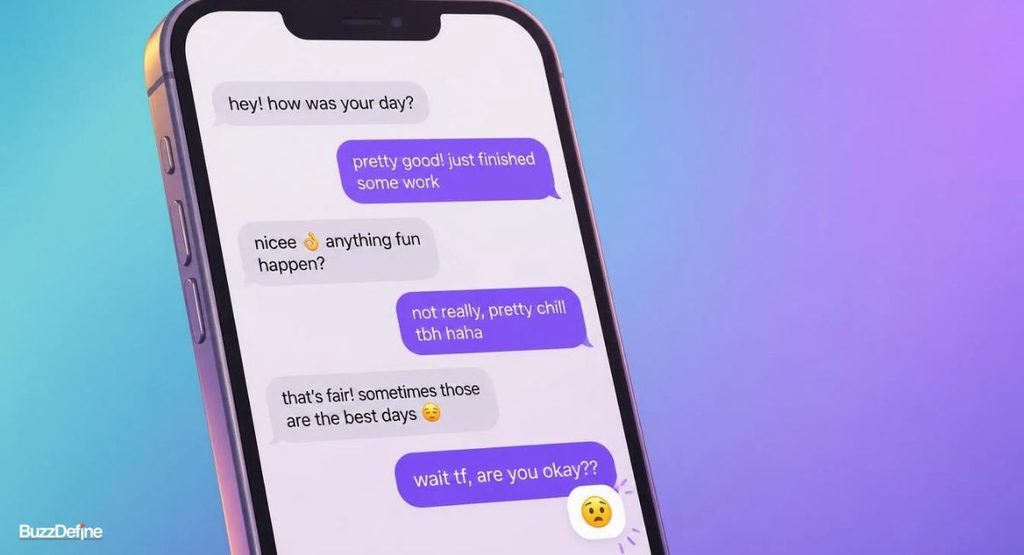
Real chats show how the same word shifts with the situation. Here are eight quick examples, grouped by mood.
1. Confusion
A: the meeting moved to 6 a.m.
B: tf? who decided that?
2. Confusion
A: your package got delivered to the wrong city
B: how tf does that even happen
3. Positive shock
A: i got the job!!
B: tf, you actually did it?! so proud of you
4. Positive shock
A: we’re going to the concert front row
B: wait tf, how did you get those tickets??
5. Annoyance
A: sorry, i forgot to reply earlier
B: tf, it’s been three hours
6. Playful
A: [sends photo of a mismatched outfit]
B: tf is this outfit 😂
7. Serious anger
A: i told them what you said
B: tf is your problem right now.
8. Worry
A: i got some bad news today
B: wait tf, are you okay??
What to notice: example 3 and example 7 use the same word, but one is a compliment and one is a confrontation. The emotion comes from the sentence around “tf,” not from the word itself.
How to Reply to “TF”
The right reply depends on who sent it and what mood they’re in. Match their energy, explain if they’re confused, and calm things down if they’re upset.
If it’s a friend
- “Long story. Call you in five?”
- “Right? I’m still processing it too.”
- “Okay, let me explain before you panic 😅”
If it’s your crush
- “Haha, that’s the reaction I was hoping for.”
- “Okay, that’s fair. Want the full story?”
- “Should I be worried or flattered? 😄”
If it’s a group chat
- “Same, I have no idea what’s happening.”
- “Wait, someone explain because I’m lost too.”
- “Scroll up, it gets worse.”
If it’s someone who’s angry
- “Fair, I get why you’re upset. Can we talk it through?”
- “I hear you. Let me explain what happened.”
- “I didn’t mean it that way. Can I call you?”
A simple rule: if the “tf” feels playful, reply playfully. If it feels cold or sharp, skip the jokes and stay calm.
TF on Each Platform
TF sounds a little different on every app, but the meaning stays the same. Here’s the tone you’ll usually meet on each one.
| Platform | Usual tone | Example |
| Snapchat | Quick, surprised or amused reactions between friends | “tf is that filter 😂” |
| Mostly close friends and family group jokes | “wait tf, when did this happen?” | |
| TikTok | Comment section reactions, often paired with 💀 | “tf did i just watch 💀” |
| Comments and DMs reacting to photos or stories | “tf, this is insane” | |
| X (Twitter) | Reacting to strange or shocking posts | “tf is this take” |
| Discord / Gaming | Fast reactions in the middle of a match | “how tf did he hit that?” |
How TF multiplies in group chats: when one person types “tf,” others often follow within seconds. The replies get longer and louder, like “tfff,” “tf??,” and “WAIT TF.” It works like a shared gasp. If you see a stack of them, everyone is probably reacting to the same surprise, and it’s usually more excitement than anger.
“TF From a Girl / From a Guy”
Gender doesn’t change what TF means. It stands for “the f***,” and it signals shock, confusion, or annoyance no matter who sends it.
What changes the meaning is everything around it:
- Your relationship. A friend teasing you sounds different from a stranger snapping at you.
- The topic. “tf” about a funny photo is light. “tf” about a broken promise is not.
- The tone. Punctuation, emojis, and timing tell you the mood. Use the Tone Decoder above.
- Earlier messages. The last few texts usually explain the reaction.
So if someone searches “what does tf mean from a girl” or “from a guy,” the honest answer is the same for both: read the message, the emoji, and your history together. Don’t guess from who sent it.
Origin & History
TF grew out of a much older phrase. According to Dictionary.com, “the f***” appeared as early as the 1910s as a coarser version of “the hell,” used in questions like “who the hell are you?”
Over time it shortened into a stand alone reaction to show disbelief or dismay. Then came the abbreviations. Dictionary.com notes that WTF was already in use by 1985, and TF followed as its shorter cousin. By the 2000s, TF had become common online.
That means this slang isn’t a fresh trend. The phrase behind it is more than a century old, and the abbreviation has been floating around chat spaces for roughly two decades.
Other Meanings of TF
In chat, TF almost always means “the f***.” Outside of texting, though, the letters have other uses, and the surrounding context usually makes it obvious which one you’re seeing.
- Twisted Fate: a champion in the game League of Legends, often shortened to TF by players (per Slang.net).
- Transcription factor: a protein that binds to specific DNA sequences in biology.
- .tf: the country code domain for the French Southern Territories.
- MG TF: a sports car built by MG Rover and later MG Motor UK.
- Halo: The Flood: a novel by William C. Dietz, sometimes abbreviated TF.
If you found “tf” in a text, comment, or DM, the profanity meaning is the safe bet.
TF vs Similar Slang
TF, WTF, and SMH all react to something, but they carry different feelings. Here’s how they compare.
| Slang | Meaning | Tone | Example |
| tf | “the f***” | Flexible: shock, confusion, or annoyance | “tf is going on?” |
| wtf | “what the f***” | Stronger, standalone shock | “wtf just happened” |
| smh | “shaking my head” | Disappointment | “smh, that’s rough” |
| fr | “for real” | Agreement or emphasis | “that’s wild fr” |
| istg | “I swear to god” | Frustration or emphasis | “istg if this happens again” |
| bruh | An expression of disbelief | Casual, often deadpan | “bruh, you’re kidding” |
| ffs | “for f***’s sake” | Exasperation | “ffs, not again” |
The main difference: TF and WTF react to a moment of surprise. FR and SMH add tone to an opinion. ISTG and FFS lean toward frustration.
When to Use & When to Avoid
Use TF only when the chat is casual and the other person is comfortable with it. If you wouldn’t say “what the f***” out loud in that moment, don’t type “tf.”
| ✅ Use it when | ⚠️ Avoid it when |
| You’re texting close friends | You’re messaging a manager, teacher, or client |
| The chat is already casual | You’re not sure how the person feels about slang |
| You feel real shock or confusion | The topic is serious, like grief or a real conflict |
| You know it won’t offend | You’re writing something formal, like an email or resume |
Safe alternatives
- “What the heck?”
- “What on earth?”
- “Seriously?”
- “Wait, what?”
- “I’m so confused right now.”
Layout note: show the table in two columns on desktop. On mobile, stack the two columns as two separate lists.
Common Myths
Myth 1: “TF only means anger.”
Not true. It often shows excitement, confusion, or playful teasing. The emotion comes from the rest of the sentence.
Myth 2: “TF and WTF are the same thing.”
They’re close, but not identical. WTF has “what” built in. TF usually attaches to a question word or reacts quickly on its own.
Myth 3: “TF is a new trend.”
Not really. Dictionary.com says it’s been common online since the 2000s, and the phrase behind it is much older.
Myth 4: “It’s fine to use anywhere online.”
No. It’s a swear abbreviation, so skip it in work chats, school messages, and anything formal.
FAQs
Is tf rude?
Not among close friends, where it usually sounds playful or surprised. Aimed at strangers or during an argument, it can sound harsh, since it stands for a swear phrase.
What’s the difference between tf and wtf?
WTF means “what the f***,” with the question word built in. TF usually attaches to one, like “why tf” or “how tf.” Both show shock or confusion.
Can I use tf at work?
No, skip it. It stands for a swear phrase, and tone is easy to misread in text. Plain words like “what happened?” work everywhere.
Is tf a swear word?
Yes, in practice. It’s short for “the f***,” so it carries the same edge, even though it looks milder. Keep it out of formal settings.
What does tf mean from a girl or guy?
It means the same thing: “the f***.” Gender doesn’t change it. Your relationship, the topic, and the tone (emojis, punctuation) decide the mood.
Can tf be flirty?
Sometimes. Between people who already tease each other, “tf” with a laughing or smiley emoji can feel playful. Without that warm context, it just means shock or confusion.
Is tf okay on Instagram or TikTok?
Yes, it’s common in comments and DMs. Still, it’s profanity, so avoid it on school, work, or brand accounts. Some platforms may filter swearing.
What is the full form of tf?
TF stands for “the f***.” People type it to add shock, confusion, or emphasis, usually right after a word like “what,” “why,” or “how.”
What does “tf is wrong with you” mean?
It’s a blunt way of asking what’s wrong with someone. Between friends it can be a joke. During an argument or between strangers, treat it as hostile.
Final Takeaway
The tf meaning in chat is simple: TF stands for “the f***,” and it adds shock, confusion, or emphasis to a message. That’s the tf full form in chat, and it’s the core of the tf meaning everywhere online. The word is easy. The mood comes from the punctuation, the emojis, and who sent it.
Use it with close friends when the chat is casual, and skip it at work or in serious moments. When in doubt, pick a softer phrase like “what the heck?”
Want to decode more slang? Read our guides on WTD Meaning in Text, ONB Meaning, and PMO Meaning in Text.

Muhammad Kaleem is the founder and lead writer at BuzzDefine, where he covers internet slang, texting abbreviations, and digital communication trends. He actively follows how language evolves across WhatsApp, Instagram, and TikTok — tracking real conversations, group chats, and comment threads to keep definitions accurate and current. He writes to make modern slang easy to understand for readers of every generation.