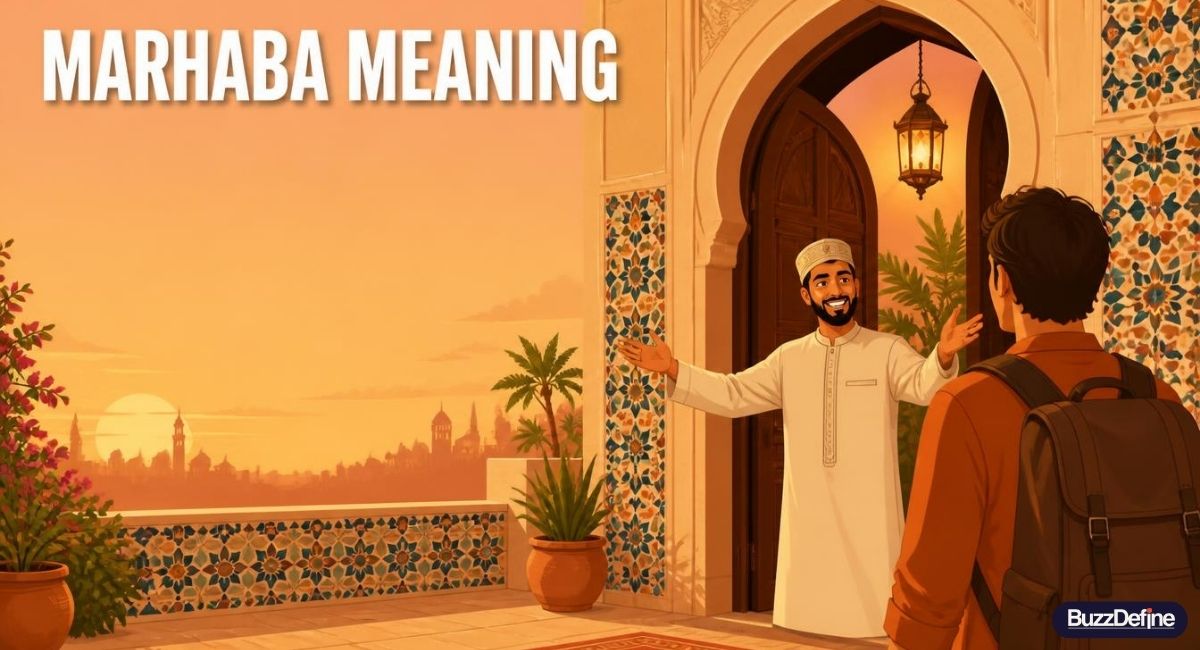
Marhaba means “hello” or “welcome” in Arabic. It’s one of the most common greetings across the Arab world, and you’ll hear it used in shops, homes, offices, and casual conversations alike. But the word carries more depth than a simple hi. Its root actually points to the idea of “space” or “openness,” which is why Marhaba feels less like a formal greeting and more like an invitation, a way of telling someone they’ve arrived somewhere they’re welcome.
In this guide to Marhaba meaning, you’ll learn exactly what the word means, where it comes from, how to pronounce it, and when (and how) to use it in real conversations.
What Does Marhaba Mean? (Quick Answer)
Marhaba (مرحبا) means “hello” or “welcome” in Arabic.
It’s a general-purpose greeting you can use with almost anyone, at any time of day, in almost any setting — formal or casual. Unlike some Arabic greetings tied to religion or time of day, Marhaba works everywhere: greeting a friend, welcoming a guest into your home, or simply saying hi to a stranger.
| Question | Answer |
| What does Marhaba mean? | Hello / Welcome |
| Language | Arabic |
| Script | مرحبا |
| Formality | Works in both formal and informal settings |
| Common use | Greeting someone, welcoming a guest |
Marhaba Pronunciation
Marhaba is pronounced mar HA ba (the stress falls on the middle syllable, “HA”). In Arabic script, it’s written مرحبا.
Here’s a quick breakdown of the three syllables:
| Syllable | Sound | Stress |
| mar | like “mar” in “market” | unstressed |
| HA | like “ha” in “hard” | stressed (main emphasis) |
| ba | like “ba” in “banana” | unstressed |
Say it smoothly, without pausing between syllables, and you’ll sound close to a native speaker.
Literal & Root Meaning of Marhaba
Marhaba comes from the Arabic root ر ح ب (r, h, b), which relates to the idea of “spaciousness” or “openness.” In its most basic sense, this root describes something wide, roomy, or unrestricted.
So how did a word about “space” turn into a greeting? Language often evolves through metaphor, and this is a clear example. Telling someone they’ve entered a “spacious place” became a way of telling them they’re welcome there, that there’s room for them, and that they’re free to feel comfortable. Over time, that idea settled into the everyday greeting we now know as Marhaba.
This is part of what makes Marhaba feel warmer than a plain “hello.” It’s built on the concept of making room for someone, not just acknowledging them.
Origin and Etymology
Marhaba is an Arabic word through and through, and its meaning as a greeting developed directly from the root ر ح ب, tied to spaciousness and ease. As Arabic evolved, this root gave rise to related words like رحّب (to welcome) and رحابة (spaciousness or amplitude), all carrying the same underlying idea of openness.
Some linguistic discussions also point to a possible connection with Aramaic, a closely related Semitic language spoken in the region long before Arabic became dominant.
While Arabic usage is the clearest and most established origin of the word as it’s used today, this Semitic language family shares many overlapping roots, which explains why similar sounding words show up in neighboring languages too.
Cultural & Religious Significance
In Arab culture, hospitality isn’t just good manners, it’s a deeply held value. Welcoming guests, feeding them, and making them feel at home is treated as a mark of character and generosity. Marhaba sits right at the center of that tradition.
In Islamic tradition, hospitality toward guests is also highly regarded, often described as a reflection of one’s faith and character. Saying Marhaba to someone entering your home or business isn’t just a formality, it’s a small act that reflects this broader cultural respect for guests.
That’s why Marhaba means more than “hi.” It carries an implicit message: you’re welcome here, there’s space for you, and you’re valued. This is also why you’ll often hear it extended into phrases like “Marhaba wa sahlan,” which adds even more warmth to the welcome.
How and When to Use Marhaba
Marhaba is flexible. You can use it in almost any setting, with almost anyone, at almost any time of day.
| Situation | Example sentence | Meaning |
| Meeting someone new | Marhaba, how are you? | Hello, how are you? |
| Entering a shop | Marhaba! | Hi! (greeting the shopkeeper) |
| Welcoming a guest home | Marhaba, ahlan wa sahlan | Welcome, you’re most welcome |
| Starting a phone call | Marhaba, kifak? | Hello, how are you? |
| Greeting a coworker | Marhaba, sabah al khayr | Hello, good morning |
Because it isn’t tied to a specific time of day or religious context, Marhaba works as a safe, all purpose greeting whether you’re speaking casually with friends or addressing someone more formally.
Marhaba in Different Arabic Dialects
Arabic has many regional dialects, and while Marhaba is understood almost everywhere, the way it’s used and paired with other words can shift slightly depending on the region.
| Dialect | Usage notes |
| Lebanese | Very common everyday greeting, often shortened casually in speech |
| Gulf (Khaliji) | Used, though “Ahlan” is sometimes preferred in daily conversation |
| Egyptian | Understood widely, though “Ahlan” or “Izzayyak” are more typical locally |
| Levantine (Syrian, Jordanian, Palestinian) | Extremely common, often paired with “Marhabtayn” as a warm reply |
No matter the dialect, Marhaba is rarely out of place. It’s one of the few greetings that crosses regional lines without sounding unnatural.
How to Respond to Marhaba
If someone greets you with Marhaba, you don’t need to overthink your reply. A few common responses include:
- Marhaba — simply repeating it back is completely natural
- Marhabtayn — literally “two Marhabas,” a friendly way of returning the greeting with extra warmth
- Ahlan wa sahlan — meaning “welcome” or “you’re welcome here,” often used interchangeably as a reply
- Ahlan biik / Ahlan biiki — “welcome to you” (said to a man or woman respectively)
Any of these responses keep the exchange friendly and natural, and none of them require a long or formal reply.
Marhaba vs Other Arabic Greetings
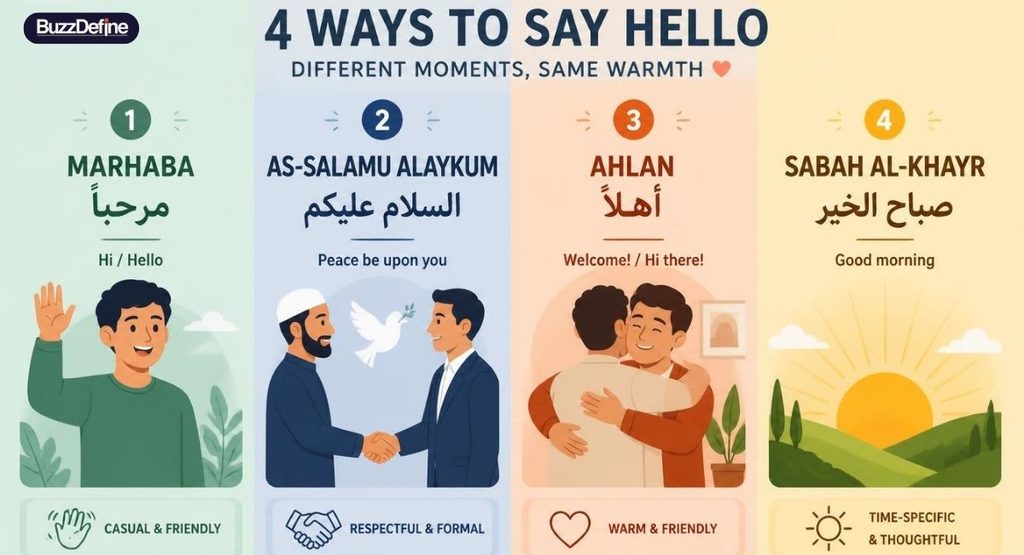
Arabic has several common greetings, and each one carries a slightly different tone or context.
| Greeting | Literal meaning | Best used when |
| Marhaba | Hello / Welcome | General, all purpose greeting, any time |
| As salamu alaykum | Peace be upon you | More formal, carries religious weight, common among Muslims |
| Ahlan | Welcome / Hi | Casual, friendly, everyday greeting |
| Sabah al khayr | Good morning | Specifically for mornings |
Marhaba stands out because it isn’t restricted by time of day or religious context, making it one of the most versatile greetings you can learn.
Common Phrases Using Marhaba
Once you know Marhaba, a few related phrases will come in handy:
- Marhaba wa sahlan — “welcome and ease,” a warmer, more elaborate way of saying welcome
- Marhabtayn — “two Marhabas,” a common friendly reply
- Marhaba beek / Marhaba beeki — “welcome to you,” said to a man or woman
- Ahlan wa sahlan wa Marhaba — a fuller, more expressive welcome, often used when greeting guests
These variations let you adjust the warmth and formality of your greeting depending on the situation.
FAQs
Is Marhaba formal or informal?
Marhaba works in both formal and informal settings. It’s polite enough for professional situations and casual enough for everyday conversation.
Is Marhaba only used in Arabic?
Marhaba originates in Arabic, though the word has been picked up in some neighboring languages and regions due to close cultural and linguistic ties. Its primary and most widely recognized use remains within Arabic.
Marhaba vs Ahlan, what’s the difference?
Both mean “welcome” or “hello,” but Ahlan tends to feel slightly more casual, while Marhaba is neutral enough to fit both casual and formal contexts.
Can Marhaba be used at night?
Yes. Unlike greetings tied to specific times of day, Marhaba isn’t restricted to mornings or evenings. You can use it any time you greet someone.
Conclusion
Understanding the Marhaba meaning is more than learning a simple “hello.” Rooted in the idea of openness and space, it carries a quiet message of welcome every time it’s said. Whether you’re greeting a friend, welcoming a guest, or just starting a conversation, Marhaba is a warm, flexible word that fits almost any situation.
Now that you know the full Marhaba meaning, you’ll be able to use it naturally and confidently in real conversations.
If you’d like to build on this, take a look at our guide to other essential Arabic greetings, or explore how everyday phrases like Ahlan and As salamu alaykum are used in real conversations.
Read Next: “Pun Intended” Meaning: Definition, Origin, Examples and How to Use It

Muhammad Kaleem is the founder and lead writer at BuzzDefine, where he covers internet slang, texting abbreviations, and digital communication trends. He actively follows how language evolves across WhatsApp, Instagram, and TikTok — tracking real conversations, group chats, and comment threads to keep definitions accurate and current. He writes to make modern slang easy to understand for readers of every generation.