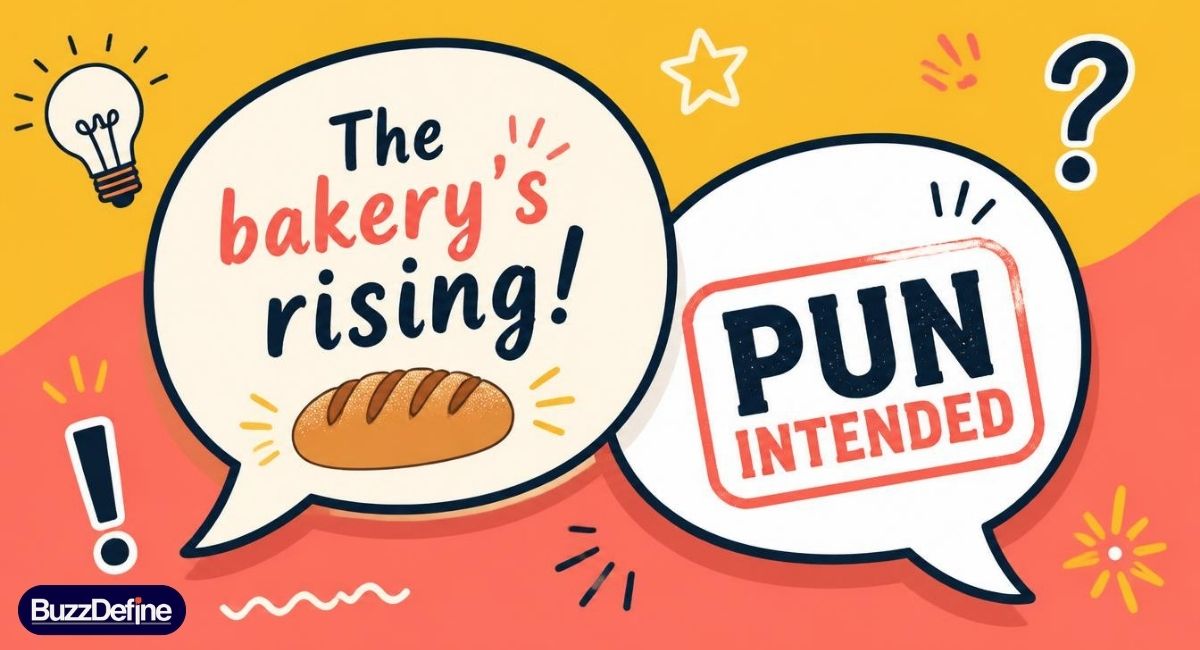
You’ve probably said it right after cracking a joke, or read it tucked in parentheses on social media. But what does “pun intended” actually mean, and where did it come from? This guide breaks down the “pun intended” meaning in plain English, walks through real examples, and shows you exactly how (and when) to use it, so you never second-guess the phrase again.
What Does “Pun Intended” Mean?
“Pun intended” means the speaker or writer made a play on words on purpose and wants you to notice it. You’ll usually see it right after a joke, tucked in parentheses or added at the end of a sentence, as a nudge that says: yes, that double meaning was deliberate.
It’s the opposite of “no pun intended,” which people say when a joke slips out by accident.
Quick Answer
“Pun intended” = a phrase you add after wordplay to confirm it was on purpose.
Example: “I’m reading a book about anti-gravity. It’s impossible to put down — pun intended.”
Where Does “Pun Intended” Come From? (Origin & History)
Puns themselves go back thousands of years, showing up in Latin wordplay, Shakespeare’s plays, and even the Bible. But the habit of pointing out a pun with a little verbal wink is much younger.
The earliest known nod to this idea shows up in the mid 1800s, in a satirical piece about a turkey that used the phrase “fowl play” and flagged it with a version of “no pun intended” right after.
By the early 1900s, writers were using the phrase more freely; even Beat generation author William S. Burroughs dropped it into a 1937 essay for Esquire magazine.
The positive version, simply “pun intended,” came later. As puns became a staple of radio comedy, sitcoms, and eventually internet culture, people started flipping the phrase to own their wordplay instead of apologizing for it.
Today “pun intended” pops up constantly in headlines, social captions, and everyday conversation, and it’s now just as common as its more famous cousin, “no pun intended.”
“Pun Intended” in Pop Culture, Headlines & Branding
The phrase shows up everywhere once you start noticing it. News outlets use it to soften a groan worthy headline, like a sports story about a player named Moore getting “more” playing time.
Magazines and blogs lean on it in reviews and interviews, especially when a celebrity’s own words happen to double up in meaning.
Brands use it too, often in taglines or social captions, since a self aware pun feels clever rather than cheesy. Even everyday people have picked up the habit, sprinkling “pun intended” into captions, texts, and comments as a small joke wrapped inside a bigger one.
“Pun Intended” vs “No Pun Intended”: What’s the Difference?
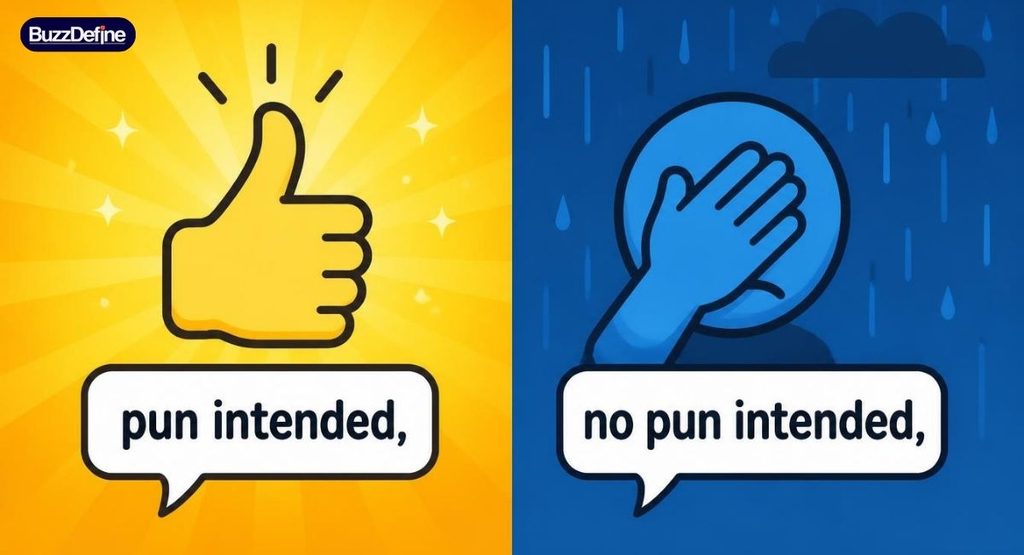
Both phrases point at a pun, but they send opposite signals about intent.
| Use “pun intended” when… | Use “no pun intended” when… |
| You made the wordplay on purpose and want people to catch it | The double meaning slipped out by accident |
| You want to own a joke instead of apologizing for it | You want to clarify you weren’t trying to be funny |
| You’re writing something playful or lighthearted | You’re making a serious point and don’t want the pun to distract |
| Example: “The math teacher was arrested for adding two negatives. Pun intended.” | Example: “This project is going downhill fast, no pun intended.” |
| It signals confidence in the joke | It signals you’re distancing yourself from an unintended joke |
The short version: “pun intended” claims the joke. “No pun intended” disowns it.
How to Use “Pun Intended” in a Sentence
You can drop “pun intended” in three main spots.
- In parentheses, right after the pun. This is the most common placement. Example: “I used to be a baker, but I couldn’t make enough dough (pun intended).”
- At the end of the sentence, set off by a comma. This feels a bit more conversational. Example: “That electrician really knows how to charge up a room, pun intended.”
- Mid sentence, when the pun happens early. Less common, but it works if the wordplay lands before the sentence ends. Example: “The fish restaurant, pun intended, is a great catch.”
Here are more examples across different everyday situations:
- Casual conversation: “I quit my job at the calendar factory. I just needed some time off, pun intended.”
- Social media caption: “New plant baby! I’m really rooting for this one. Pun intended.”
- Storytelling: “The glassblower’s business finally took shape, pun intended, after years of trial and error.”
- Light professional writing: “Our bakery’s sales are really rising this quarter, pun intended.”
- Text message: “Can’t talk right now, I’m swamped (pun intended, I’m literally at the marsh restoration site).”
- Headline style: “Local Locksmith Says Business Is Key. Pun Intended.”
- Comedy or public speaking: “This next joke is a real stretch, pun intended, so bear with me.”
- Writing/blogging: “Grammar teachers never retire, they just lose their sentence. Pun intended.”
Types of Puns (With Examples for Each)
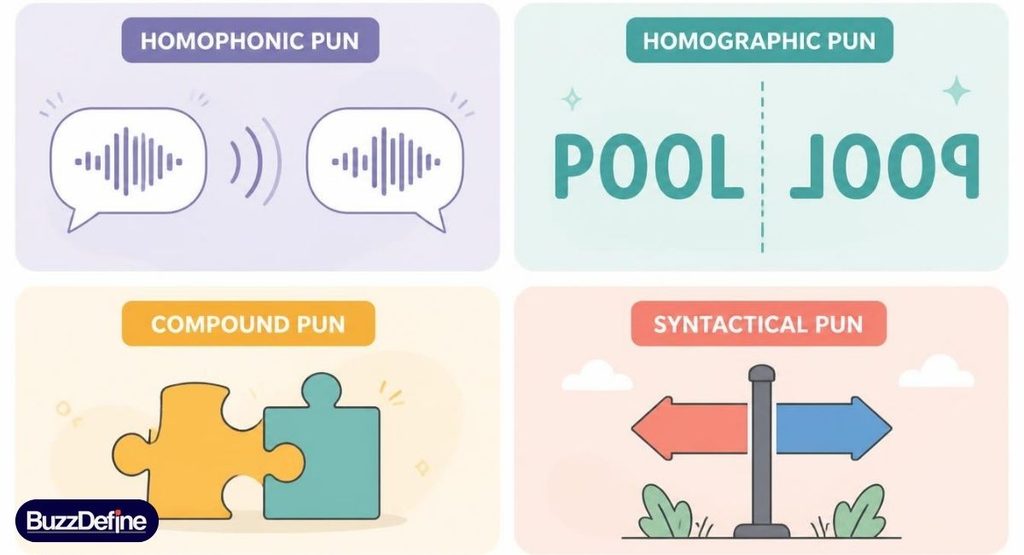
Not all puns work the same way. Here are the four main types you’ll run into.
Homophonic puns rely on words that sound alike but mean something different. Example: “Time flies like an arrow; fruit flies like a banana.”
Homographic puns use one word that’s spelled the same but carries two different meanings. Example: “I used to be a banker, but I lost interest.”
Compound puns stack two or more wordplays into a single joke, so the humor builds in layers. Example: “Seven days without a pun makes one weak.” (Here, “weak” plays on “week,” and the whole sentence pokes fun at how often puns show up.)
Syntactical puns come from how a sentence is structured, not from any single word. The ambiguity lives in the grammar itself. Example: “Police help dog bite victim.” You can read this as police helping a dog attack someone, or police helping a person who got bitten by a dog. Both readings are grammatically valid, and that’s exactly what makes it a pun.
Is “Pun Intended” Grammatically Correct or Formal?
Yes, “pun intended” is grammatically correct. It’s a short, understood phrase, similar to saying “mission accomplished,” where the subject is implied rather than spelled out in full.
That said, it’s an informal, conversational phrase. You’ll see it comfortably in blog posts, social captions, casual speeches, and everyday chat, but it’s usually too playful for formal writing like academic papers, legal documents, or official business reports.
If you want to keep a light touch in semi formal writing, such as a company newsletter or a friendly email, it can still work fine.
Common Mistakes People Make With “Pun Intended”
Even though the phrase is simple, people trip up on it in a few common ways.
Using it when there’s no real pun. Some people tack on “pun intended” out of habit, even when the sentence doesn’t actually contain a double meaning. If nothing in the sentence has two possible readings, the phrase falls flat.
Confusing it with sarcasm. “Pun intended” isn’t sarcastic. It’s a sincere flag that says the wordplay was on purpose, not a way to mock what you just said.
Overusing it in one piece of writing. One well placed “pun intended” lands. Three in a row starts to feel forced and pulls attention away from your actual point.
Mixing it up with “no pun intended.” These two phrases mean opposite things. Using the wrong one can confuse readers about whether the wordplay was planned or accidental.
Synonyms and Alternatives to “Pun Intended”
If you want to mix things up, try one of these:
- “Pardon the pun” — a slightly more apologetic, old fashioned way to flag a pun
- “If you’ll excuse the pun” — polite and a bit formal sounding, good for writing
- “Quip intended” — a less common variation that swaps “pun” for its close cousin, “quip”
- “Pun very much intended” — a playful, emphatic twist that leans into the joke even harder
- “No pun… okay, pun intended” — a self aware, humorous way to flip the usual apology into an admission
“Pun Intended” vs Double Entendre vs Malapropism
These three terms all involve double meanings, but they’re not the same thing.
| Term | What it means | Example |
| Pun intended | Confirms a wordplay was made on purpose | “The bakery’s profits are rising. Pun intended.” |
| Double entendre | A phrase with two meanings, where one is usually suggestive or risqué | “That’s what she said” style jokes |
| Malapropism | An accidental misuse of a word that sounds like the correct one, usually unintentional | Saying “for all intensive purposes” instead of “for all intents and purposes” |
The key difference: a pun is deliberate wordplay, a double entendre is a specific flavor of pun with a cheeky undertone, and a malapropism is a mistake, not a joke at all.
Frequently Asked Questions
What is a synonym for “pun intended”?
Common alternatives include “pardon the pun,” “if you’ll excuse the pun,” and “quip intended.” Each signals the same thing: the wordplay was deliberate.
Is “pun intended” sarcastic?
Not usually. It’s typically sincere and playful, used to own a joke rather than mock it. It can occasionally carry a sarcastic edge if the pun itself is meant ironically.
Can you use “pun intended” in professional writing?
In casual or semi formal business writing, like a newsletter or blog, yes. In strictly formal documents, such as legal or academic writing, it’s best avoided.
What’s an example of “pun intended”?
“I’m reading a book about anti gravity. It’s impossible to put down, pun intended.” The phrase confirms the double meaning of “put down” was on purpose.
Where did the phrase originate?
Its roots trace back to the mid 1800s with an early version tied to “no pun intended.” The positive phrasing, “pun intended,” became common much later as pun humor grew more mainstream.
Conclusion: Try It Yourself
Now that you know exactly what “pun intended” means, how it started, and how to drop it into your own writing, the only thing left is to try it out. Next time a double meaning slips into your sentence, don’t apologize for it. Own it, add “pun intended,” and let the joke land.
Read Next: Tree Puns: 400+ Funny, Short & Clever Tree Puns

Muhammad Kaleem is the founder and lead writer at BuzzDefine, where he covers internet slang, texting abbreviations, and digital communication trends. He actively follows how language evolves across WhatsApp, Instagram, and TikTok — tracking real conversations, group chats, and comment threads to keep definitions accurate and current. He writes to make modern slang easy to understand for readers of every generation.