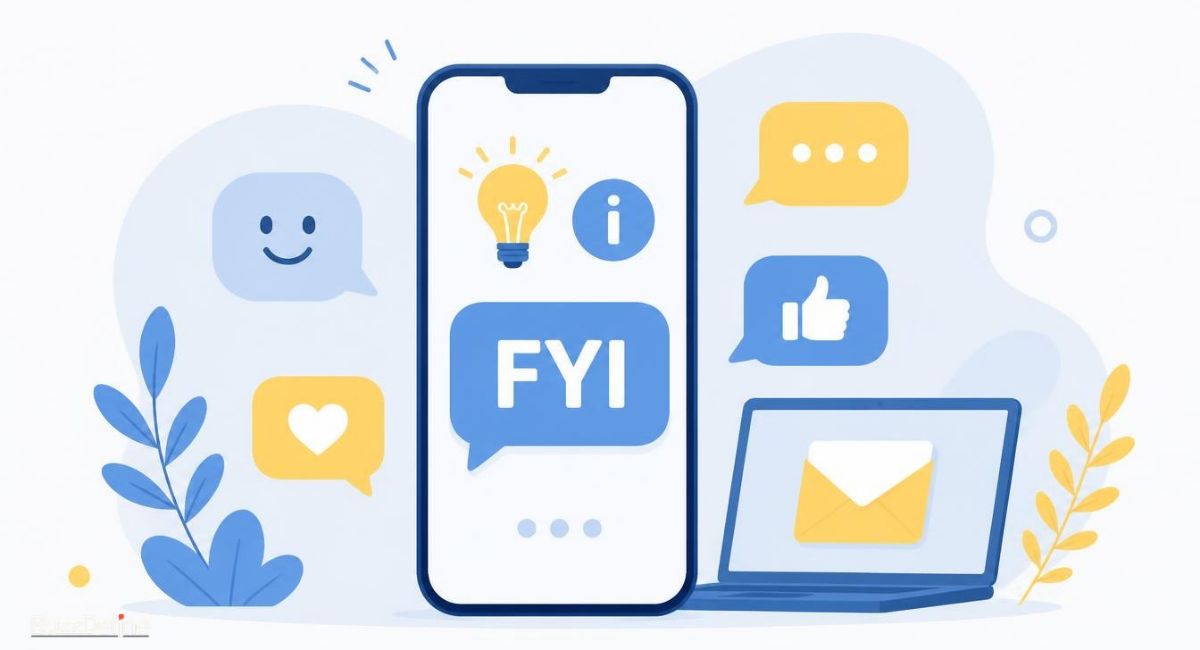
You open a chat and the message starts with three small letters: FYI. Is the sender just sharing news, or are they quietly annoyed with you? The FYI meaning in text is simple on paper, but the tone can feel different from one message to the next.
FYI is short for “for your information.” People use it to pass along something you should know, usually without expecting you to do anything. This guide explains the FYI meaning in text, where the abbreviation came from, when it sounds friendly or rude, how to reply, and what to say instead.
What Does FYI Mean in Text?

FYI stands for “for your information.” In a text, email or chat, it signals that the sender is sharing a fact, update or reminder so you are aware of it. It does not usually ask for a reply or action.
FYI in Simple Words
Think of FYI as a light tap on the shoulder that says, “Just so you know.” If a friend texts, “FYI, the café closes at 4 today,” they are not starting a debate or giving an order. They want you to have the information.
What FYI Means When Sent by Itself
A standalone “FYI” usually sits above something forwarded, such as an email, screenshot, link or document. It means “I’m sending this so you’re aware of it,” not “please act on this.”
Many writing guides describe the same habit of captioning an attachment with FYI so the receiver knows no immediate reply is expected.
In a workplace, this is routine. Between friends, it is casual. The tone only changes when the content attached is critical or corrective, so read the message that follows before deciding how the sender feels.
FYI as a Noun
FYI is also used as a noun. Merriam-Webster lists it as a brief statement meant to advise or warn someone. That is why people say, “Just an FYI, the office is closed Monday.”
Where Did FYI Come From?
FYI is older than texting. It began as a shorthand used by journalists and wire services in the early 1900s, and its use goes back as far as 1915. Telegraph messages were charged by the word, so short abbreviations like FYI saved both space and money.
From the newsroom, FYI moved into office life. Businesses used it on memos and internal notes to mark a message as informational only, with no reply or action required.
When email arrived, the abbreviation carried over naturally, and instant messaging and texting made it even more common. That long history in workplace writing is why FYI still feels so at home in professional messages today.
There is one more nerdy detail. In the world of internet standards, “FYI” also names a series of informational documents within the RFC collection. It is an older, technical use of the same three letters and has nothing to do with texting.
Where Do People Use FYI?
Texts and Group Chats
Friends use FYI for quick heads-ups: plans, delays, discounts or news. In group chats it saves time because one line reaches everyone.
Work Emails and Chat Tools
At work, FYI appears in subject lines (“FYI: Updated schedule”), forwards and quick Slack or Teams updates. Adding someone to a thread with “Adding Sam, FYI” tells them they are being kept in the loop and do not need to respond.
Social Media and Comments
On Instagram, X, Facebook and similar platforms, people use FYI in captions and replies to share tips, corrections or announcements. It reads as casual and informational.
Dating Apps and Gaming
On dating apps, FYI adds context quickly (“FYI, I’m a terrible texter but great in person”). In gaming chat, it gives teammates live updates, such as “FYI, the boss respawns in two minutes.”
Real Examples of FYI in Messages
| Purpose | Example |
| Schedule update | “FYI, the meeting moved to 3 PM.” |
| Reminder | “FYI, rent is due tomorrow.” |
| News | “FYI, the new season just dropped.” |
| Polite correction | “FYI, the deadline is actually Friday.” |
| Forwarded item | “Forwarding this for your awareness. FYI.” |
| Playful | “FYI, I ate the last slice.” |
In every case, FYI does the same job: it shares information without demanding anything back.
Why Do People Use FYI?
- It saves time. One word replaces “I thought you might want to know.”
- It sets expectations. The reader knows no reply or task is required.
- It sounds neutral. There is no emotion built in, which suits busy inboxes.
- It works almost anywhere. Casual and professional settings both accept it.
Does FYI Sound Rude?
FYI is neutral by itself. The sentence around it creates the tone, along with your relationship with the sender and the timing.
When It Sounds Neutral or Friendly
“FYI, parking is free after 6 PM.” This is helpful and carries no hidden message.
When It Sounds Cold
“FYI. You missed the deadline.” The abrupt, one-word opener with no greeting makes the message feel distant.
When It Sounds Passive-Aggressive
“FYI, I already sent this twice.” The information is a complaint in disguise. Use this quick check: if the message would still make sense without “FYI” and sounds sharper without it, the FYI may be softening something critical.
Can FYI Be Flirty?
Not on its own. FYI is informational. People can use it playfully (“FYI, I look great tonight”), but the flirting comes from the joke, not the abbreviation.
FYI vs “For Your Information”
The meaning is identical. The difference is tone. The full phrase “for your information” can sound formal or even pointed, especially when someone is correcting you. The abbreviation feels lighter and more routine. Oxford Learner’s Dictionaries notes that FYI is used mainly in writing.
| Version | Feels like |
| “FYI, the meeting starts at 10.” | Quick, casual update |
| “For your information, the meeting starts at 10.” | More formal, can sound corrective |
FYI vs Similar Texting Terms
| Term | Meaning | Best for |
| FYI | For your information | Neutral updates |
| BTW | By the way | A side note added to a conversation |
| JSYK | Just so you know | Softer, friendlier FYI |
| ICYMI | In case you missed it | Resharing older news |
| LMK | Let me know | Asking for a response |
| FYA | For your action | Work messages that need action |
| PSA | Public service announcement | Warnings or important notices |
| Heads up | Early warning | Something upcoming |
The key contrast: FYI shares, LMK and FYA ask. If you need something done, don’t hide it behind FYI.
When Should You Use FYI?

- Sharing a schedule change or update
- Forwarding an email or file for awareness
- Giving background that needs no reply
- Politely correcting a small mistake
- Adding someone to a thread so they stay informed
When Should You Avoid FYI?
- When you need action. “FYI, the form is due today” is unclear. Write “Please submit the form by 5 PM.”
- When emotions are involved. “I’m upset, FYI” sounds cold and unclear.
- In sensitive news. Use full sentences and warmth.
- When the reader may not know the slang. Non-native English speakers may find abbreviations confusing, so plain wording is safer.
- In very formal writing. Use “Please note” or “For your information” in full.
How to Reply to an FYI Message
You often don’t need to reply. If you want to acknowledge it:
- Casual: “Got it,” “Thanks!” or “Good to know.”
- Neutral: “Noted.” or “Understood.”
- Professional: “Thanks for the update.” or “Noted, thank you.”
- Playful (friends only): “Appreciate the intel.”
Reply with a question if the information changes your plans or raises concerns. Silence is usually fine for pure updates, but not if the “FYI” quietly affects your work.
Better Alternatives to FYI
| Instead of | Try | Tone |
| “FYI, we’re closed Monday.” | “Just letting you know, we’re closed Monday.” | Friendly |
| “FYI, rent is due.” | “Quick reminder that rent is due tomorrow.” | Soft |
| “FYI, policy changed.” | “Please be aware that the policy has changed.” | Professional |
| “FYI, you missed this.” | “In case you missed it…” | Gentle |
| “FYI, it’s wrong.” | “Quick flag: I think this needs a fix. Happy to help.” | Collaborative |
Common Misunderstandings and Mistakes
Myths
- FYI always means no reply is needed. Not always. Context can imply a response.
- FYI is always rude. No. Tone comes from the surrounding words.
- FYI is only slang. It predates the internet.
- FYI explains the information. It only introduces it.
Mistakes
- Using it for urgent instructions
- Adding it to every message until it loses meaning
- Using it to hide criticism
- Sending it with no context, like a bare “FYI.”
Quick FYI Etiquette Checklist
- Is this information-only? If not, use a clearer request.
- Would a warmer phrase fit the relationship better?
- Is the tone neutral, or am I venting?
- Could the reader misunderstand the abbreviation?
- Am I overusing it?
FAQs
What does FYI mean in text messages?
FYI means “for your information.” It shares an update or fact without expecting action.
Is FYI rude?
Not by itself. It sounds rude only when the message around it is blunt or critical.
Do you have to reply to FYI?
No. A reply is optional unless the message asks a question or affects your work.
Is FYI formal or informal?
It works in both, but very formal writing may prefer “please note” or the full phrase.
What is the difference between FYI and BTW?
FYI shares information. BTW adds a side note to a conversation.
Can FYI be used on social media?
Yes. It is common in captions, comments and replies to share tips or news.
What is the difference between FYI and FYA?
FYI is information only, while FYA, commonly read as “for your action,” signals that a task is expected.
Conclusion
Understanding the FYI meaning in text makes digital conversations easier. This simple abbreviation helps people share information quickly without long explanations.
Whether it appears in casual chats, social media or work messages, FYI usually means someone is just passing along helpful details. When you understand the tone and context, you can read it correctly and reply with confidence.
Read Next: WSP Meaning in Text: What It Stands For, How to Reply & When to Use It

Muhammad Kaleem is the founder and lead writer at BuzzDefine, where he covers internet slang, texting abbreviations, and digital communication trends. He actively follows how language evolves across WhatsApp, Instagram, and TikTok — tracking real conversations, group chats, and comment threads to keep definitions accurate and current. He writes to make modern slang easy to understand for readers of every generation.







1 thought on “FYI Meaning in Text: What It Really Means and How to Use It”