You open a chat and see a message that ends with “yfm?” It’s not a typo, and the sender isn’t being cryptic. The yfm meaning in text is simple once you’ve seen it in action: it’s short for “You Feel Me?”
People now drop it into replies, captions, comments and group chats, which is why so many people search for the yfm meaning in text every day. This guide covers what it means, where it came from, how to read its tone, how to reply, and when to skip it.
What Does YFM Mean in Text?
Quick Answer
YFM stands for “You Feel Me?” It’s a casual way of asking someone if they understand, relate to, or agree with what you just said.
What the Sender Is Really Asking
Depending on the sentence, “yfm” can quietly mean:
- Do you get what I’m saying?
- Can you relate?
- Do you agree?
- Are we on the same page?
Most of the time the sender isn’t asking for a formal answer. They want a small signal that you’re with them: a “yeah,” a “facts,” a “same.”
Where YFM Comes From
YFM didn’t begin in a chat room. It was shortened from a spoken phrase, “you feel me?”, which has long been part of American slang and is deeply tied to hip-hop and African American English.
Speakers used it at the end of a thought to check that the listener understood. Dictionaries now record “feel” in the sense of understanding someone, as in “I feel you.”
Once texting and social media took off, people did what they always do with fast, spoken phrases: they cut it down. “You feel me?” became “u feel me?” and then YFM. Short-form platforms helped it travel far beyond its original circles.
How YFM Works in a Sentence
As a Question
At the end of a statement, “yfm?” seeks agreement or understanding.
“Nobody replies fast when they’re busy living their life, yfm?”
As a Statement Tag
Without a question mark, it works more like emphasis, similar to “you know?” or “right?”
“Sunday naps fix everything, yfm.”
Capital vs. Lowercase
“YFM” and “yfm” mean the same thing. Lowercase usually feels more relaxed, while capitals can add emphasis or energy. Neither changes the definition.
Real Examples of YFM in Conversations
Friends texting
A: I’m done answering messages the second they come in.
B: Honestly, good idea.
A: My phone is not my boss, yfm?
B: Loud and clear.
Instagram DM
A: Best weekends are the ones with zero plans.
B: Couldn’t agree more.
A: YFM!
Group chat
A: That finale did not deserve the hype, yfm.
B: Facts.
C: I felt that.
In each example, the sender is inviting the other person to share the same view.
How People Use YFM on Different Platforms
Snapchat and Instagram
Captions, story replies and DMs often end with “yfm” to sound personal and conversational: “Monday motivation hits different when the coffee’s good, yfm.”
TikTok
In comments, it pulls other viewers into a shared opinion or experience. Creators sometimes use it at the end of short rants to invite agreement.
WhatsApp and Group Chats
Here it’s mostly casual banter between friends, family cousins or classmates. It keeps the tone easy and conversational.
Gaming and Discord
Players use it while explaining tactics: “Stick with the team instead of rushing in alone, yfm?” It softens advice so it doesn’t sound like a lecture.
Dating Apps
On dating apps, “yfm” can feel playful: “Good food and good music is the perfect date, yfm?” It invites chemistry without sounding formal.
What Tone Does YFM Carry?
The words are neutral. Context sets the tone.
- Friendly: “Saving money now means less stress later, yfm?” It sounds supportive.
- Confident: “You have to stay consistent to see results, yfm?” It sounds sure, not rude.
- Flirty: “Sunset drives and good music… best combo, yfm?” Playful and light.
- Confrontational: “You can’t keep being late to everything, yfm?” After criticism, it can sound pointed.
YFM itself is not offensive. If you’re unsure how it landed, look at the sentence before it and the sender’s usual style.
YFM vs. FYM
The two look nearly identical in a fast chat, but they point in different directions.
- YFM = “You Feel Me?” It’s a friendly check for understanding or agreement.
- FYM is a blunt, profane way of asking “what do you mean?” It often signals confusion or annoyance.
Tip: if the message follows an opinion and invites you to relate, it’s YFM. If it follows something you said and challenges it, it’s likely FYM.
Other Meanings of YFM
In texting and social media, “You Feel Me?” is by far the main meaning. Outside chats, the letters can mean something else. YFM is also the name of a well-known youth radio station in Johannesburg, South Africa, broadcasting on 99.2 FM. The letters can also appear in usernames, brand names or community-specific abbreviations.
A quick check: if the sentence ends with “yfm?” or “yfm.” after an opinion, it’s slang. If it appears as a name or a title, treat it as a proper noun.
YFM vs. Similar Slang
| Term | Meaning | How it differs from YFM |
| YFM | You feel me? | Asks for understanding or relatability |
| YKWIM | You know what I mean? | More neutral and literal |
| KWIS | Know what I’m saying? | Common in spoken style, often after an explanation |
| IYKYK | If you know, you know | Signals a shared inside reference, no question asked |
| FR | For real | Adds sincerity or agreement |
| Facts | That’s true | A reply, not a question |
| IMO | In my opinion | Presents a view without seeking agreement |
| TBH | To be honest | Introduces candor, not connection |
| NGL | Not gonna lie | Opens an honest admission |
| Right? | Don’t you agree? | The plain, everyday version of YFM |
How to Reply When Someone Sends YFM
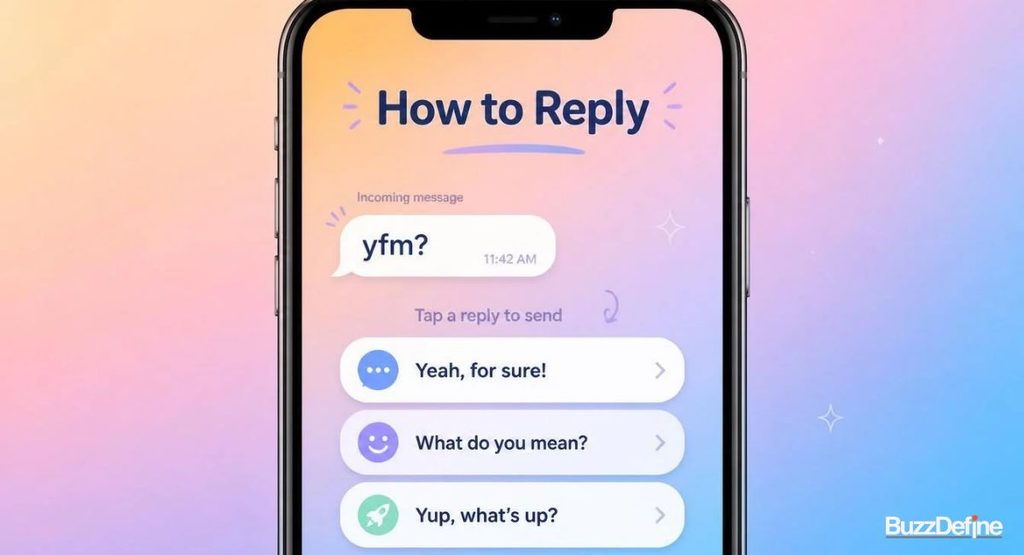
Match the energy of the chat.
Casual
- Yeah, I get you.
- Definitely.
- Same.
- Facts.
Funny
- Loud and clear.
- Say less.
- I feel you spiritually.
- Only if snacks are involved.
Neutral or unsure
- I think I get it.
- Can you explain a bit more?
- Got you.
- That makes sense.
Professional (if it shows up in a work chat)
- Yes, I understand.
- That makes sense.
- I agree.
- Thanks for clarifying.
When You Should Not Use YFM
Skip it when clarity or formality matters more than style:
- Work emails and client messages. Use “Does that make sense?” or “Do you agree?”
- School and academic writing. Slang looks out of place.
- Cross-cultural chats. Not every English learner has seen it.
- Older audiences. Full phrases are safer.
- Sensitive conversations. In serious or emotional moments, slang can feel dismissive. Say what you mean plainly.
Common Misunderstandings
- “It always means agreement.” Not always. Sometimes the sender only wants to know that you understood.
- “It’s a question every time.” No. Without a question mark it often just adds emphasis.
- “It’s rude.” The phrase itself is casual, not rude. Tone depends on the situation.
- “It stands for ‘your favorite musician.'” In everyday texting, that’s not what it means.
- “It’s the same as FYM.” They’re different and the tone is very different.
Frequently Asked Questions
What does YFM mean in text?
YFM means “You Feel Me?” It asks whether someone understands, relates to, or agrees with what you said.
Is YFM slang?
Yes. It’s informal internet and texting slang rooted in a spoken phrase.
Is YFM rude?
No. It’s casual and usually friendly. Tone depends on context.
Is YFM the same as “you know what I mean”?
They’re very close. Both check understanding, but YFM sounds more casual and personal.
What’s the difference between YFM and FYM?
YFM asks “You feel me?” in a friendly way. FYM is a blunt way of asking “what do you mean?”
Can I use YFM at work?
Better not. Use “Does that make sense?” or “Do you agree?” instead.
How do I reply to YFM?
Reply with “Yeah,” “I get you,” “Facts,” or “That makes sense,” depending on the conversation.
Is YFM only used by young people?
It’s most common among younger users on social media, but the original phrase “you feel me?” is used across age groups in speech.
Conclusion
The yfm meaning in text comes down to three words: “You Feel Me?” It’s a quick, friendly way to ask whether someone understands, relates to or agrees with what you just said. Behind the short abbreviation is a spoken phrase with a long history in everyday speech and music.
Now that you know the yfm meaning in text, you can read the tone from context, tell it apart from FYM, and reply naturally. Use it with friends, skip it in formal settings, and let context guide you.
Read Next: SOL Meaning: What It Stands For in Text

Muhammad Kaleem is the founder and lead writer at BuzzDefine, where he covers internet slang, texting abbreviations, and digital communication trends. He actively follows how language evolves across WhatsApp, Instagram, and TikTok — tracking real conversations, group chats, and comment threads to keep definitions accurate and current. He writes to make modern slang easy to understand for readers of every generation.