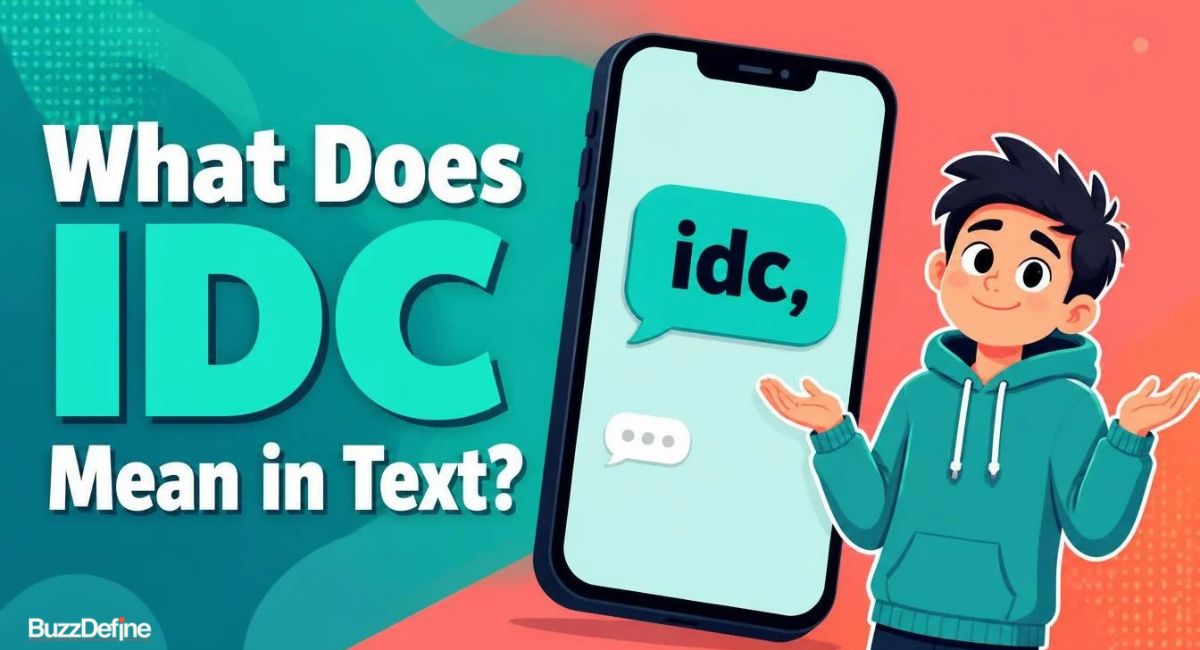
You ask a simple question, and the reply is just “idc.” No emoji, no explanation. Now you’re wondering whether the person is relaxed, annoyed, or genuinely unbothered.
So, what does IDC mean? It stands for “I don’t care,” and it’s used to show indifference, no preference, or a lack of interest. But the same three letters can sound easygoing in one chat and cold in another. This guide explains what does IDC mean in different situations, how to read its tone, and how to reply.
Quick definition: IDC = “I don’t care.” It signals no preference, no concern, or no interest, and its tone depends on context, punctuation, and emojis.
What Does IDC Stand For?
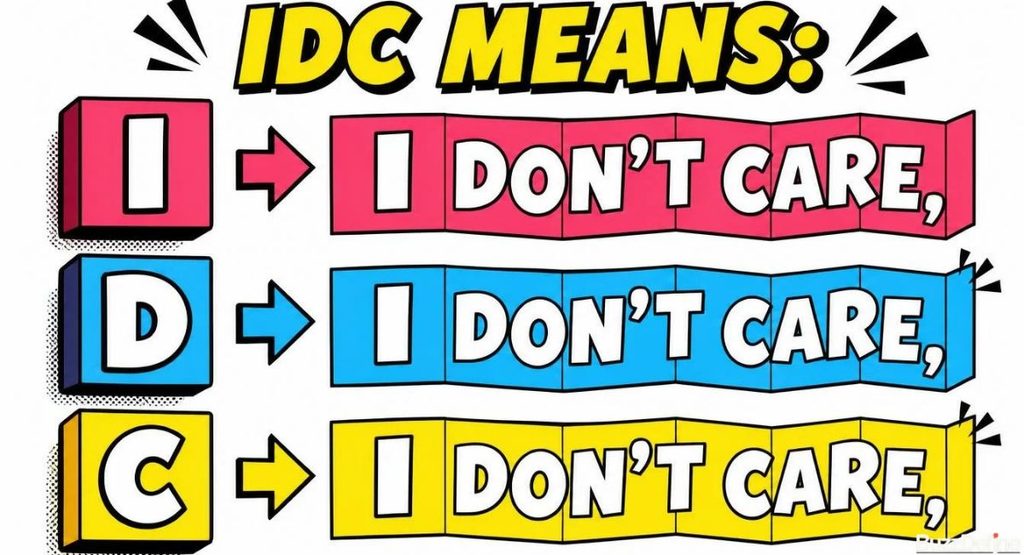
IDC is an initialism built from the first letters of “I Don’t Care.” It’s the same pattern as IDK (“I don’t know”) and TBH (“to be honest”): quick to type and instantly recognizable.
Quick Definition
IDC means you’re indifferent about something. That might be a decision (“pizza or burgers?”), an opinion (“what will people think?”), or a topic you don’t want to discuss.
Simple Meaning in Plain Words
Depending on the message, IDC usually translates to one of these:
- “Either option is fine with me.”
- “You decide.”
- “It doesn’t bother me.”
- “I’m not interested in this.”
In rarer, sharper cases, it means “I don’t care what you think.” That’s why tone matters so much.
Where Did IDC Come From?
IDC grew out of the same shorthand culture that gave us LOL, BRB, and OMG. As SMS texting, chat rooms, and instant messaging became popular in the late 1990s and early 2000s, people shortened phrases to save time and character space.
The earliest known Urban Dictionary entry for IDC dates to 2003, though people were almost certainly using it earlier. Today it’s one of the most recognized texting abbreviations online.
How Is IDC Used in Texting?
No Preference
This is the friendliest use. When someone asks where to eat or what time to meet, IDC passes the decision back.
“Should we go at 6 or 7?”
“idc, either works.”
Not Interested
IDC can also close a topic you don’t care about, such as gossip, celebrity news, or a trend.
“Did you see the drama about that show?”
“idc tbh.”
Dismissive
Used during a disagreement or a serious talk, IDC can mean “I don’t care what you think,” and it lands hard.
“You should really apologize.”
“IDC.”
Confident Detachment
Many people use IDC to show they won’t be swayed by outside opinions.
“idc what anyone says, I’m wearing it.”
IDC Meaning on Social Media and Chat Apps
The meaning stays the same everywhere, but the tone shifts by platform.
- WhatsApp and iMessage: Mostly “no preference” (“idc where we eat”).
- Instagram: Often a confidence line in captions and comments (“idc if people disagree”).
- TikTok: Common in captions and comments to state an opinion (“idc, this song is amazing”).
- Snapchat: Usually playful and quick, especially with an emoji (“idc 😂”).
- Discord and gaming chats: Used when players decide on modes, maps, or teams and nobody has a strong preference.
- X (Twitter) and comment sections: Often blunter, especially in debates.
Real IDC Text Examples
Everyday Conversations
Choosing dinner
“Chinese or Mexican?” “idc, I’m good with either.” → No preference.
After a disagreement
“Are you still mad about earlier?” “idc anymore.” → Often signals emotional distance, not true indifference.
Opinion on an outfit
“People might not like that outfit.” “idc 😂 I like it.” → Confidence, ignoring outside opinions.
An emotional moment
“You really hurt my feelings yesterday.” “IDC.” → Cold and dismissive.
Quick Chat-Ready Examples
- “idc what movie we watch 😊”
- “Pick a time. idc.”
- “idc if it’s raining, let’s go.”
- “idc about spoilers 😂”
- “idc, I’m just here for the snacks.”
- “You can invite whoever you want, idc.”
What Tone Does IDC Carry?
| Situation | Likely tone | What it usually means |
| Choosing food or plans | Relaxed | Either option is fine |
| Discussing gossip | Uninterested | I don’t want to talk about it |
| With “lol” or an emoji | Playful | Not taking it seriously |
| During an argument | Dismissive | Your opinion doesn’t change mine |
| Replying to something emotional | Cold | I’m not engaging with this |
| After conflict (“idc anymore”) | Withdrawn | I’m tired of caring |
Emojis, Punctuation and Capitalization
Small cues change how IDC reads:
- Emoji: “idc 😊” feels warm. A bare “idc” feels flat.
- Period: “idc.” feels colder than “idc.”
- Capitals: “IDC” can feel louder or more emphatic than lowercase “idc.”
- Follow-up words: “idc, you pick!” feels generous. “idc what you think” feels sharp.
Is IDC Rude?
Not always, but it can be. Saying “idc where we eat” is harmless. Using it to dismiss someone’s feelings or opinion is what makes it rude. It’s also a very short reply, and some people read brevity as not caring enough to type the full phrase.
A good rule: IDC about your own preferences is usually fine. IDC about someone else’s feelings is risky.
Common Misunderstandings
- “IDC always means anger.” Most of the time it’s casual indifference.
- “IDC is always rude.” Emojis and context can make it friendly.
- “Everyone reads it the same way.” Some hear “relaxed,” others “dismissive.” When in doubt, add context.
- “IDC and IDK mean the same thing.” One is about caring, the other about knowing.
What Does IDC Mean From a Girl or a Guy?
The abbreviation means the same regardless of who sends it. What differs is the individual’s style and the situation, not gender.
- If the message comes with an emoji or a follow-up (“idc, you pick 😊”), they likely have no preference.
- If it arrives after a disagreement or a question about feelings, it may signal frustration or a wish to end the conversation.
- If the person usually texts in lowercase with little punctuation, a plain “idc” may just be their normal style.
Compare the message to how that person usually texts. A sudden short “idc” from someone who’s normally chatty is more meaningful than the same word from someone who always writes briefly.
IDC Variations You’ll See in Chats
- idc tbh: “I don’t care, to be honest.” More direct.
- idc lol: Lighter, casual, or joking.
- idc anymore: Suggests you’ve stopped caring, often after frustration.
- idc what…: Followed by the thing that doesn’t matter (“idc what they say”).
- idc either way: Both options are fine.
- IDRC: “I don’t really care,” a softer, interchangeable variant.
IDC vs IDK, IDGAF, NVM and Similar Terms
| Term | Meaning | Tone and use |
| IDC | I don’t care | Casual; relaxed or blunt |
| IDK | I don’t know | Neutral; shows uncertainty |
| IDGAF | I don’t give a [expletive] | Strong, harsh; close friends only |
| NVM | Never mind | Drops a topic |
| W/E | Whatever | Indifferent, sometimes passive-aggressive |
| IMO | In my opinion | Shares a viewpoint |
| Meh | Unimpressed | Informal, mild |
| Up to you | You decide | Friendly, polite |
| I don’t mind | Any option works | Soft and polite |
IDC vs IDK: If someone asks where to eat, “IDK” means you haven’t decided or lack information. “IDC” means you’re fine with any choice.
IDC vs “I don’t mind”: Both can mean “no preference,” but “I don’t mind” sounds warmer. IDC can carry a stronger sense of indifference.
Other Meanings of IDC
In texting, IDC almost always means “I don’t care.” Outside texting, it appears in other settings:
| Context | Meaning |
| Texting | I don’t care |
| Sarcastic captions | “I do care,” said ironically |
| Business and technology | International Data Corporation, a global market intelligence firm |
| Technology | Internet data center |
| Trade and regulation | Industrial Development Certificate |
| Specialized fields | Various technical, medical, and research terms |
If a friend texts “idc where we go,” it means “I don’t care.” If you’re reading a market report, it likely refers to the company.
How to Reply When Someone Says IDC
Casual:
- “Okay, I’ll choose.”
- “Sounds good, pizza it is.”
Funny:
- “Decision-making powers unlocked 😂”
- “Then I’m picking, no complaints later.”
Friendly:
- “Thanks, I’ll handle it.”
- “No worries, I’ve got it.”
Formal:
- “Understood, I’ll proceed.”
- “Thank you for letting me decide.”
When it feels heavy: If IDC arrives during an argument or an emotional talk, don’t assume the worst. Ask gently: “Do you mean you don’t care about this, or you just don’t want to talk about it right now?” If they’re clearly upset, giving them space is often better than pushing.
When to Use IDC (and When to Skip It)
Good times to use it:
- Low-stakes decisions like food, movies, or timing
- Group chats where you’re happy to go along
- Light conversations with friends
- Showing you’re unbothered by minor drama
Better to skip it:
- Serious or emotional conversations
- Work emails, school messages, and professional chats
- When someone needs support
- When texting people unfamiliar with slang
Smarter Ways to Use It
- Add an emoji (😊 or 😅) to soften it.
- Pair it with a follow-up: “idc, you pick!”
- Watch your punctuation. A period can sound colder.
- Avoid it when someone is opening up to you.
Professional Alternatives
- “Either option works for me.”
- “I have no preference.”
- “I’m happy with whatever you choose.”
- “I don’t mind.”
Is IDC Still Popular?
Yes. IDC remains common because it’s short, instantly understood, and works across every messaging app and social platform.
It’s heavily used by teens, college students, gamers, and social media users, though it isn’t exclusive to any single generation.
It’s best described as everyday internet and texting slang rather than slang owned by one age group.
FAQs About IDC
What does IDC mean in a text message?
IDC means “I don’t care.” It shows indifference, no preference, or lack of interest.
What does IDC stand for?
It stands for “I Don’t Care,” formed from the first letters of each word.
Is IDC rude?
It can be. It’s harmless when choosing between options but can sound dismissive when someone shares a concern.
What does IDC mean on Snapchat or Instagram?
Same meaning. On Snapchat it’s usually playful, and on Instagram it often signals confidence or not caring about others’ opinions.
What’s the difference between IDC and IDK?
IDC means “I don’t care.” IDK means “I don’t know.”
What does “idc lol” mean?
It means “I don’t care” in a lighter, joking, or casual way.
What does IDC mean from a girl or a guy?
The meaning is the same. Read the context, emojis, and the person’s usual texting style.
Can I use IDC in professional emails?
Avoid it. Use “I have no preference” or “Either option works for me.”
Can IDC mean something other than “I don’t care”?
Yes, in business and technical settings, such as International Data Corporation. In texting, it almost always means “I don’t care.”
What does IDRC mean?
“I don’t really care.” It’s a softer variant of IDC.
Conclusion
So, what does IDC mean? It means “I don’t care,” and most of the time it’s just a quick way to say you have no preference or aren’t bothered. But as this guide shows, the feeling behind it changes with emojis, punctuation, and the conversation around it.
Now that you know what does IDC mean in different contexts, you can read it more accurately and use it with confidence. Keep it for casual chats, add a friendly touch when needed, and choose a softer phrase when the conversation matters.
Read Next: DWS Meaning: What It Really Means in Text (2026 Guide)

Muhammad Kaleem is the founder and lead writer at BuzzDefine, where he covers internet slang, texting abbreviations, and digital communication trends. He actively follows how language evolves across WhatsApp, Instagram, and TikTok — tracking real conversations, group chats, and comment threads to keep definitions accurate and current. He writes to make modern slang easy to understand for readers of every generation.



1 thought on “What Does IDC Mean in Text? Meaning, Examples & Tone Guide”