DTTM meaning in text is “Don’t Talk To Me.” It’s a texting acronym people use when they’re annoyed, overwhelmed, or just done with a chat for now, more of a mood signal than a literal command. In tech and database contexts, DTTM has a different job entirely: it’s shorthand for a combined date-time field. Context tells you which one you’re looking at.
Seen DTTM pop up in a text or Snapchat caption and had no idea what it meant? You’re not alone. This four-letter acronym shows up everywhere from group chats to TikTok comments, and its tone shifts depending on who sends it and how. Here’s a clear, no-fluff breakdown of what DTTM actually means, when it’s a joke versus a real boundary, and where the same letters mean something completely different.
DTTM Full Form & Where It Comes From
DTTM’s full form is “Don’t Talk To Me.” That’s the version you’ll see confirmed across slang dictionaries and it’s the one people actually use when they type it.
The earliest recorded uses on Urban Dictionary go back to 2005 and 2008, right in the middle of the SMS shorthand era. That’s the same period that gave us TTYL, BRB, and IDK. Phones had tiny keypads, texts often had character limits, and typing fast mattered more than typing full sentences. DTTM grew out of that same need: a quick way to say “I need space” without writing it out.
There’s no single event or app that made it go viral. It spread the way most texting slang does, through everyday use in group chats and messaging apps, until enough people recognized it that it didn’t need explaining anymore.
Over time its tone softened. What started as a blunt way to shut down a conversation now works more like a mood marker. People use it to react, not necessarily to end things.
Is DTTM Always Serious? (Tone Decoder)
No, DTTM is rarely meant literally. Most of the time it’s a dramatic reaction, not a real request for silence. The trick is reading what’s around it.
A few small details give away the real tone:
| Message Style | Likely Meaning |
| “DTTM 😂” | Joking, playful teasing |
| “DTTM!!” or with exclamation marks | Exaggerated, for comedic effect |
| “DTTM.” (flat, no emoji) | Real annoyance or frustration |
| “DTTM, I need a minute” | Genuine, temporary boundary |
| DTTM repeated in a group chat | Running joke, not directed at one person |
Emojis and punctuation usually do the heavy lifting. A laughing emoji turns DTTM into a joke about something embarrassing. A flat, short DTTM with no punctuation is more likely to mean the person is genuinely irritated and wants a beat before replying.
The relationship also matters. Close friends throw DTTM around as banter all the time. From someone you don’t talk to much, it reads more literally.
If you’re unsure, check the last two or three messages before it. That’s usually enough to tell you whether someone’s joking or actually asking for space.
DTTM on Different Platforms
DTTM shows up a little differently depending on where you see it.
Texting, iMessage, and WhatsApp Here it’s usually personal and one-on-one. It’s the most likely place to see a genuine “I need space” version, since private texts carry more weight than a public comment.
Snapchat DTTM often appears in captions, chat replies, or Snap comments reacting to something cringe or funny. Since most Snaps are casual and disappear anyway, the tone here leans heavily playful.
TikTok comments It’s common under relatable or embarrassing videos, where viewers use it almost like a stand-in for “I feel that.” It’s rarely aimed at anyone specific, more a shared reaction to the content.
Instagram captions and DMs On Instagram, DTTM fits self-deprecating captions or story replies. Because captions are public, it tends to feel more performed than a private text would.
Group chats vs one-on-one chats In group chats, DTTM often turns into a running bit, repeated after every small embarrassment. In one-on-one chats, it’s more likely to reflect an actual mood, since there’s no audience to perform for.
DTTM Meaning From a Girl vs From a Guy
The honest answer is that DTTM doesn’t mean something different because of who sends it. The meaning stays the same: “Don’t Talk To Me.” What actually shifts the tone is the relationship and the situation, not gender.
Between close friends, whether it’s a girl or a guy sending it, DTTM is almost always playful. It’s teasing, self-roasting, or reacting to something embarrassing.
In a newer or more serious relationship, DTTM can carry more weight regardless of who sends it. It might genuinely mean someone wants quiet time after a stressful day, an argument, or an awkward moment.
Instead of reading into who sent it, look at the same cues that apply everywhere: the punctuation, the emoji, and what was said right before it. That tells you far more than the sender’s gender ever will.
Real Example Messages
Seeing DTTM in context makes it much easier to read. Here are a few common scenarios:
Embarrassing moment “I called my teacher ‘mom’ in class. DTTM 😂” This is self-roasting, not a real boundary. The emoji signals humor.
Group project stress “Group project again? DTTM.” Mild frustration with the situation, not directed at any one person.
Genuine boundary “I need space right now, DTTM for a bit.” A real, temporary request. No emoji, and it’s paired with a direct explanation.
Gaming chat “You missed that shot? DTTM” Quick, competitive teasing between teammates or friends.
Reacting to a friend’s story “You ate the whole pizza by yourself? DTTM 😭” Playful disbelief, said in good humor.
Across all of these, the pattern holds: DTTM almost never travels alone. It’s paired with an emoji, punctuation, or a follow-up line, and that pairing is what tells you whether it’s a joke or something real.
How to Reply to DTTM
There’s no single correct reply. What works best is matching the tone of the message rather than overthinking it.
- If it’s clearly a joke, laugh it off or roast them back. A DTTM with an emoji after something embarrassing doesn’t need a serious response. Play along.
- If it feels like real stress, check in gently. A flat, short DTTM after a rough day is worth a simple “you good?” rather than a joke.
- If they say they need space, give them room. Don’t push for more explanation right after someone sets a boundary. Let it sit.
- Avoid over-explaining yourself in response to a joke. If someone’s clearly teasing, a long, earnest reply can come across as missing the point.
Reading the tone before you reply prevents most of the awkwardness that comes with a four-letter message. When in doubt, a short, low-pressure response works better than guessing wrong in either direction.
DTTM’s Other Meaning: Date-Time (Tech/Database Use)
Outside of texting, DTTM has a completely different job. In databases, system logs, and enterprise software, DTTM is a common shorthand used to label a column or field that stores a combined date and time value, for example, the exact moment a record was created or an event happened.
You’ll see this convention in database schemas, application logs, and data pipelines, where compact field names matter and “DTTM” is faster to type and read than “date_time_stamp” or similar alternatives.
It’s worth being clear about what this actually is: an informal naming convention, not an official standard.
There’s no single governing body or technical standard that defines “DTTM” the way, say, ISO defines a date format. Different teams and systems adopt it simply because it’s short and self-explanatory once you know the pattern, not because it’s mandated anywhere.
So if you spot DTTM in a spreadsheet, a database table, or a log file, it almost certainly refers to a date-time value, not the “don’t talk to me” version. The two meanings live in completely different worlds, and context makes it obvious which one you’re looking at.
DTTM vs Similar Slang
DTTM is part of a bigger family of short, blunt texting acronyms. Here’s how it compares:
| Term | Meaning | Tone |
| DTTM | Don’t Talk To Me | Annoyed, playful, or overwhelmed |
| DTM | Don’t Text Me | Similar, but usually less intense |
| IDC | I Don’t Care | Dismissive |
| GTG | Got To Go | Neutral exit |
| SMH | Shaking My Head | Disappointed or annoyed |
| TTTH | Talk To The Hand | Playful dismissal |
What sets DTTM apart is that it names an actual boundary instead of just signaling a feeling or an exit. GTG just ends a conversation. SMH just reacts to something. DTTM does something more specific: it tells the other person, directly, that you don’t want to keep talking right now, even if you don’t mean it literally.
Is DTTM Rude or Offensive?
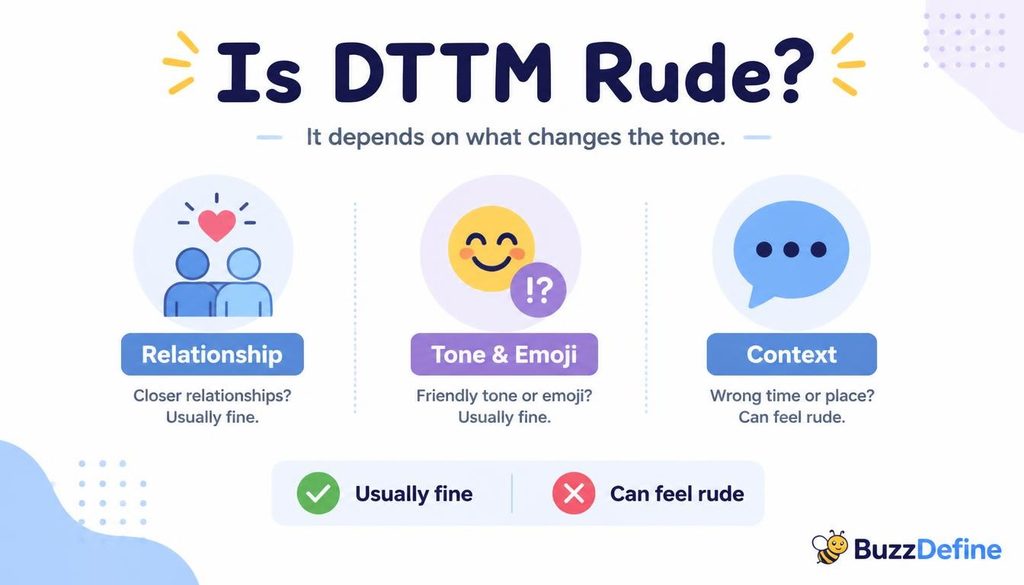
Generally, no. On its own, DTTM isn’t considered offensive. It’s blunt by design, but between people who already understand texting shorthand, it usually reads as casual rather than harsh.
That said, whether it lands as rude depends on a few things:
Relationship. Between close friends, DTTM is normal banter. From someone you barely know, the same four letters can feel cold or dismissive, simply because there’s no established rapport to soften it.
Punctuation and emoji. A DTTM with a laughing emoji reads as a joke. A flat “DTTM.” with a period and nothing else can come across as sharper or more final than the sender actually intended.
Delivery context. Sent in response to genuine concern, like a friend asking if you’re okay, DTTM can feel dismissive even if that’s not the intent. Sent after a lighthearted comment, it barely registers as anything more than a reaction.
The safest approach, on either side, is to treat DTTM as a tone signal rather than a literal instruction. If you’re sending it to someone who might not read the context the way you mean it, a little extra context or an emoji goes a long way.
When NOT to Use DTTM
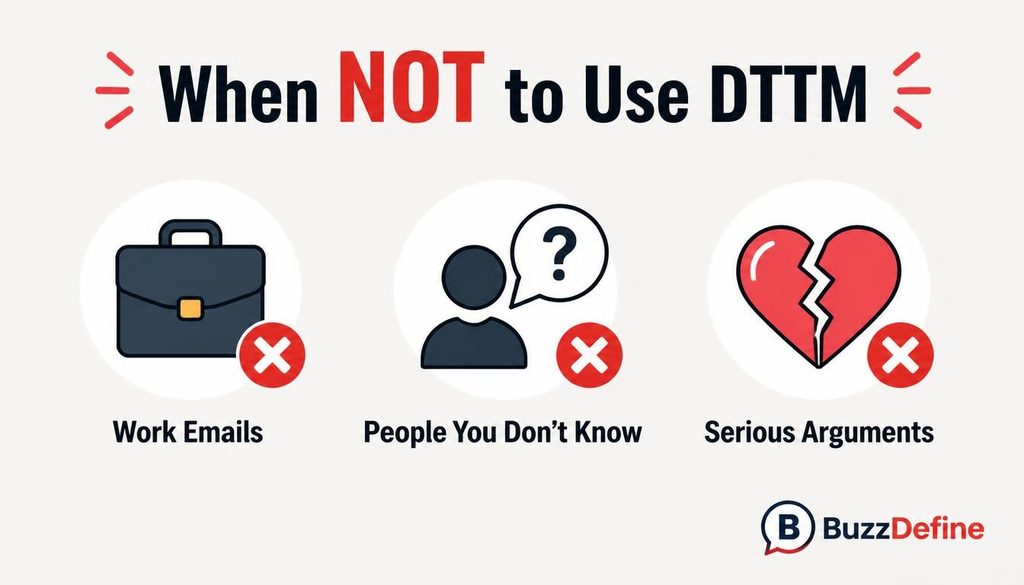
DTTM works fine in casual texting, but it doesn’t fit every setting. A few situations where it’s better to skip it:
Work emails or messages to a boss. DTTM reads as too casual for a professional context, even though it’s harmless among friends. Something like “I need to focus right now” gets the same point across without the slang.
With someone you don’t know well. Without an established rapport, DTTM can come across as colder or more dismissive than intended. A clear, direct sentence avoids the confusion entirely.
In a genuinely serious argument. When emotions are actually running high, four letters can’t carry the weight a real conversation needs. Explaining what you’re feeling, even briefly, works better than shorthand in situations that matter.
The general rule: the more the relationship or the stakes matter, the less DTTM fits. It’s built for low-stakes, casual moments, not situations that need actual clarity.
FAQ
What does DTTM mean from a girl?
The same thing it means from anyone: “Don’t Talk To Me.” Tone depends on the relationship and context, not gender.
Is DTTM the same as DTM?
Not quite. DTM (“Don’t Text Me”) is similar but usually reads as slightly less intense than DTTM.
What does DTTM mean in a database?
It’s shorthand for a combined date-time field, an informal naming convention, not an official standard.
Is DTTM rude to say?
Generally no. It’s blunt but casual, though tone and relationship can shift how it lands.
What do you reply to DTTM?
Match the energy: laugh off a joke, check in gently on real stress, or give space if it’s a genuine boundary.
Conclusion
DTTM mostly comes down to one simple idea: give me a little room. Whether it shows up as a joke in a group chat or a real request for space, the four letters carry more mood than command.
Outside of texting, the same letters do a totally different job, quietly labeling date-time values in databases and logs, with no connection to the slang version at all.
Once you know the platform, the relationship, and the tone around it, DTTM stops being confusing. Next time it lands in your messages, you’ll already know exactly what’s going on.
Read Next : SA Meaning in Text: Every Common Use and How to Tell Which

Muhammad Kaleem is the founder and lead writer at BuzzDefine, where he covers internet slang, texting abbreviations, and digital communication trends. He actively follows how language evolves across WhatsApp, Instagram, and TikTok — tracking real conversations, group chats, and comment threads to keep definitions accurate and current. He writes to make modern slang easy to understand for readers of every generation.