The me gusta el desmadre meaning comes down to this: “I like the chaos,” and in everyday Mexican Spanish, “I love a wild, lively party.” It is a casual, cheeky line that people use to say they enjoy noise, spontaneity and a little disorder.
Understanding the me gusta el desmadre meaning takes more than a dictionary lookup, because the word desmadre can describe a messy room, a rowdy night out or a situation spiraling out of control.
This guide covers the translation, the origin, the tone and the real-life usage so you can understand it and use it with confidence.
Me Gusta el Desmadre Meaning in English

“Me gusta el desmadre” means “I like the chaos,” “I like the mess,” or, in a social setting, “I love a wild party.” Which version applies depends on context. After a night out it means partying. When someone describes their personality, it means they enjoy unpredictable, high-energy situations.
Word-by-Word Breakdown
| Spanish | English | Role |
| Me | to me | Indirect object pronoun |
| gusta | is pleasing | Verb gustar (3rd person singular) |
| el | the | Definite article |
| desmadre | chaos / mess / wild party | Noun |
Spanish handles “liking” differently from English. The literal structure is “the chaos is pleasing to me.” The article el is required because desmadre is a general concept. To say you dislike it, use “No me gusta el desmadre.”
How to Pronounce It
Say it as meh GOOS-tah el dehs-MAH-dreh. The stress falls on MAH in desmadre, and the final e is a short “eh” sound.
What Does Desmadre Mean in Mexican Spanish?
Desmadre is a common Mexican slang noun for disorder, a mess or chaos. It can describe a physical mess, a chaotic situation or a party that is loud and out of control.
The Core Meanings
- A mess: “Mi cuarto es un desmadre.” (My room is a disaster.)
- Chaos or a situation out of control: traffic, a family argument, a disorganized event.
- A wild party or rowdy fun: when someone “loves the desmadre,” they love lively, uninhibited celebrations.
The Literal Translation: “Lack of Mother”
The word is built from des- (a prefix meaning “without” or “undoing”) and madre (“mother”), so it literally translates as “lack of mother.” The image is of a household or group with no one in charge to keep order. Native speakers do not think about this when they use the word. They hear “chaos.”
Where Does the Word Desmadre Come From?
The word traces to livestock, and it also connects to older Spanish ideas about order and boundaries.
The Cattle Origin
The verb desmadrar originally meant separating young animals from their mothers so they would stop nursing. The Royal Spanish Academy (RAE) lists this as the first meaning of the verb. Once the young animal is away from its mother, the natural order is broken. That sense of “things without their anchor” carried over into everyday speech.
Madre and the Riverbed
The RAE also notes that madre can mean the bed of a river or stream. This explains the Spanish idiom salirse de madre, which describes something that overflows its limits, like a river leaving its banks, and by extension something getting out of hand. The idea of things breaking their boundaries sits at the heart of desmadre.
Desmadrar and Desmadrarse
The verb family reflects the same idea. In Mexican usage, desmadrar can mean to injure someone physically, and the reflexive desmadrarse describes behaving without restraint or measure, losing all sense of limits. A person who is desmadroso is wild, chaotic or hard to keep in check.
How Mexicans Use “Me Gusta el Desmadre”

The phrase is flexible, so the speaker’s meaning shifts with the setting.
Enjoying Chaos and Spontaneity
It can also describe a personality. A person who thrives in busy kitchens, crowded family events or unplanned road trips might say it to show they don’t need everything controlled.
The Playful Troublemaker
Said with a grin, it can mean “I like stirring things up.” It is a bit teasing, a way of admitting you enjoy a little mischief.
Desmadre Examples in Spanish and English
| Spanish | English |
| Mi casa es un desmadre desde que llegaron mis primos. | My house has been a mess since my cousins arrived. |
| Después del gol se armó el desmadre en la calle. | After the goal, chaos broke out in the street. |
| ¿Vamos al antro? Claro, me gusta el desmadre. | Want to go to the club? Sure, I like a wild night. |
| No te juntes con él, siempre trae desmadre. | Don’t hang around him; he always brings trouble. |
| Mi agenda está hecha un desmadre. | My schedule is a complete mess. |
| Nos gusta el desmadre, pero con respeto. | We like a wild time, but respectfully. |
Common Phrases With Desmadre
| Phrase | Meaning |
| Armar un desmadre | To cause a ruckus or create chaos |
| Se armó el desmadre | Chaos broke out. |
| Echar desmadre | To mess around, party or have rowdy fun |
| Puro desmadre | Nothing but chaos (or nothing but fun) |
| ¡Qué desmadre! | What a mess! / What a wild scene! |
| Ser un desmadre | To be a total mess (a place, a plan or a person) |
Slang Similar to Desmadre
Mexican Spanish has many words for disorder and fun. These are the closest to desmadre.
| Word | Meaning | Difference from desmadre |
| Desvergue | A mess, a situation out of control | Very close; leans toward chaos rather than partying |
| Cotorreo | Hanging out, a get-together, a party | Lighter and friendlier; no sense of disorder |
| Relajo | Rowdy fun, joking around, also disorder | Playful and often harmless |
| Reventón | A big, lively party | Refers to the event itself |
| Argüende | Fuss, gossip or a lively commotion | Often about drama or noise |
| Pedo | Problem, trouble, fight | Can be a conflict, not a celebration |
Desmadre vs. Relajo vs. Pedo
Relajo is mischievous fun, pedo is a problem or fight, and desmadre covers the broad middle: it can be fun, it can be a mess, and it can be both at once. If a party gets too wild and the police arrive, that is a desmadre.
Desmother: The Spanglish Version
Among Mexicans living in the United States, desmother is a Spanglish twist that swaps madre for the English word “mother.” It carries the same meaning: a huge mess or an out-of-control scene, as in “It turned into a real desmother at the club.”
Is Desmadre a Bad Word?
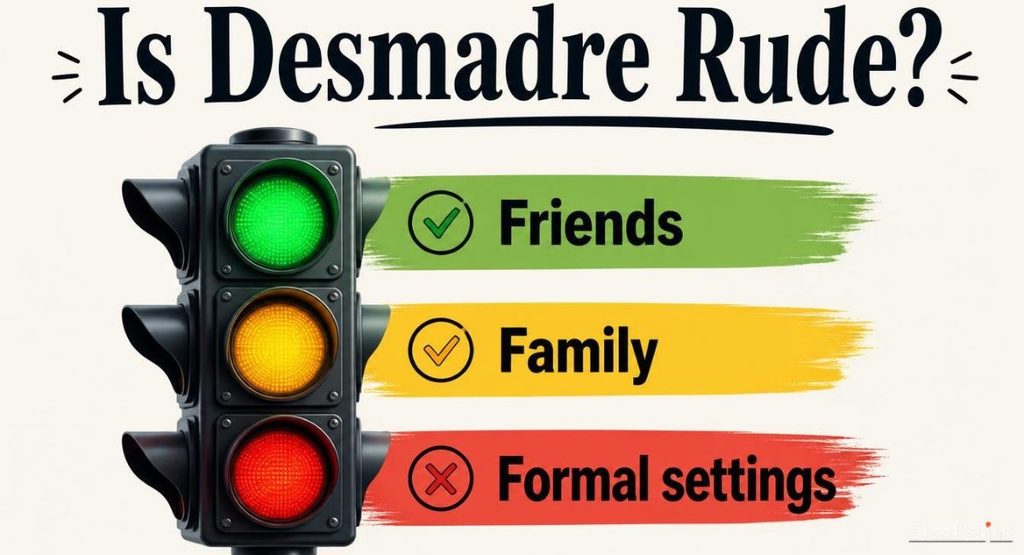
Desmadre is informal slang rather than a harsh profanity, but it contains madre, a word that carries emotional weight in Mexican culture, and many expressions built on it are crude.
Among friends it is perfectly normal. In job interviews, formal emails, presentations or with elders you don’t know well, choose a neutral word like desorden, caos or fiesta.
Where Is Desmadre Used?
Desmadre is common throughout Mexico and understood far beyond it, but it feels most natural in Mexican speech. In the United States, Mexican communities use both desmadre and the Spanglish desmother. If you’re traveling, expect to hear it in casual talk, at parties, in sports crowds and in family settings.
Variations of Me Gusta el Desmadre
| Variation | Meaning |
| Le gusta el desmadre | He/she likes the chaos or partying |
| Nos gusta el desmadre | We like the chaos or partying |
| Me late el desmadre | I’m into the chaos (very Mexican) |
| Me encanta el desmadre | I love the chaos |
| No me gusta el desmadre | I don’t like mess or rowdiness |
| Soy de puro desmadre | I’m all about wild fun |
Common Mistakes When Using Desmadre
- Using it in formal settings. It sounds too casual.
- Translating it only as “mess.” In social contexts, it often means “wild fun.”
- Taking it literally. “Lack of mother” is the origin, not the everyday meaning.
- Forgetting the article. “Me gusta desmadre” sounds off. Use el desmadre.
- Confusing it with other madre idioms. Phrases like a toda madre or me vale madre mean something completely different.
Frequently Asked Questions
What does “me gusta el desmadre” mean?
It means “I like the chaos” or “I love a wild party.” The exact meaning depends on whether the speaker is talking about disorder in general or about partying.
Does desmadre literally mean “lack of mother”?
Yes, it is formed from des- plus madre. In everyday speech it simply means chaos, a mess or a rowdy party.
Is “me gusta el desmadre” positive or negative?
Usually positive or playful among friends. It can sound negative if it suggests someone enjoys causing trouble.
What is “desmother”?
A Spanglish variation of desmadre used by Mexicans in the United States. It means a total mess or an out-of-control situation.
Is desmadre used outside Mexico?
It is understood in other Spanish-speaking regions, but it is most closely tied to Mexican Spanish.
How do I say “I don’t like the mess” in Spanish?
Say “No me gusta el desmadre” for slang, or “No me gusta el desorden” for a neutral tone.
Final Thoughts on Me Gusta el Desmadre
The me gusta el desmadre meaning captures a big part of Mexican social energy: enjoying noise, movement and a little chaos with the people around you. Whether you are describing a messy house or a legendary night out, desmadre gives you a vivid, informal way to say it.
Now that you know the me gusta el desmadre meaning, use it with friends, pair it with the phrases above and keep it out of formal settings. Used in the right moment, it sounds natural, fun and unmistakably Mexican.
Read Next: No Manches Meaning: What It Means and How to Use It

Muhammad Kaleem is the founder and lead writer at BuzzDefine, where he covers internet slang, texting abbreviations, and digital communication trends. He actively follows how language evolves across WhatsApp, Instagram, and TikTok — tracking real conversations, group chats, and comment threads to keep definitions accurate and current. He writes to make modern slang easy to understand for readers of every generation.