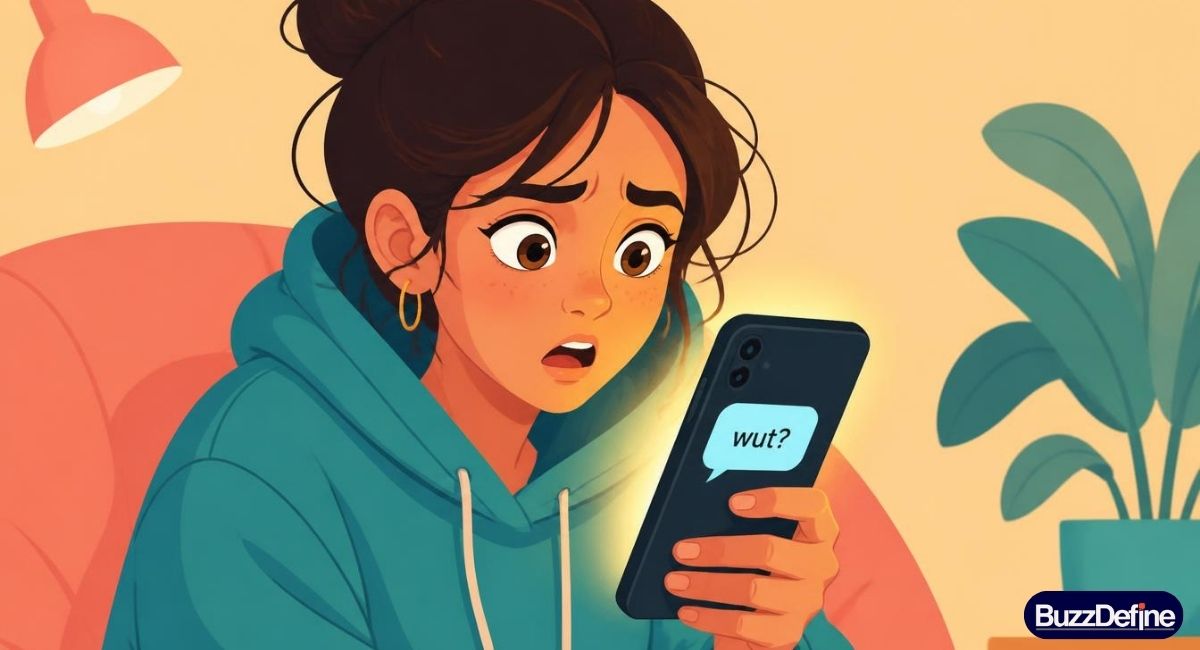
You get a text. It just says: “wut.” No punctuation, no context, just three letters staring back at you. Is your friend confused? Shocked? Messing with you? If you’re wondering what “WUT” mean in text, here’s the short answer: WUT is a casual, exaggerated way of spelling “what,” and people use it to react with surprise, confusion, or disbelief, not to ask a serious question.
Quick Answer:
WUT = an informal, playful spelling of “what?”
Pronunciation: “woot” (rhymes with boot, loot), not “wutt” with a short u sound. IPA: /wʊt/
Used for: shock, confusion, sarcasm, disbelief, or a funny reaction in texts and social media
You’ll see it everywhere: Snapchat replies, TikTok comments, gaming chats, group texts. It’s not slang with a hidden meaning. It’s just “what,” turned up a notch.
What Does WUT Mean? (Core Definition)
In texting, WUT means “what.” That’s it. There’s no hidden layer, no secret code. It’s a stretched out, informal spelling that people type instead of the standard word because it carries more emotion.
When someone sends you “wut,” they’re usually reacting to something, not asking a plain question. It can mean:
- I’m surprised by what you just said
- I don’t believe you
- Please explain that again
- That’s funny or unexpected
- I’m confused right now
Example:
Your friend texts: “I got into Harvard.”
You reply: “WUT?! Since when?!”
Here, “wut” isn’t really asking for information. It’s expressing shock first, and asking for clarification second.
The tone always depends on punctuation, capitalization, and emojis around it. “wut” (lowercase, no punctuation) feels calm or amused. “WUT?!” feels loud and excited. “wut…” feels suspicious or hesitant.
Is WUT an Acronym or Just Slang?
No, WUT is not an acronym. It doesn’t stand for a phrase, and it isn’t short for multiple words strung together. This is where a lot of guides get it wrong, either skipping the question entirely or burying a vague answer deep in the article.
Here’s the clear breakdown:
| Question | Answer |
| Does WUT stand for something? | No |
| Is it an abbreviation of multiple words? | No |
| Is it a phonetic/creative spelling of one word? | Yes, of “what” |
| Is it internet slang? | Yes |
People sometimes assume WUT is an acronym because so much texting shorthand actually is one (think LOL, BRB, IDK). WUT breaks that pattern. It’s purely a spelling variation, similar to how “sup” is a shortened, casual version of “what’s up” rather than an acronym.
If someone tells you WUT “stands for” something specific, they’re likely thinking of a different, far less common usage tied to a niche community or inside joke, not the mainstream texting meaning.
Origin & History of WUT
Unlike a lot of internet slang, WUT doesn’t trace back to one platform or one viral moment. It grew out of early internet chat culture, where typing fast and expressively mattered more than proper spelling.
Here’s a grounded timeline of how it developed:
Late 1990s, IRC and AIM chatrooms. Real time text chat exploded, and users started dropping formal spelling to type faster. Phonetic shortcuts (u for you, r for are, wut for what) became common simply because they saved keystrokes in fast paced conversations.
1999, Urban Dictionary launches. Aaron Peckham founded Urban Dictionary as a crowdsourced slang reference. It became the place where informal spellings like “wut” got documented and defined by actual internet users, giving terms like this a searchable public record for the first time.
Early 2000s, online gaming and forums. As multiplayer gaming chat and forum culture grew, “wut” spread further. Gamers reacting to an unexpected kill, a bug, or a rage quit would type “wut” as a quick, expressive reaction rather than typing the full word.
Mid to late 2000s, meme culture takes over. As image macros and meme pages became mainstream, “wut” started appearing as a caption for confused or shocked reactions, cementing its emotional tone rather than its literal meaning.
2010s to now, social media and texting. Snapchat, Instagram, TikTok, and group texts turned “wut” into an everyday reaction word, used by Gen Z and younger Millennials without a second thought.
The throughline across all of it: WUT survived because it’s fast to type and instantly readable as a reaction, not a real question.
WUT vs WHAT vs WAT vs WTF vs HUH — Comparison Table
These all sound similar but carry different tones. Mixing them up can change how your message lands.
| Term | Meaning | Tone | Best Used For |
| WHAT | Standard question word | Neutral, formal or casual | Genuine questions, professional texts |
| WUT | Playful spelling of “what” | Casual, expressive, surprised | Reacting to shocking or funny news |
| WAT | Near identical to WUT | Slightly more sarcastic or meme flavored | Meme captions, exaggerated disbelief |
| WTF | “What the f***” | Strong, blunt, sometimes crude | Extreme shock, frustration, disbelief |
| HUH | Confusion or not hearing/understanding | Genuine, low energy confusion | When you actually didn’t understand something |
The quick way to remember it: WHAT asks a real question. WUT and WAT react with personality. WTF reacts with intensity. HUH reacts with genuine confusion, no attitude attached.
Tone Spectrum of WUT
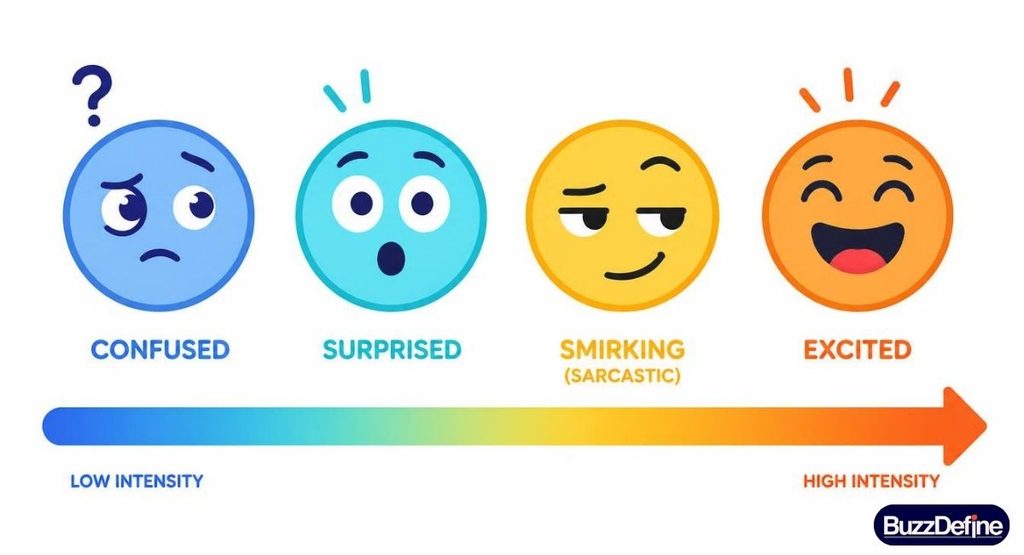
The same three letters can sound completely different depending on how you type them. Here’s the tone scale, from calm confusion to full blown excitement.
| Tone | How It’s Typed | Emoji Combo | What It Signals |
| Confused | wut | 🤔😕 | Genuine “I don’t get it” energy |
| Surprised | WUT | 😲😳 | Caught off guard, didn’t expect that |
| Sarcastic | wut… | 🙄😏 | Playful disbelief, “sure, okay” energy |
| Excited | WUTTT / WUT?!?! | 😍🎉 | Hyped reaction to good news |
A good rule of thumb: the more letters and punctuation you stack, the bigger the reaction. “wut” is a shrug. “WUTTTTT?!?!” is practically shouting.
Platform-Specific Usage
WUT doesn’t mean something different on each app, but the way people use it shifts slightly depending on where the conversation is happening.
Snapchat
Usually reacts to a snap that’s unexpected, funny, or dramatic.
“wut 😭 you actually did that”
TikTok
Shows up constantly in comments under shocking, chaotic, or plot twist videos.
“wut did I just watch 💀”
Common in comments, Story replies, and DMs, often reacting to a big life update or a bold outfit choice.
“WUT this is gorgeous 😍”
Tends to be more conversational here, since it’s mostly one on one or close group chats.
“wut are you even talking about lol”
Discord
Very common in gaming and community servers, often typed fast during live conversation or voice chat follow ups.
“wut just happened in that match 💀”
Gaming Chats (in game text/voice overlay)
Used as a quick reaction to a bug, an unfair kill, or a surprising play, since typing full sentences mid game isn’t practical.
“wut, how did you even hit that shot”
X (Twitter)
Shows up in quote tweets and replies reacting to unexpected news, screenshots, or viral posts, often with zero other context.
“wut is going on with this timeline today”
Across every platform, the core use case stays the same: it’s a fast, low effort way to react before typing out a full response.
Generational Usage: Gen Z vs Millennials vs Gen Alpha
WUT isn’t tied to one generation, but each group tends to use it a little differently.
Millennials
Grew up with the earliest versions of this spelling from AIM, MSN Messenger, and early forums. For a lot of Millennials, “wut” feels nostalgic, a throwback to dial up era chat culture, and it’s often used sincerely rather than ironically.
Gen Z
This is where “wut” became a full blown reaction word rather than just a spelling choice. Gen Z leans into it for memes, sarcasm, and exaggerated disbelief, often pairing it with skull emojis (💀) or crying laughing faces to signal “this is unhinged.”
Gen Alpha
The youngest texters are picking it up through TikTok and gaming chats rather than older internet culture. For Gen Alpha, “wut” often blends with other reaction slang (like “wut is bro doing”) as part of a bigger, faster evolving slang vocabulary.
The pattern across all three: the word survives generation to generation because each group reshapes it slightly, but the core emotional function (react first, ask questions later) never really changes.
Real Chat Examples
Here are realistic examples, grouped by the emotion behind them.
Confusion
Friend: “Meet me at the thing at the place.”
You: “wut. be specific 😭”
Friend: “I switched majors again.”
You: “wut, to what this time?”
Surprise
Friend: “I just got engaged!”
You: “WUT?! Show me the ring right now”
Friend: “I found out I’m adopted.”
You: “wut… are you serious?”
Disbelief
Friend: “I ran into your ex today.”
You: “wut. where. tell me everything”
Friend: “The concert got cancelled.”
You: “wut, after I already bought the outfit?”
Sarcasm
Friend: “I totally didn’t eat your leftovers.”
You: “wut 🙄 sure you didn’t”
Friend: “I’m always on time.”
You: “wut is this alternate reality”
Excitement
Friend: “We’re going to Japan next month!”
You: “WUTTTT let’s gooo 🎉”
Friend: “I got the promotion!”
You: “WUT?! Congrats, you earned it”
Gaming/Fast Reaction
Teammate: “That was a 1v4 clutch.”
You: “wut, run it back on stream”
Teammate: “Server just crashed mid ranked match.”
You: “wut, not again”
How to Reply to WUT
How you reply depends on what you’re actually going for. Here’s a breakdown by intent, plus when it’s better to skip a reply entirely.
Casual Replies
Use these when you just want to move the conversation along naturally.
- “Let me explain.”
- “It’s true, I know.”
- “Long story, gimme a sec.”
- “Exactly what it sounds like.”
Funny Replies
Good for keeping the joke going instead of explaining right away.
- “Plot twist, right?”
- “Welcome to my chaotic life.”
- “You heard that correctly.”
- “Surprise!”
Serious Replies
Better when the news is actually significant and deserves a real explanation.
- “I’ll walk you through everything.”
- “It’s a longer story than a text can cover.”
- “Call me, I’ll explain properly.”
- “I know, it caught me off guard too.”
Flirty Replies
Playful, teasing energy for close or romantic conversations.
- “Guess you’ll have to ask me in person.”
- “Only telling you if you ask nicely.”
- “You’ll find out soon enough 😉”
- “Come find out yourself.”
When NOT to Reply at All
Sometimes “wut” is rhetorical, not a real request for clarification. Skip a text reply and just:
- Send a follow up voice note or call if the news is emotionally heavy
- Wait if you’re mid conversation elsewhere and the “wut” was clearly just a reaction, not a question
- Avoid over explaining a joke that already landed, since spelling it out kills the humor
The short version: if “wut” comes with a question mark or clear curiosity, answer it. If it’s just a reaction (like “wut 💀” under something funny), a like or an emoji reply is often enough.
Common Mistakes & Misunderstandings
Even though WUT is simple, people misread it more often than you’d think.
Mistake 1: Assuming it’s an acronym
People sometimes think WUT must stand for something, especially since so much texting slang is acronym based. It isn’t. It’s just a spelling of “what.”
Mistake 2: Reading it as rude by default
A blunt “wut” with no punctuation can look cold in text, especially to someone unfamiliar with how it’s used. Most of the time it’s not meant that way at all.
Mistake 3: Using it in professional or formal messages
Texting your friend “wut” is fine. Texting your manager “wut” about a deadline change is not. It reads as too casual for workplace or client communication.
Mistake 4: Confusing it with WTF
“Wut” and “WTF” are not interchangeable. WTF carries frustration or intensity that “wut” usually doesn’t. Sending “wut” when you mean “WTF” (or the other way around) can send the wrong emotional signal.
Mistake 5: Missing the tone cues
Since “wut” has no built in punctuation rules, people often miss whether it’s meant as confused, sarcastic, or excited, especially without emojis or context. When in doubt, look at the conversation around it, not just the word itself.
Is WUT Rude or Offensive?
Short answer: No, WUT is not inherently rude or offensive. It’s informal slang, not an insult, and it doesn’t target anyone or carry hateful meaning.
That said, context matters:
- In casual conversations with friends, it’s completely normal and often playful.
- Sent alone with no punctuation (“wut.”), it can come across as blunt or dismissive, depending on the relationship and what came before it.
- In professional settings (emails, work chats, messages to teachers or authority figures), it reads as too casual and can seem disrespectful, even if that’s not the intent.
- Directed at a stranger online, tone can be harder to read, so it might come across differently than intended among friends.
If you’re a parent or guardian seeing “wut” in your child’s messages, there’s generally no cause for concern. It’s one of the more harmless pieces of internet slang out there, closer in spirit to “huh?” or “wait, what?” than anything aggressive or inappropriate.
It’s worth understanding the tone cues above so you can tell a genuinely confused “wut” from a sarcastic one, but the word itself isn’t something to worry about.
WUT in Memes & Pop Culture
WUT has become a go to caption in reaction based meme culture, especially for images and clips that capture pure confusion or shock. You’ll commonly see it paired with:
- Confused animal photos (dogs tilting their heads, cats mid blink) captioned simply “wut”
- Screenshot reaction memes, where someone shares a bizarre text or comment with “wut” as the entire caption
- Reaction video formats on TikTok and Instagram Reels, where a creator’s face freezes mid expression while “WUT” appears as on screen text
- Gaming clip compilations, where “wut” gets used as a caption for unexpected fails, glitches, or insane plays
The appeal is pretty simple: “wut” says everything without needing a full sentence. It works as a caption precisely because it mirrors how people actually react out loud when something catches them off guard.
Similar & Related Slang
If WUT makes sense to you, these related terms are worth knowing too, since they show up in the same kinds of conversations.
| Term | Meaning |
| Huh | Genuine confusion or “come again?” |
| Wat | Near identical to wut, often more meme flavored |
| Bruh | Disbelief, frustration, or secondhand embarrassment |
| FR | “For real,” used to confirm something is true |
| SMH | “Shaking my head,” disappointment or disbelief |
| IKR | “I know, right?”, agreement with a reaction |
| NGL | “Not gonna lie,” honest admission |
| TBH | “To be honest,” giving a genuine opinion |
| LMK | “Let me know,” asking for a follow up |
| OOF | Sympathy or secondhand pain reaction |
Each one fills a slightly different emotional gap, but they all belong to the same family of quick, reaction based texting shorthand.
Is WUT Still Trending in 2026?
Yes, WUT is still very much in active use. Unlike a lot of internet slang that peaks and fades within a year or two, WUT has stuck around because it’s simple, easy to type, and instantly understood across generations.
A few signs it’s holding steady rather than fading out:
- It continues to show up regularly in TikTok and Instagram comment sections, especially under viral or “plot twist” style content
- It’s a common reaction in Discord and gaming chats, where speed matters more than proper spelling
- Newer slang trends tend to stack on top of it rather than replace it, so you’ll often see it combined with other current slang instead of being swapped out entirely
- It’s flexible enough to work across text, voice chat callouts, and meme captions, which helps it stay relevant as platforms change
Slang that depends on a specific meme, app, or moment tends to burn out fast. WUT has outlasted several trend cycles because it isn’t tied to any one platform or joke, it’s just a fast, expressive way to react, and that need never really goes away.
Quick Reference/Meaning Table
| Category | Details |
| Term | WUT |
| Meaning | Informal spelling of “what” |
| Type | Slang/casual spelling, not an acronym |
| Pronunciation | “woot” (rhymes with boot) |
| Common Emotions | Surprise, confusion, disbelief, sarcasm, excitement |
| Platforms | Snapchat, TikTok, Instagram, WhatsApp, Discord, X, gaming chats |
| Popular With | Gen Z, Millennials, Gen Alpha |
| Tone | Casual, playful, expressive |
| Formal Use? | No, avoid in professional or formal messages |
| Offensive? | No, generally harmless |
| Related Terms | Wat, Huh, Bruh, WTF, SMH, IKR |
| Still Used in 2026? | Yes, actively used across major platforms |
FAQs
What does WUT mean in a text message?
WUT means “what.” It’s an informal spelling used to react with surprise, confusion, or disbelief rather than to ask a plain question.
Is WUT an abbreviation?
No. WUT isn’t short for a phrase or multiple words. It’s simply a casual, phonetic spelling of “what.”
Is WUT a real word?
It’s not a dictionary word in the formal sense, but it is a widely recognized piece of internet slang, documented on sites like Urban Dictionary and used consistently across texting and social media.
Wut vs Wat, what’s the difference?
They mean almost the same thing. WUT tends to feel slightly more like a genuine reaction (surprise, confusion), while WAT leans a bit more meme flavored and sarcastic. In everyday use, most people treat them as interchangeable.
Is WUT rude?
No, it’s not inherently rude. It can come across as blunt if sent alone with no punctuation, but it’s usually playful or curious, not disrespectful.
Can I use WUT in professional messages?
It’s best to avoid it. WUT is casual slang meant for friends and informal conversations, not emails, work chats, or messages to teachers or managers.
What does WUT mean in a text from a girl (or guy)?
The meaning doesn’t change based on who’s sending it. It still means “what,” expressing surprise, confusion, or curiosity. If it comes with flirty emojis or follows a compliment, it may carry a playful or teasing tone, but the base meaning stays the same regardless of gender.
Why do people spell “what” as WUT instead of just typing it normally?
It’s faster to type, and it carries more emotional weight than the standard spelling. “Wut” reads as a reaction, while “what” can read as a flat, literal question.
What’s the difference between WUT and WTF?
WUT is a mild, casual reaction. WTF (“what the f***”) is much stronger and signals frustration, shock, or intensity. They’re not interchangeable.
Is WUT only used by younger people?
No. While Gen Z and Gen Alpha use it heavily, Millennials have used variations of this spelling since early chat platforms like AIM and MSN Messenger, so it spans multiple generations.
Is WUT still popular in 2026?
Yes. It’s still commonly used across TikTok, Instagram, Snapchat, Discord, and gaming chats, and shows no signs of fading out.
How should I reply when someone texts me WUT?
It depends on their intent. If it reads as a genuine question, explain what happened. If it’s clearly just a reaction (often followed by emojis), a short reply or even just an emoji back is usually enough.
Conclusion
At the end of the day, WUT is one of the simplest pieces of internet slang out there. It’s not an acronym, it’s not hiding a deeper meaning, and it’s definitely not something to worry about if you see it pop up in a message. It’s just “what,” dressed up to carry more emotion, whether that’s shock, confusion, sarcasm, or excitement.
What makes it stick around is exactly that simplicity. It works the same way across Snapchat, TikTok, Discord, gaming chats, and everyday texts, and it’s been passed down and reshaped across generations without ever really losing its core purpose: reacting first, asking questions second.
Next time “wut” lands in your inbox, you’ll know exactly what’s behind it, and how to reply in a way that actually matches the tone.
Got a slang term you keep seeing and can’t quite place? Check out our other guides in the slang and texting series to stay on top of what’s actually being said.

Muhammad Kaleem is the founder and lead writer at BuzzDefine, where he covers internet slang, texting abbreviations, and digital communication trends. He actively follows how language evolves across WhatsApp, Instagram, and TikTok — tracking real conversations, group chats, and comment threads to keep definitions accurate and current. He writes to make modern slang easy to understand for readers of every generation.