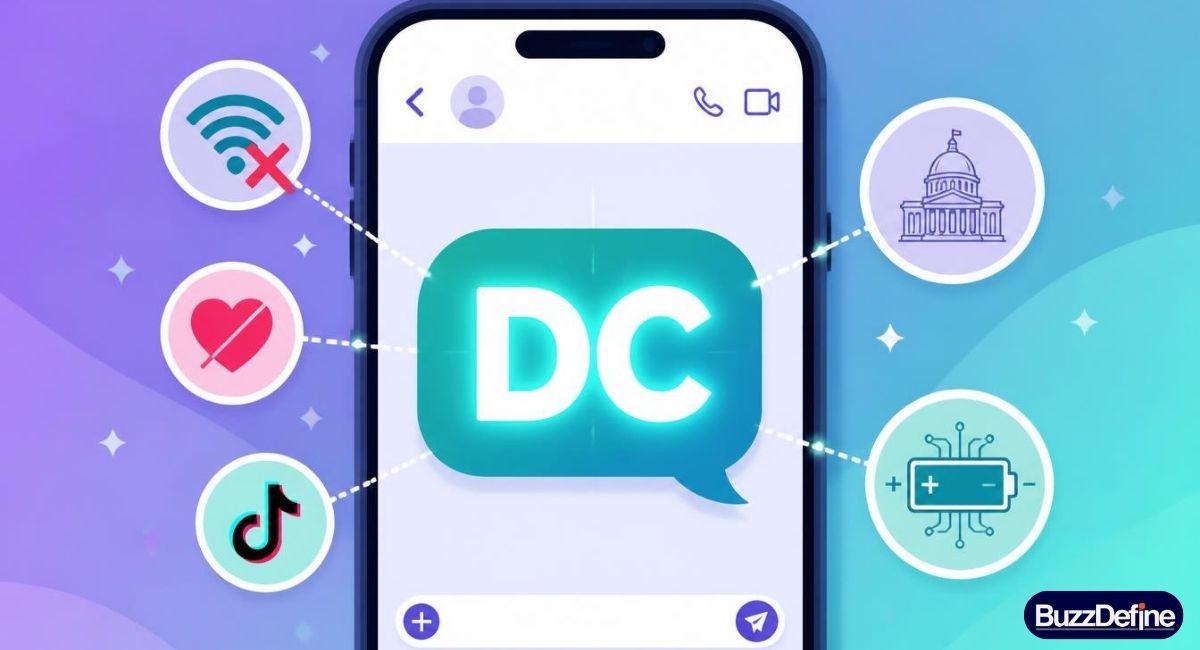
DC in text usually means “don’t care” or “disconnect/disconnected.” In gaming and Discord chats, it almost always means someone lost connection.
In casual texting, it means the sender has no strong opinion. On TikTok and Instagram, DC often stands for “dance credit,” giving credit to the original choreographer.
Outside of slang, DC can also mean Washington, D.C. or direct current. The exact meaning depends on the platform, the topic, and the words around it.
Seen “dc” in a message and got confused? You’re not the only one. It’s a two-letter abbreviation that changes meaning depending on where you see it, and guessing wrong can make you misread the whole message.
Quick Answer: DC Meanings at a Glance
Here’s every common meaning of DC, where it’s used, and how formal it is.
| Meaning | What It Means | Platform / Context | Formality |
| Don’t care | No strong opinion or preference | Texting, group chats | Informal |
| Disconnect / disconnected | Lost connection, dropped, or left | Gaming, Discord, calls | Informal |
| Dance credit | Credit given to the original dance creator | TikTok, Instagram | Informal |
| Dance challenge | A viral dance trend | TikTok | Informal |
| Discord | Short for the Discord app | Gaming, online communities | Informal |
| Washington, D.C. | The U.S. capital (District of Columbia) | General conversation, travel, news | Neutral/Formal |
| Direct current | Electrical current flowing one way | Electronics, physics, school | Formal/Technical |
| Distribution center | A warehouse or shipping hub | Business, logistics, retail | Formal |
| Doctor of Chiropractic | A professional title after a name | Medical, professional bios | Formal |
How to Decode DC in 5 Seconds
You don’t need a slang dictionary to figure out DC. Just ask yourself one question:
What is the conversation actually about?
Use this quick check:
- If the message is about opinions, plans, or choices, DC usually means don’t care
- If the message is about wifi, a call, a game, or a server, DC usually means disconnect
- If DC shows up in a TikTok or Instagram caption with a video, it likely means dance credit
- If the topic is travel, politics, or a U.S. city, DC probably means Washington, D.C.
- If the conversation is about electronics, circuits, or power, DC means direct current
- If it’s in a work chat about shipping or warehouses, DC likely means distribution center
Most of the time, one of these five clues solves it instantly. The platform you’re on and the words sitting next to DC do almost all the work.
DC Meaning by Platform
The same two letters shift meaning depending on where you see them. Here’s how DC breaks down across the apps and spaces you actually use.
Texting / SMS
In regular text messages, DC almost always means don’t care or disconnect. Since a text thread can cover anything, tone and topic matter most.
Examples:
- “Pizza or tacos tonight?” “DC, you pick.”
- “Call dropped, I think I DC’d.”
Discord / Gaming
On Discord and in gaming chats, DC means disconnect nearly every time. Players use it as both a noun and a verb.
Examples:
- “He DC’d right before the boss fight.”
- “If I DC, just start without me.”
Some gamers also use DC casually as shorthand for Discord itself, but that’s rarer and only makes sense when the topic is clearly about servers or invites.
TikTok
On TikTok, DC almost always means dance credit. Creators tag the original choreographer so viewers know who made the dance.
Examples:
- “DC: @originalcreator”
- “Learned this DC in one try”
Instagram / Snapchat
On Instagram, DC follows the same pattern as TikTok. It usually means dance credit under video posts, though don’t care still shows up in regular captions and DMs.
On Snapchat, DC leans more toward don’t care or disconnect since Snapchat is built around chatting, not dance content.
Examples:
- Instagram caption: “DC: @dancer_name 💃”
- Snapchat chat: “Movie tonight?” “DC, whatever works.”
Twitter / X
On Twitter/X, DC is used less often as slang. When it shows up, it usually means don’t care in replies or quote tweets, or Washington, D.C. when the topic is news or politics.
Examples:
- “New policy announced.” “DC, not surprised.”
- “Protest happening in DC today.”
Workplace / Slack
In professional chats like Slack or email, DC almost never means don’t care. Business contexts use it for distribution center, data center, or direct current, depending on the industry.
Examples:
- “The order is being shipped from the DC in Ohio.”
- “We’re migrating servers to the new DC next week.”
This is a big difference from casual texting, and it’s why guessing the slang meaning at work can cause real confusion.
All Meanings of DC (Detailed)
Here’s a closer look at each meaning, with examples and the clues that give it away.
Don’t Care
DC often stands for “don’t care” in casual texting. It signals that the sender has no strong preference, no opinion, or isn’t interested in the topic.
Examples:
- “Blue or black?” “DC, either is fine.”
- “We can go now or later, I DC.”
- “DC honestly, up to you.”
Sometimes this reads as relaxed and easygoing. Other times, especially in a one word reply like “DC.” with nothing else, it can come across as blunt or dismissive. The words around it usually reveal the tone.
Disconnect / Disconnected
DC also means someone lost their internet connection, dropped from a call, or exited a game unexpectedly. This is the dominant meaning in gaming spaces and voice chats.
Examples:
- “Sorry, I DC’d in the middle of the match.”
- “He keeps DC’ing every round.”
- “Hold on, I think she DC’d from the call.”
Look for nearby words like wifi, lag, server, reconnect, or dropped. Those almost always confirm this meaning. Grammar is a clue too: “DC’d” with an apostrophe and D usually points to an action, not an opinion.
Dance Credit / Dance Challenge
On TikTok and Instagram, DC is shorthand for dance credit, giving recognition to the person who created a dance. It can also mean dance challenge when referring to a trending routine others are copying.
Examples:
- “DC: @creatorname”
- “New DC, try this tonight”
- “This DC is everywhere right now”
If DC appears in a caption alongside music, hashtags, or a video of someone dancing, this is almost certainly the meaning, not don’t care or disconnect.
Discord (shorthand)
In some gaming and online communities, people shorten “Discord” to DC. It’s a more niche use and only makes sense when the conversation is clearly about servers, invites, or group chats.
Example:
- “Send it on DC” (meaning: send it on Discord)
This meaning overlaps with “disconnect,” so context is essential. If someone mentions joining, inviting, or linking a DC, they mean the app, not a lost connection.
Washington D.C.
Outside of slang, DC is widely used as shorthand for Washington, D.C., the U.S. capital, with the letters standing for District of Columbia.
Example:
- “My cousin just moved to DC for work.”
- “There’s a big event happening in DC this weekend.”
This meaning shows up most in conversations about travel, politics, government, or U.S. news.
Direct Current
In science and electronics, DC stands for direct current, electrical current that flows in one direction (as opposed to AC, alternating current).
Example:
- “This adapter converts AC to DC.”
- “Solar panels generate DC power.”
You’ll see this meaning in classrooms, tech specs, and anything related to circuits, batteries, or power adapters.
Distribution Center (business)
In retail, logistics, and supply chain conversations, DC refers to a distribution center, a warehouse facility where goods are stored and shipped out to stores or customers.
Example:
- “The shipment is delayed at the DC.”
- “We’re opening a new DC in Texas next quarter.”
This meaning is common in business emails, logistics teams, and retail operations, and it has nothing to do with texting slang.
Doctor of Chiropractic (DC after a name)
When DC appears right after someone’s name, it’s often a professional credential meaning Doctor of Chiropractic.
Example:
- “Dr. Sarah Lin, DC”
This use is formal and shows up in medical bios, business cards, and professional directories rather than casual conversation.
Origin & History of “DC” as Slang
DC as internet slang goes back to the early days of online gaming and chat rooms in the late 1990s and early 2000s. Dial up and early broadband connections were unstable, and players in multiplayer games got dropped mid match constantly. Typing “DC” became a fast way to explain what happened without breaking the flow of a fast paced match.
Massively multiplayer games and competitive shooters helped the term spread internationally. Players from different countries needed short, simple terms everyone could understand instantly, and “DC” fit that need perfectly.
As texting and instant messaging grew through the 2000s and 2010s, the term crossed over into casual conversation. Younger users picked it up and started applying it to opinions and preferences too, which is how “don’t care” became a second major meaning.
The most recent shift happened with the rise of TikTok. Once dance trends became a core part of the platform, creators needed a fast way to tag who made a routine, and “DC” for dance credit became standard practice almost overnight.
So the term has moved through three clear phases:
- Gaming era: DC means disconnect
- Texting era: DC expands to include don’t care
- Short video era: DC picks up dance credit on TikTok and Instagram
Each phase added a meaning without fully replacing the last one, which is why all three are still active today.
DC vs IDC vs Discord vs DM
These four terms get mixed up often because they look similar or show up in the same spaces. Here’s how they actually differ.
DC vs IDC
DC can mean don’t care, but it’s ambiguous since it also means disconnect. IDC always means “I don’t care” and nothing else. If clarity matters, IDC is the safer choice to type.
DC vs Discord
DC is sometimes used casually as shorthand for Discord, but only when the context clearly points to servers, invites, or group chats. On its own, DC is far more likely to mean disconnect or don’t care.
DC vs DM
DC and DM are unrelated despite both being common two letter abbreviations online. DM always means direct message, referring to a private message sent on a platform. DC never means this.
| Term | Meaning | Common Mix Up |
| DC | Don’t care, disconnect, dance credit, and more | Confused with Discord or DM |
| IDC | I don’t care | Sometimes shortened back to DC |
| Discord | The chat app | Shortened casually to DC |
| DM | Direct message | Confused with DC due to similar look |
Is Saying “DC” Rude?
It depends entirely on the phrasing and tone around it.
Usually not rude:
- “DC, either one works for me.”
- “Whatever you want, I DC.”
These read as relaxed and low pressure, not dismissive.
Can come across as rude:
- “DC.”
- “I DC about that.”
- A one word “DC” reply with no follow up
A short, standalone “DC” can feel cold or dismissive, especially in a conversation where the other person is looking for input or emotional support. The problem isn’t the abbreviation itself. It’s that a two letter reply strips out tone, so the recipient fills in the gap, and they often assume the worst.
If you want to sound less blunt while keeping the same meaning, try:
- “Either one is fine with me.”
- “I don’t really mind, you choose.”
- “Honestly not fussed either way.”
These say almost the same thing as DC but land much softer.
Real Conversation Examples
Seeing DC in context makes the meaning click faster than any definition. Here are realistic exchanges for each major use.
When DC means don’t care:
A: Pizza or burgers tonight? B: DC, you pick.
A: Should we leave now or wait? B: DC tbh, both work.
When DC means disconnect:
A: Why’d you leave the match? B: I didn’t leave, I DC’d.
A: Can you hear me? B: Hold on, I think I DC’d from the call.
When DC means dance credit:
Caption: “New routine, DC: @originalcreator 💃”
Comment: “This DC is so clean, learned it in 10 minutes.”
When DC means Washington, D.C.:
A: Where’s the conference this year? B: DC, at the convention center downtown.
When DC means distribution center:
A: Any update on the shipment? B: Still sitting at the DC, should move tomorrow.
Notice how the surrounding words, not the letters themselves, carry the real meaning in every example.
How to Reply to DC
Your reply depends on which meaning you’re reacting to.
If DC means don’t care:
- “Okay, I’ll decide then.”
- “Got it, no worries.”
- “Cool, I’ll pick something.”
If DC means disconnect:
- “Ah, your connection okay now?”
- “No rush, reconnect when you can.”
- “Did the server drop you again?”
If you’re not sure which one they mean:
- “Wait, DC as in don’t care, or did you disconnect?”
- “What do you mean by DC here?”
- “Are you talking about the game or the plan?”
Asking directly takes five seconds and avoids replying to the wrong meaning entirely, which happens more often than people expect.
Common Mistakes People Make With DC
Assuming it always means “don’t care”
This is true in a lot of texts, but not in gaming chats, calls, or TikTok captions. Treating every DC the same way leads to misreadings.
Reading it as rude too fast
A quick “DC, you pick” is often just genuine indifference, not disrespect. Don’t assume attitude before checking the tone of the full message.
Ignoring the platform
A gaming lobby, a TikTok caption, and a regular text thread don’t use DC the same way. The platform alone narrows the meaning down fast.
Missing the grammar clues
“DC” on its own tends to read like an opinion. “DC’d” with the apostrophe reads like an action, almost always pointing to disconnected. That small difference speeds up decoding a lot.
Overlooking business and technical use
Not every DC is slang. In a work email or a physics class, DC almost always means distribution center or direct current, not anything casual.
FAQs
What does DC mean in text?
DC most commonly means “don’t care” or “disconnect,” depending on the conversation. The topic and platform usually make the meaning clear.
What does DC mean on TikTok?
On TikTok, DC almost always means “dance credit,” giving recognition to the person who created a dance.
What does DC mean in gaming?
In gaming, DC means a player lost connection or dropped out of a match or server.
Is DC rude?
Not usually. A short, standalone “DC” can sound blunt, but when it’s paired with more words, it usually just signals indifference, not disrespect.
Does DC mean Discord?
Sometimes. In gaming and online communities, people occasionally shorten “Discord” to DC, but only when the topic is clearly about servers or invites.
What does DC stand for in electricity?
In physics and electronics, DC stands for direct current, meaning electrical current that flows in one direction.
What does DC mean on Instagram?
On Instagram, DC usually means “dance credit” under video posts, though it can also mean “don’t care” in regular chats and comments.
What does DC mean on Snapchat?
On Snapchat, DC typically means “don’t care” or “disconnect,” since Snapchat is built more around chatting than dance content.
What does DC mean in a work chat?
In professional settings, DC usually refers to a distribution center, data center, or direct current, not the slang meanings used in texting.
What’s the difference between DC and IDC?
DC is ambiguous and can mean don’t care, disconnect, or dance credit. IDC only ever means “I don’t care,” so it’s clearer when you want to avoid confusion.
Why do people use DC instead of typing the full word?
DC started as a fast way for gamers to explain dropped connections mid match. It later expanded into texting and TikTok because short abbreviations save time in fast paced conversations.
What does DC mean after someone’s name?
When DC follows a name, it’s typically a professional title meaning Doctor of Chiropractic, common in medical bios and business cards.
Conclusion: Quick Recap
DC doesn’t have one fixed meaning, and that’s exactly why it trips people up. In texting, it most often means don’t care. In gaming and Discord, it means disconnect.
On TikTok and Instagram, it usually stands for dance credit. Outside of slang, DC can mean Washington, D.C., direct current, a distribution center, or even a professional title like Doctor of Chiropractic.
The fastest way to decode it is to look at where you saw it and what the conversation is actually about. Once you check the platform and the topic, the right meaning almost always becomes obvious in a few seconds.
Read Next: DTTM Meaning in Text: What It Really Stands For (2026)

Muhammad Kaleem is the founder and lead writer at BuzzDefine, where he covers internet slang, texting abbreviations, and digital communication trends. He actively follows how language evolves across WhatsApp, Instagram, and TikTok — tracking real conversations, group chats, and comment threads to keep definitions accurate and current. He writes to make modern slang easy to understand for readers of every generation.