You’re scrolling through your DMs and someone texts, “That outfit is FYE.” You pause. Is that a compliment, a typo, or something else?
So, what does FYE mean in text? Most of the time, it’s just a casual spelling of “fire,” slang for something really good. But the meaning can shift depending on where you see it.
Here’s what FYE means, where it comes from, how to reply, and when it means something totally different.
Quick Answer
“FYE” in text usually means “fire,” slang for something excellent, exciting, or impressive. It’s a slang spelling of “fire,” not a true acronym. For example, “That song is FYE” means “That song is really good.” You’ll mostly see it in texts, DMs, and comments.
Quick example:
Text: “Check out my new shoes”
Reply: “Those are FYE 🔥”
FYE Meaning at a Glance
If you want the short version, FYE is just a casual way to write “fire.” People use it when something is really good, whether that’s a song, an outfit, or a meal. Here’s how it compares with similar slang:
| Term | Meaning and tone | Example |
| FYE | Excellent or impressive. Very informal. | “This beat is fye.” |
| Fire | Same idea, the standard spelling. Informal. | “This beat is fire.” |
| Lit | Exciting, lively, fun. Informal. | “The party was lit.” |
| Dope | Cool or impressive. Informal. | “Those shoes are dope.” |
FYE and fire mean basically the same thing. FYE is just the way people spell it when they text. Lit leans toward energy and excitement, while dope leans toward “that’s cool.”
How Do You Pronounce FYE?
You say “FYE” like “fi-yuh,” which is basically how many people say “fire” out loud. Dictionary.com lists the pronunciation as “fi-yuh.” It doesn’t rhyme with “bye” in a quick, single beat. Think of “fire” with a relaxed, drawn-out ending.
Where Does FYE Come From?
FYE is a slang respelling of “fire.” Wiktionary explains it as a spelling that reflects how “fire” sounds in Southern US and African American English. In those dialects, the “r” at the end softens, so “fire” sounds closer to “fye-uh.”
The word has been around online for a while. The earliest Urban Dictionary entry using the “fye” spelling dates to 2003. People were using “fire” to mean “excellent” in slang even earlier than that.
You might also see other spellings of the same word:
- Fya: a slang form of “fire,” based on how the word sounds in varieties of Black English.
- Fiyah: the more common variant of fya.
- Fyah: a common form of “fire” in Jamaican English.
All of them point back to the same idea: something so good it’s “on fire.”
How Is FYE Used in Texting?
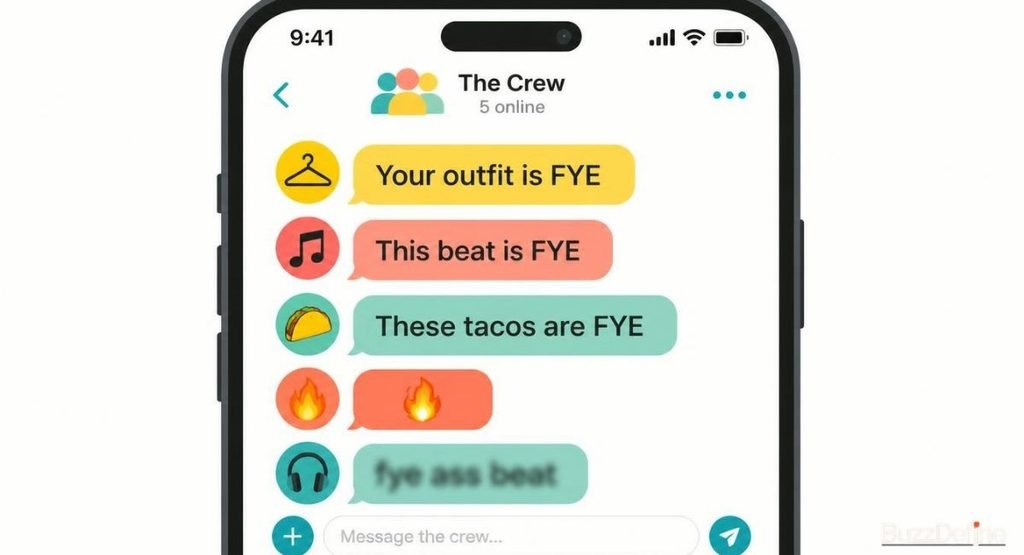
People use FYE as a quick way to show approval. Here are the five most common ways you’ll see it:
| Type | Example | What it means |
| Compliment | “Your outfit is FYE.” | You look great. |
| Music | “This beat is FYE.” | This beat sounds excellent. |
| Food | “These tacos are FYE.” | These tacos taste amazing. |
| Reaction | “FYE 🔥” | That’s really cool. |
| Intensified | “This is a fye ass beat.” | This beat is extremely good. |
That last one is very casual. “Fye ass” pairs fye with an intensifier and is often used about music. Save it for close friends.
FYE on Social Media
FYE means the same thing everywhere: “fire,” or really good. The platform changes what’s being praised, not the meaning.
| Platform | What FYE usually praises |
| TikTok | A video, song, dance, outfit, or edit |
| A photo, Reel, outfit, or song in comments and DMs | |
| Snapchat and WhatsApp | Anything a friend sends you, like a pic, a track, or a plan |
A comment like “FYE 🔥🔥” simply means “This is fire!”
What Does FYE Mean From a Girl or Guy?
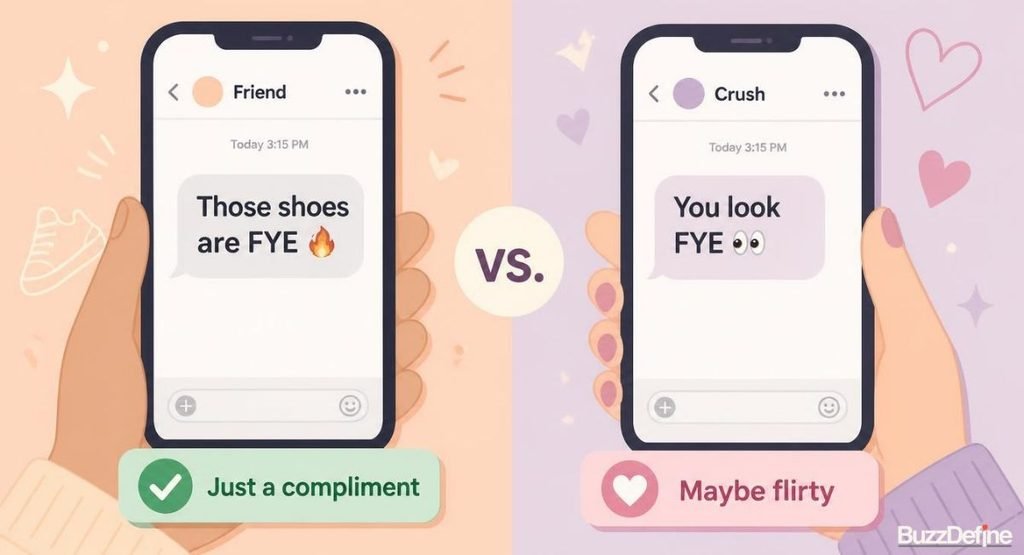
Nothing changes based on who sends it. The word means “really good” whether it comes from a girl or a guy. What matters is what they’re calling FYE and how they say it.
Clues it’s just a compliment:
- They’re talking about an object, like your shoes, your post, or your playlist.
- The chat is casual and friendly, with no extra hints.
- They use fire emojis (🔥) or normal reactions.
Clues it might be flirty:
- They say “You look FYE” about you, not your outfit.
- They add 👀, 😏, or 😍.
- It comes with extra attention, like late-night texts or follow-up questions.
One “FYE” doesn’t prove romantic interest. If you’re unsure, look at the pattern. Is this how they usually talk to you, or is something different? You can also just ask, or reply lightly and see what happens.
How to Reply to FYE
Pick the reply that matches the mood. You can copy any of these.
Friendly
- “Thanks, I appreciate it!”
- “Glad you like it!”
- “That means a lot, thank you!”
Casual
- “Right? 🔥”
- “Haha, thanks!”
- “I know, it’s so good.”
Flirty-safe (friendly, but not over-committing)
- “Aw, thanks. You’re not so bad yourself 😄”
- “Thank you! You made my day.”
Not sure what they meant? “Thanks!” works every time.
Other Meanings of FYE
Slang is the most common meaning in texts, but FYE can stand for other things too. Context tells you which one it is.
| Meaning | Example | How to spot it |
| Fire (slang) | “That song is FYE.” | A casual chat praising something |
| Fiscal Year End | “The FYE report is due Friday.” | Business, finance, or accounting talk |
| FYE (the retailer) | “I got that album at FYE.” | A store, shopping, or a place name; a U.S. chain selling music, movies, and collectibles |
| For Your Eyes | “FYE: please don’t share this.” | A private, restricted note; FYEO (“for your eyes only”) is far more common |
If you see FYE in a work email next to words like “budget” or “quarter,” it’s almost certainly Fiscal Year End.
FYE vs Fire vs Lit vs Dope
These all praise something, but they don’t feel exactly the same.
| Word | Best for | Example |
| FYE | Anything you think is excellent | “That jacket is fye.” |
| Fire | Same as FYE, standard spelling | “That jacket is fire.” |
| Lit | Parties, energy, exciting moments | “The concert was lit.” |
| Dope | Something cool or stylish | “Those sneakers are dope.” |
FYE and fire are nearly identical. Lit, which started as slang for being drunk, grew to mean exciting or really great. Dope is a bit more laid-back.
When Not to Use FYE
Skip FYE in anything formal. That includes:
- Work emails and reports
- School essays and assignments
- Messages to a teacher, boss, or client
- Job applications and cover letters
It’s fine for friends, DMs, and social comments. For everything else, switch to a formal word:
- Instead of “The presentation was FYE,” write “The presentation was excellent.”
- Instead of “Your idea is FYE,” write “Your idea is impressive.”
Common Mistakes
- Thinking it always means “fire.” It usually does in texts, but in a finance email it can mean Fiscal Year End.
- Treating it as an acronym. The slang FYE is a respelling of “fire,” not letters standing for words.
- Assuming it’s romantic. It can be a compliment about shoes, music, or food. Check the tone before reading into it.
- Calling it a typo. It’s usually intentional slang, not a mistake.
FAQ
What does FYE mean in text?
FYE usually means “fire,” slang for something excellent, exciting, or impressive. For example, “That song is FYE” means “That song is really good.”
Is FYE the same as fire?
Yes, in slang they mean the same thing. FYE is just a casual spelling of “fire.”
How do you pronounce FYE?
It’s pronounced “fi-yuh,” like a relaxed version of “fire.”
What does FYE mean on TikTok or Instagram?
It means “fire” or “really good.” People use it in comments and DMs to praise videos, photos, songs, or outfits.
What does FYE mean from a girl or guy?
There’s no special meaning based on gender. It’s usually a compliment, and it can be flirty if it’s about how you look and comes with hints like 👀.
How do you reply to FYE?
A simple “Thanks!” or “Glad you like it!” works. For something casual, try “Right? 🔥”
What does FYE stand for in business?
In business, FYE stands for Fiscal Year End, the last day of a company’s accounting year.
Key Takeaway
FYE usually means “fire” in text. It’s a casual spelling people use to call something excellent, exciting, or impressive. Check the context: in a work document, it may mean Fiscal Year End instead.
Read Next: WYS Meaning in Text: What It Means, How to Reply & Other Meanings (2026)

Muhammad Kaleem is the founder and lead writer at BuzzDefine, where he covers internet slang, texting abbreviations, and digital communication trends. He actively follows how language evolves across WhatsApp, Instagram, and TikTok — tracking real conversations, group chats, and comment threads to keep definitions accurate and current. He writes to make modern slang easy to understand for readers of every generation.