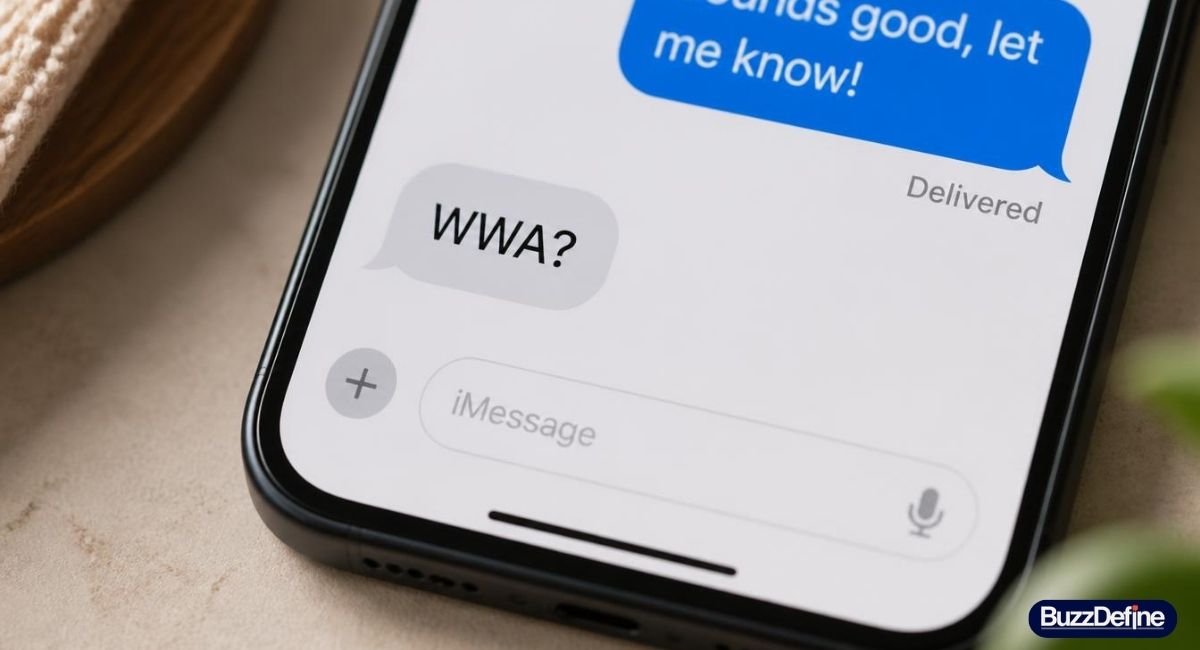
You get a text that just says “WWA?” No context, no explanation, and now you’re staring at your phone trying to decode it.
Here’s the quick answer: the WWA meaning in text doesn’t come down to one fixed definition. In most texts, it stands for “What’s Wrong?”, “Where We At?”, or “What We Are?”, and which one applies depends entirely on what was said right before it. Once you know the three common versions, spotting the right one takes about two seconds.
All Meanings of WWA
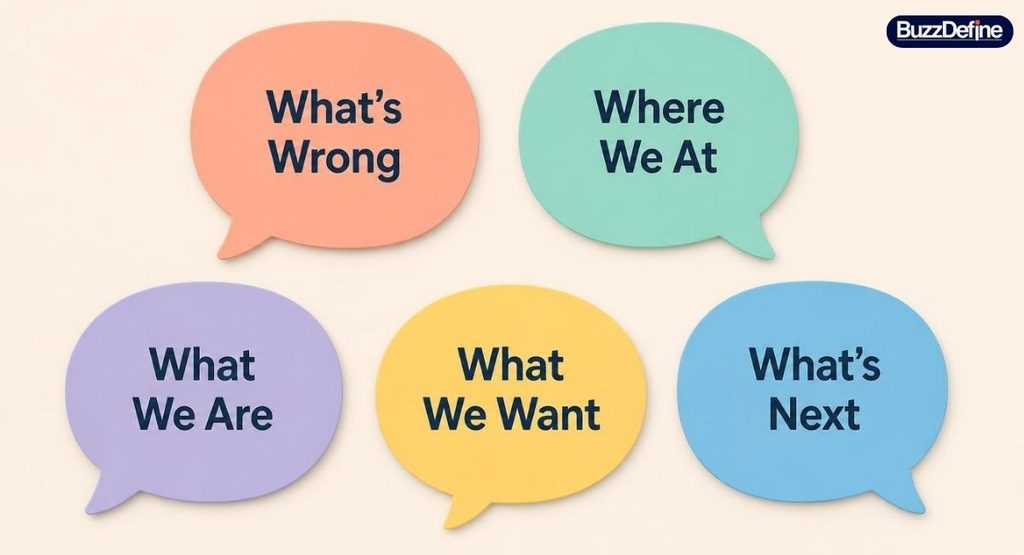
Meaning: What’s Wrong?
Context: Checking in on someone who seems upset, quiet, or off
Example: “You’ve been really quiet today. WWA?”
Meaning: Where We At?
Context: Asking for a status update on plans, a task, or a group activity
Example: “WWA with the party tonight? Still happening?”
Meaning: What We Are?
Context: Asking about the status of a relationship, usually between two people
Example: “Can we talk? I keep thinking about WWA.”
Meaning: What Was Asked?
Context: Requesting clarification because a question wasn’t heard or understood
Example: “WWA? I didn’t catch that.”
Meaning: What’s With That?
Context: Reacting to something surprising, confusing, or unexpected
Example: “He just walked out mid meeting. WWA?”
No single meaning is “the official one.” WWA is a flexible abbreviation, and its meaning shifts based on the conversation around it. That’s exactly what the next section helps you figure out.
How to Know Which Meaning Fits
Reading “WWA” in isolation won’t tell you much. Reading the message right before it almost always will. Here’s a simple process to follow.
- Look at the message before WWA. If the previous text mentioned feelings, stress, or a change in behavior, WWA likely means “What’s Wrong?” If it mentioned plans, timing, or a task, it probably means “Where We At?”
- Check who’s texting you. A partner or someone you’re dating is more likely using “What We Are?” A friend or coworker is more likely asking about status or plans.
- Notice the tone and punctuation. A single “WWA?” after silence usually signals concern. “WWA lol” or “WWA 😂” after something odd happened usually signals “What’s With That?”
- Consider the platform. A gaming chat or group planning thread leans toward “Where We At?” A one on one DM after an emotional post leans toward “What’s Wrong?”
- Read what comes after. If the reply that follows explains a feeling, the earlier WWA meant “What’s Wrong?” If it gives a location or time update, it meant “Where We At?”
Once you get used to spotting these signals, decoding WWA becomes automatic. You won’t need to guess anymore.
WWA in Real Conversations
Meaning: What’s Wrong?
Person A: “I don’t really feel like talking right now.”
Person B: “WWA? You okay?”
Person A: “I failed my exam today.”
Person B: “WWA? Want to talk about it?”
Meaning: Where We At?
Person A: “Are we still meeting at 7?”
Person B: “WWA? I’m stuck in traffic.”
Person A: “Did you finish the slides?”
Person B: “WWA on the presentation? Almost done.”
Meaning: What We Are?
Person A: “We’ve been talking for months now.”
Person B: “I know. WWA at this point?”
Meaning: What Was Asked?
Person A: “So, are you coming or not?”
Person B: “Sorry, WWA? My connection dropped.”
Meaning: What’s With That?
Person A: “She unfollowed everyone overnight.”
Person B: “WWA? That’s random.”
Each version reads clearly once you know which conversation it belongs to. The words don’t change. The context around them does.
WWA on Different Platforms
WhatsApp
Typical meaning: Where We At? or What’s Wrong?
Example: “WWA with the trip plan?”
Instagram DMs
Typical meaning: What’s Wrong? or What’s With That?
Example: “You seemed upset in your story. WWA?”
Snapchat
Typical meaning: What’s Wrong?
Example: “You haven’t snapped back all day. WWA?”
Discord
Typical meaning: Where We At?
Example: “WWA on the raid? Everyone ready?”
TikTok comments
Typical meaning: What’s With That?
Example: “WWA 😭 that plot twist came out of nowhere.”
Gaming chats
Typical meaning: Where We At?
Example: “WWA on the mission? Loading in.”
The platform itself doesn’t fix the meaning. It just makes one interpretation more common than the others.
WWA vs Similar Abbreviations
WWA
Full meaning: What’s Wrong? / Where We At? / What We Are?
Purpose: Multi purpose check in, meaning depends on context
WYD
Full meaning: What You Doing?
Purpose: Ask what someone is doing right now
WYA
Full meaning: Where You At?
Purpose: Ask for someone’s location
HBU
Full meaning: How About You?
Purpose: Return a question back to the sender
IDC
Full meaning: I Don’t Care
Purpose: Express lack of interest or preference
TTYL
Full meaning: Talk To You Later
Purpose: Politely close a conversation
WSG
Full meaning: What’s Good?
Purpose: Casual greeting
WWA stands out because it isn’t tied to one fixed question. It absorbs meaning from context, which is why so many people search for a clear explanation of it.
How to Reply to WWA
If it means “What’s Wrong?”
Be honest about how you’re feeling, even briefly. A short reply like “Just tired, nothing serious” works fine if you’d rather not go into detail.
If it means “Where We At?”
Give a direct status update. “Almost there” or “Still working on it, 10 more minutes” answers the question without extra explanation.
If it means “What We Are?”
Take a moment before replying. This version usually opens a bigger conversation, so a thoughtful response matters more than a quick one.
If it means “What Was Asked?”
Simply repeat or rephrase your original question. No need to overthink this version.
If it means “What’s With That?”
A short explanation or reaction usually closes the loop. “Right? I have no idea either” keeps the tone light.
When you’re not sure which one applies, it’s completely fine to ask. “WWA meaning here, everything okay?” clears up confusion instantly.
Common Mistakes People Make
- Assuming WWA has only one meaning. Many people learn one definition and apply it to every message, which leads to confused replies.
- Ignoring the message that came before it. WWA rarely makes sense on its own. The context around it carries most of the meaning.
- Using WWA in formal writing. It belongs in casual texting, not emails, resumes, or professional messages.
- Confusing WWA with WYD or WYA. These abbreviations look similar but ask different questions.
- Overthinking a simple check in. Most of the time, WWA is just someone showing they’re paying attention. It rarely carries a hidden agenda.
Avoiding these mistakes makes texting conversations smoother and cuts down on unnecessary back and forth.
Origin and History of WWA
Like most modern texting abbreviations, WWA grew out of SMS culture in the early 2000s, when character limits and slow typing speeds pushed people toward shorter phrases. Terms like BRB, LOL, and IDK became common first, and abbreviations built around everyday questions followed soon after.
WWA fits this pattern closely. Instead of typing out “What’s wrong?” or “Where are we at?” every time, users compressed the question into three letters.
As messaging moved from SMS to apps like WhatsApp, Snapchat, and Discord, the abbreviation carried over and picked up new shades of meaning depending on the community using it, which explains why it now covers several related questions instead of just one.
FAQs
What does WWA mean in text?
WWA usually means “What’s Wrong?”, “Where We At?”, or “What We Are?” depending on the conversation. There’s no single fixed meaning, so the context of the message determines which one applies.
Is WWA the same as WYD?
No. WYD asks what someone is doing right now, while WWA usually checks on someone’s wellbeing, asks for a status update, or questions a relationship, depending on context.
What does WWA stand for on Snapchat?
On Snapchat, WWA most commonly means “What’s Wrong?” It’s typically used when someone notices a friend has gone quiet or seems upset based on their recent activity.
Is WWA formal or slang?
WWA is informal internet slang. It works well in casual texting and social media but shouldn’t be used in emails, professional messages, or formal writing.
Can WWA mean something else outside of texting?
Yes. Outside of texting, WWA can refer to organizations or formal terms unrelated to slang, such as legal or historical acronyms. In everyday chat, the informal meanings almost always apply.
How do I know which meaning of WWA someone means?
Read the message sent right before WWA. If it mentions feelings, the meaning is likely “What’s Wrong?” If it mentions plans or timing, it’s likely “Where We At?”
Conclusion
WWA doesn’t come with one fixed definition, and that’s exactly why it confuses so many people at first. Depending on the conversation, it can mean “What’s Wrong?”, “Where We At?”, “What We Are?”, or a couple of other closely related questions.
Once you get in the habit of checking the message before it, the platform you’re on, and the tone being used, picking the right meaning becomes quick and natural. The next time WWA shows up in your messages, you’ll know exactly how to read it and how to reply.
Read Next: HRU Meaning In Chat: Full Guide + How to Reply (2026)

Muhammad Kaleem is the founder and lead writer at BuzzDefine, where he covers internet slang, texting abbreviations, and digital communication trends. He actively follows how language evolves across WhatsApp, Instagram, and TikTok — tracking real conversations, group chats, and comment threads to keep definitions accurate and current. He writes to make modern slang easy to understand for readers of every generation.