
Casi algo is Spanish for “almost something.” It describes a connection, relationship, or situation that felt real and emotionally significant but never became official or clearly defined no label, no clear commitment, just something left unfinished.
Casi algo meaning comes down to two small Spanish words that carry a surprisingly big feeling: “almost something.” You’ve probably seen it in a caption, a comment, or a text from a bilingual friend, and wondered why it seems to hit so differently than any English phrase you know.
That’s exactly what this guide is here to clear up. Below, you’ll get the real meaning of casi algo, how to say it correctly, the grammar behind it, and how it’s actually used in everyday Spanish, without any of the fluff or filler most explanations add.
By the end, you’ll know exactly what it means, when to use it, and when to leave it alone.
What Does “Casi Algo” Mean?
Casi algo means “almost something” in English. It’s made of two everyday Spanish words: casi (“almost”) and algo (“something”).
Together, they describe anything often a romantic connection, but not always that came close to being real or official, but never fully got there.
| Spanish Word | Meaning | Example | Literal English |
| Casi | Almost / Nearly | Casi gané | I almost won |
| Algo | Something / Anything | Quiero algo | I want something |
| Casi algo | Almost something | Fuimos casi algo | We were almost something |
One-line takeaway: Casi algo names the space between “nothing” and “something official,” a connection or outcome that stayed unfinished.
How Do You Pronounce “Casi Algo”?
Casi algo is pronounced KAH see AHL goh. Say it with light, even stress on each syllable, the way it sounds in normal spoken Spanish.
| Syllables | Sound | Stress |
| ca si | KAH see | first syllable |
| al go | AHL goh | first syllable |
A common mistake is saying “kay sigh,” which turns it into English sounds instead of Spanish ones. Keep the vowels short and clean: “ah,” not “ay.”
Spain vs. Latin America: In Spain, the “c” in casi can carry a slightly softer, more clipped tone, closer to “KAH see.” In most of Latin America, it’s a touch smoother and faster: “kah’see.” The difference is subtle, and either pronunciation is understood everywhere.
Grammar Behind the Phrase
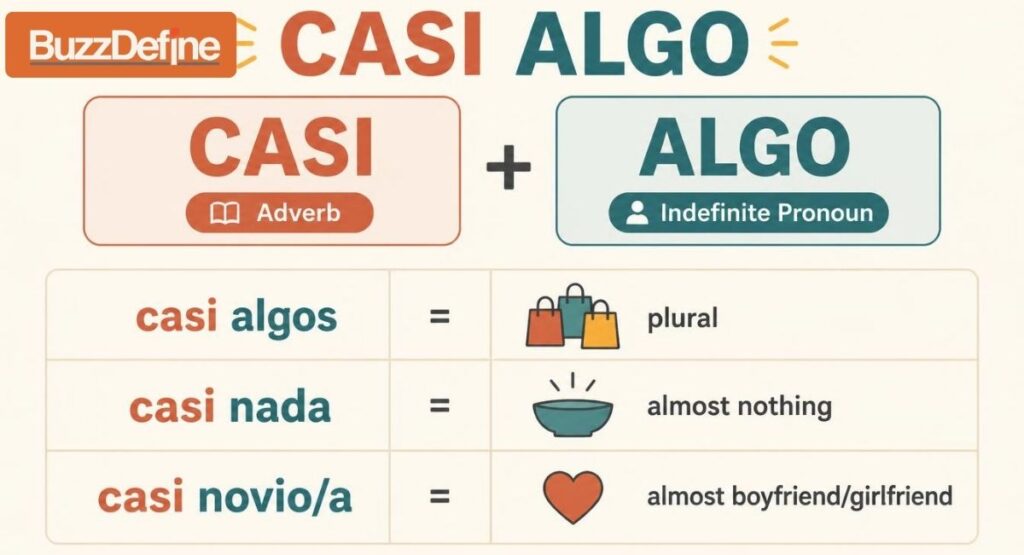
Casi is an adverb. Algo is an indefinite pronoun. Put together, they form a simple noun phrase that Spanish speakers use freely in everyday conversation, not just as slang.
The phrase is gender neutral. Casi algo doesn’t change based on who you’re talking about, which is one reason it works so easily in casual speech and online writing.
Plural form: casi algos (used when talking about more than one undefined connection or outcome).
It also has close relatives that follow the same pattern:
| Phrase | Literal Meaning | Real Usage |
| Casi nada | Almost nothing | Something that barely happened or barely mattered |
| Casi novio / novia | Almost boyfriend / girlfriend | Someone close to being an official partner, but not quite |
| Casi amigos | Almost friends | A friendship that never fully formed |
These related phrases all share the same structure: casi plus a noun, describing something that came close but stayed incomplete.
Where the Phrase Comes From
Casi algo grew out of everyday Spanish, not a dictionary or formal source. Words like casi and algo have always existed; what’s new is how younger Spanish speakers started combining them to describe undefined situations in daily life.
The phrase gained traction in Latin American youth slang during the early 2010s, especially among young people in Mexico and Colombia.
As social media platforms grew, so did the phrase’s reach. It spread through captions, comments, and casual posts, eventually becoming a widely recognized expression among bilingual online communities.
It has since been popularized further through music and social media, where it’s used to describe the same undefined, in between feeling in everyday conversation.
What Does “Casi Algo” Actually Describe?
A casi algo describes a connection or situation that never got a clear status. It’s not “nothing,” but it’s not officially “something” either.
It usually involves:
- No clear label or definition
- Unclear intentions from one or both sides
- Friends asking “so what’s going on with you two,” and no real answer
- A connection that stayed in limbo instead of moving forward
- Real feelings, without a clear commitment attached to them
The phrase doesn’t describe a specific kind of relationship. It describes the undefined space itself, whatever caused it.
Casi Algo vs. Situationship vs. Almost Relationship
These three terms overlap, but they aren’t identical. Here’s how they compare.
| Feature | Casi Algo | Situationship | Almost Relationship |
| Language origin | Spanish, Latin American slang | English, modern dating culture | English, general usage |
| Tone | Warm, natural | Clinical, descriptive | Plain, literal |
| Where it’s used | Social media, casual conversation | Dating discussions | Everyday conversation |
| What it emphasizes | The connection stayed undefined | The lack of a formal label | How close things came to being official |
| Closest English equivalent | “Almost something” | “Undefined relationship” | “Not quite official” |
All three describe a connection without a clear label. Casi algo is simply the Spanish original that the other terms echo.
Real Examples & How the Phrase Is Used
Here’s how casi algo shows up in real sentences.
| Spanish | English | Context |
| Somos casi algo | We are almost something | Describing an undefined connection |
| Ella fue mi casi algo | She was my almost something | Talking about a past undefined connection |
| No fuimos nada, casi algo | We weren’t nothing, almost something | Explaining an in between situation |
| Fue solo un casi algo | It was just an almost something | Downplaying or summarizing what happened |
| Tuvimos un casi algo | We had an almost something | Referring to a specific undefined period |
| Casi algo, nunca algo real | Almost something, never something real | Emphasizing it stayed undefined |
“Mi Casi Algo” Meaning
Mi casi algo means “my almost something.” Adding mi makes the phrase personal, pointing to a specific person or situation that held significance without ever becoming official.
When Not to Use This Phrase
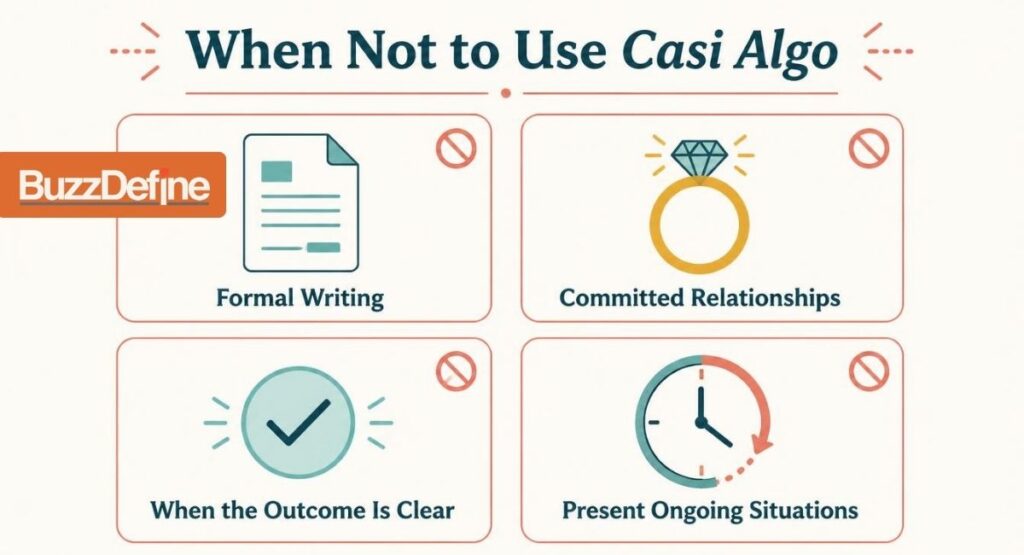
Casi algo fits casual, personal conversation, not every context. Here’s when to skip it.
- Formal or professional writing. It’s slang, so it doesn’t belong in reports, emails, or formal Spanish.
- When talking about someone who’s married or in a committed relationship. The phrase describes undefined connections, not situations where a clear commitment already exists.
- When the relationship or outcome is already clear. If something is definitely a relationship, a friendship, or a flat “no,” casi algo doesn’t apply anymore.
- In the present tense, for most speakers. Many Spanish speakers use casi algo to describe something that already ended, not an ongoing situation. Using it for something still unfolding can sound off.
Why “Almost” Feels Unsettled
An unclear outcome is harder to sit with than a clear “no.” When something stays undefined, there’s no clean point to move on from, just an open question.
That’s part of why casi algo resonates. It doesn’t just describe an event; it names a specific kind of uncertainty, one where nothing was confirmed and nothing was fully denied either. The lack of a clear answer is what makes “almost” feel heavier than “nothing” ever does.
Clarity Over Ambiguity
An undefined connection doesn’t serve anyone, no matter how meaningful it feels in the moment. If something matters, it deserves a clear answer, not an open-ended guess.
A few things worth keeping in mind:
- Clarity is a form of respect. A connection built on clear intentions holds more value than one left ambiguous.
- Protect your time and effort. It’s worth being cautious about investing heavily in something that has no clear direction.
- Move forward on solid ground. Time spent on education, work, family, and personal growth builds something real, unlike staying stuck in “almost.”
Understanding casi algo is useful. Living by clarity, instead of staying in it, is more useful still.
Other Spanish Phrases Like Casi Algo
| Phrase | Meaning |
| Casi nada | Almost nothing |
| Media naranja | Literally “half orange,” meaning a person’s other half or perfect match |
| Ni contigo ni sin ti | “Neither with you nor without you,” describing a conflicted, back and forth connection |
| Casi novio/a | Almost boyfriend or girlfriend |
Each of these captures a different shade of the same idea: connections that don’t fit neatly into “yes” or “no.”
FAQs
What does casi algo mean in English?
It means “almost something.” It describes a connection or situation that felt real but never became official.
How do you pronounce casi algo?
It’s pronounced “KAH see AHL goh,” with even stress on each syllable.
What does “mi casi algo” mean?
It means “my almost something,” referring to a specific person who held meaning without ever becoming official.
Is casi algo the same as a situationship?
They’re closely related. Casi algo is the Spanish version, with a warmer, more natural tone.
Is casi algo real Spanish or slang?
Both. Casi and algo are everyday Spanish words; their combination as a phrase started as slang.
Can casi algo be used for non-romantic things?
Yes. It’s often used for careers, friendships, and goals that almost worked out but didn’t.
What’s the plural of casi algo?
The plural is “casi algos,” used for more than one undefined connection or outcome.
Which countries use casi algo the most?
It’s most common in Mexico, Colombia, and other parts of Latin America, though it’s widely understood in Spain too.
Is casi algo a formal phrase?
No. It’s casual and doesn’t belong in formal or professional writing.
What’s the English equivalent of casi algo?
The closest equivalent is “almost something” or an “undefined connection.”
Takeaway
Casi algo means “almost something,” a Spanish phrase for any connection or outcome that stayed undefined, whether in love, work, or life.
Some words matter because they name a feeling most people recognize but struggle to put into their own words. Casi algo does exactly that. But naming the feeling is only useful up to a point. What matters more is choosing clarity over ambiguity, and putting your time and energy into things that are certain, purposeful, and worth building on.
Read Next : Snowball Kiss Meaning: What the Phrase Actually Means

Muhammad Kaleem is the founder and lead writer at BuzzDefine, where he covers internet slang, texting abbreviations, and digital communication trends. He actively follows how language evolves across WhatsApp, Instagram, and TikTok — tracking real conversations, group chats, and comment threads to keep definitions accurate and current. He writes to make modern slang easy to understand for readers of every generation.