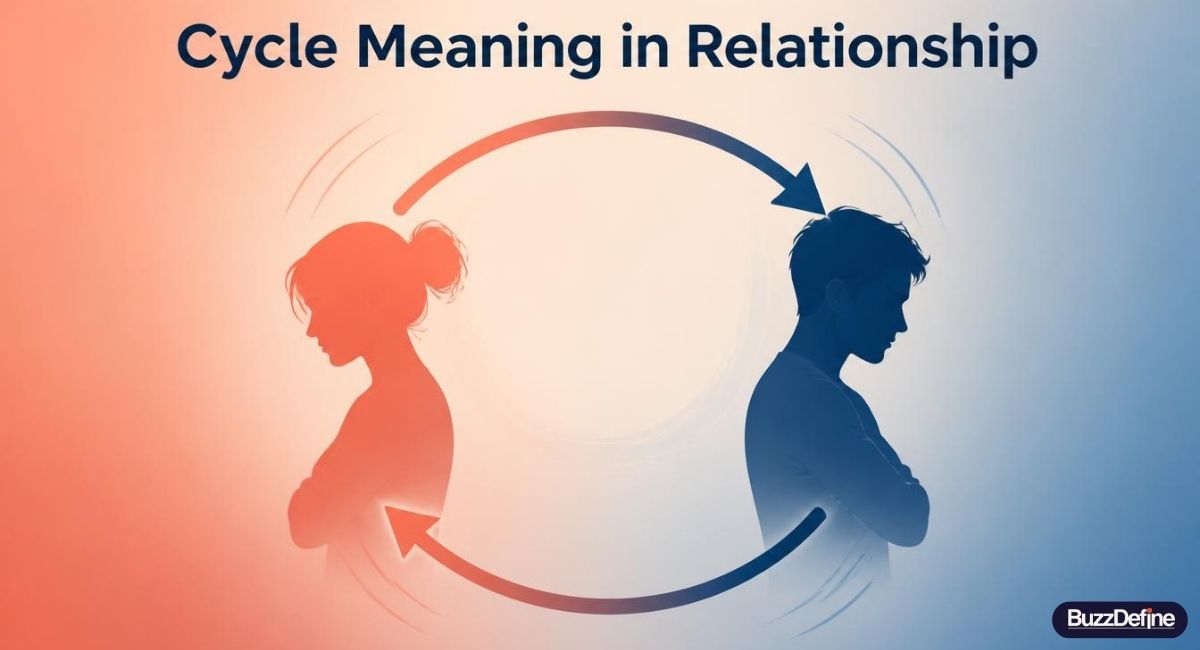
When someone says a couple is “stuck in a cycle,” they’re not talking about bikes. In relationships, a cycle means a pattern that keeps repeating: the same fight, the same breakup, the same reunion, or the same push-and-pull between closeness and distance.
If you’ve searched cycle meaning in relationship, you’ve probably noticed this pattern in your own life and want a straight answer.
The cycle meaning in relationship context is simple: it’s a recurring pattern of behavior or emotion that a couple keeps repeating over time, often without realizing it. It can be as harmless as normal ups and downs, or as damaging as a toxic loop of breaking up and getting back together for the wrong reasons.
Understanding what a relationship cycle really means, and knowing the difference between a healthy pattern and a toxic one, can save you months (or years) of confusion. That’s exactly what this guide breaks down.
What Does “Cycle” Mean in a Relationship? (Quick Definition)
In a relationship, cycle meaning refers to a repeating pattern of behavior, emotion, or conflict between two partners. The same situation plays out again and again, often in the same order, until something changes.
Think of it like a loop. A couple argues, one person pulls away, tension builds, then they make up, and things feel fine again. Until the same trigger shows up and the loop starts over.
This pattern can show up in different forms:
- A couple who breaks up and reconciles repeatedly
- Partners who swing between feeling close and feeling distant
- The same argument resurfacing every few weeks
- A relationship that keeps hitting the same wall without resolving it
The key idea behind cycle meaning in relationship contexts is repetition without resolution. It’s not just that something happened once. It’s that it keeps happening, usually because the root cause was never actually fixed.
Where Does This Term Come From?
The word “cycle” has been used in psychology and relationship counseling for decades to describe repeating relational patterns. But its casual, everyday use has grown a lot through texting and social media.
On platforms like TikTok and Twitter, “cycle” became shorthand for any repeating situation, not just romantic ones. People talk about being in a “friendship cycle,” a “work cycle,” or a “relationship cycle” to describe patterns that keep looping.
In dating and relationship slang specifically, saying you’re “in a cycle” with someone usually means you keep breaking up and getting back together, or you keep repeating the same emotional pattern with that person. It’s become a quick, casual way to describe something that used to take a whole sentence to explain.
So when someone uses this term in a text or caption, they’re borrowing a psychological concept and compressing it into one word that fits a caption or a quick message.
Types of Relationship Cycles
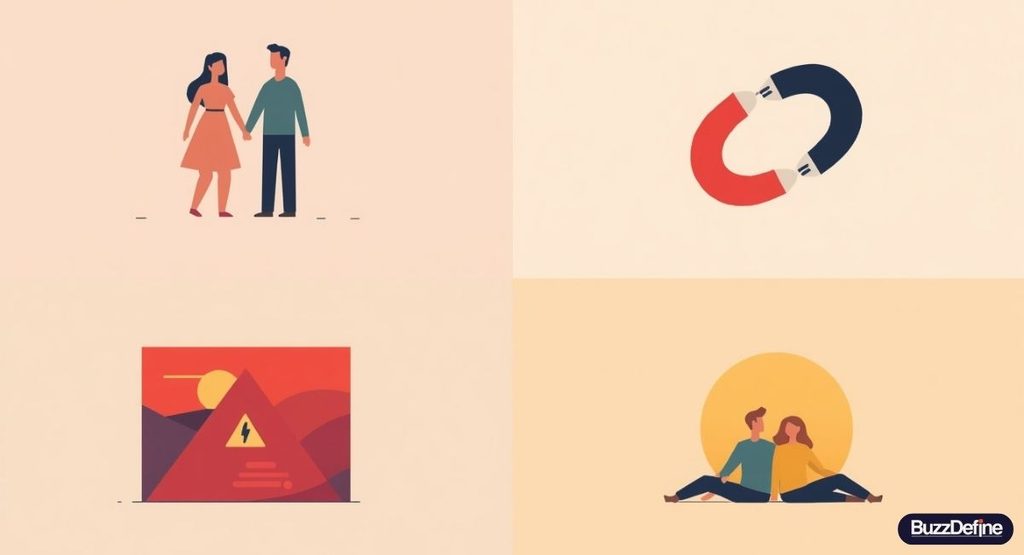
Not all relationship cycles look the same. Some are minor and normal. Others point to something that needs real attention. Here are the main types.
| Type of Cycle | What It Looks Like |
| On again, off again cycle | Breaking up and reconciling repeatedly, often without resolving the original issue |
| Emotional or intimacy cycle | Swinging between periods of closeness and periods of distance |
| Toxic or abusive cycle | A repeating pattern of tension, conflict, and temporary calm, often with harmful behavior involved |
| Honeymoon conflict repair cycle | The natural rhythm many long term relationships and marriages go through over time |
On again, off again cycle
This is the most talked about type. A couple breaks up, feels the sting of being apart, then gets back together, only for the same issue to resurface later. Each round can feel more draining than the last.
Emotional or intimacy cycle
Even happy couples go through phases where they feel more connected, followed by phases where they need space. This is often completely normal and doesn’t signal a problem on its own.
Toxic or abusive cycle
This is more serious. It usually involves a pattern of tension building, an incident happening, a period of calm or apology, and then tension building again. This cycle can be harmful and often needs outside support to break.
Honeymoon conflict repair cycle
Many long term relationships move through a rhythm of excitement, followed by friction as real life sets in, followed by a period of working things out. This cycle, when handled well, can actually strengthen a relationship over time.
Why Do Couples Get Stuck in a Cycle?
Getting stuck in a repeating pattern rarely happens by accident. Usually, there’s something underneath the surface keeping it going.
- Attachment style. How you learned to connect with others early in life shapes how you handle conflict and distance as an adult. Someone with an anxious attachment style might chase reconciliation, while someone avoidant might pull away, and together that push and pull can create a steady cycle.
- Fear of being alone. Sometimes people return to a relationship not because the core issue is resolved, but because being apart feels worse than being in a flawed relationship.
- Low self esteem. If someone doesn’t feel confident they deserve better, they may keep accepting the same pattern instead of setting a boundary against it.
- Unresolved conflict. This is often the biggest driver. If the actual problem never gets addressed, of course it comes back. A breakup or a fight can pause the tension, but it doesn’t erase the cause.
Most cycles keep repeating because the surface level issue gets managed temporarily, while the deeper cause stays untouched.
Signs You’re in a Relationship Cycle
Wondering if this applies to you? Here are common signs to look out for.
- You’ve broken up and gotten back together more than once for the same reason
- The same argument keeps coming up, almost word for word
- You feel a strong pull to reconcile even when you know the issue isn’t fixed
- Things feel great right after making up, but the same tension returns within weeks
- You find yourself predicting exactly how the next fight or breakup will go
- One partner tends to pull away while the other tends to chase, and this dynamic repeats
- You feel more relief than joy after making up, like you just avoided a loss instead of gaining something good
If several of these sound familiar, you’re likely in some form of relationship cycle. That alone isn’t necessarily bad. What matters more is whether the pattern is helping the relationship grow or keeping it stuck.
Is a Relationship Cycle Healthy or Toxic?
This is where a lot of explanations oversimplify things. Not every relationship cycle is a red flag, and not every cycle is fine either. The honest answer sits in the middle.
A cycle tends to be healthy when each round actually resolves something. If a couple goes through tension, talks it through, and comes out with better communication or a clearer boundary, that’s growth, even if it looks repetitive from the outside. Many long term couples move through phases of closeness and distance their whole relationship, and that rhythm is completely normal.
A cycle tends to be toxic when nothing actually changes between rounds. If the same fight, the same breakup, or the same hurtful behavior shows up again with no real resolution, the relationship isn’t growing. It’s just repeating.
A simple way to check which one you’re in is to ask one question. After this cycle repeats, is anything actually different, or does it just feel the same as last time? If the answer is nothing changed, that’s a strong signal the cycle isn’t a healthy one.
How to Break an Unhealthy Relationship Cycle
Breaking a cycle takes more than good intentions. It usually takes a deliberate change in behavior from at least one partner. Here’s how to start.
- Name the pattern out loud. Talk to your partner about the cycle itself, not just the latest fight. Say something like, this is the third time we’ve broken up over the same issue, and mean it as an observation, not an accusation.
- Identify the real trigger. Look past the surface argument and figure out what actually starts the cycle. It’s often something like feeling unheard, feeling controlled, or feeling unimportant.
- Set a boundary instead of repeating the same reaction. If your usual response is to break up or to chase after your partner, try responding differently this time. Small changes in reaction can interrupt a pattern that’s been running on autopilot.
- Address the issue when things are calm, not mid conflict. Cycles often repeat because couples only talk about the problem while emotions are high. Revisit it later, when both people can think clearly.
- Get outside support if the cycle involves harm. If the pattern includes any form of abuse, don’t try to fix it alone. A licensed therapist or counselor can help safely.
- Give it time and consistency. One good conversation won’t erase a pattern built over months or years. Real change usually takes several consistent efforts before the old cycle stops repeating.
Breaking a cycle isn’t about ending the relationship. It’s about making sure the relationship actually moves forward instead of looping in place.
FAQs
What does “cycle” mean in relationship slang?
In casual or texting slang, saying you’re “in a cycle” with someone usually means you keep breaking up and getting back together, or repeating the same emotional pattern with that person.
What is relationship cycling?
Relationship cycling is the pattern of a couple breaking up and reconciling multiple times, often without fully resolving the issue that caused the split in the first place.
Is cycling in a relationship bad?
Not always. It’s only a concern when the same problem keeps repeating with no real resolution. When each round leads to genuine growth or better communication, the cycle can actually be healthy.
Can a relationship cycle be broken?
Yes. It usually requires naming the pattern honestly, identifying the real trigger, and changing at least one person’s usual reaction, sometimes with the help of a therapist.
Is a marriage cycle different from a relationship cycle?
Not fundamentally. A marriage cycle refers to the same idea of repeating phases, often described as honeymoon, friction, and repair, playing out over a long term partnership.
Conclusion
At its core, the cycle meaning in relationship terms comes down to one thing: repetition. Whether it’s breaking up and reconciling, swinging between closeness and distance, or repeating the same argument, a cycle only becomes a problem when nothing actually changes between rounds.
The good news is that cycles aren’t permanent. Once you can name the pattern and understand what’s really driving it, you’re already in a better position to change it, whether that means fixing it together or deciding it’s time to step away for good.

Muhammad Kaleem is the founder and lead writer at BuzzDefine, where he covers internet slang, texting abbreviations, and digital communication trends. He actively follows how language evolves across WhatsApp, Instagram, and TikTok — tracking real conversations, group chats, and comment threads to keep definitions accurate and current. He writes to make modern slang easy to understand for readers of every generation.