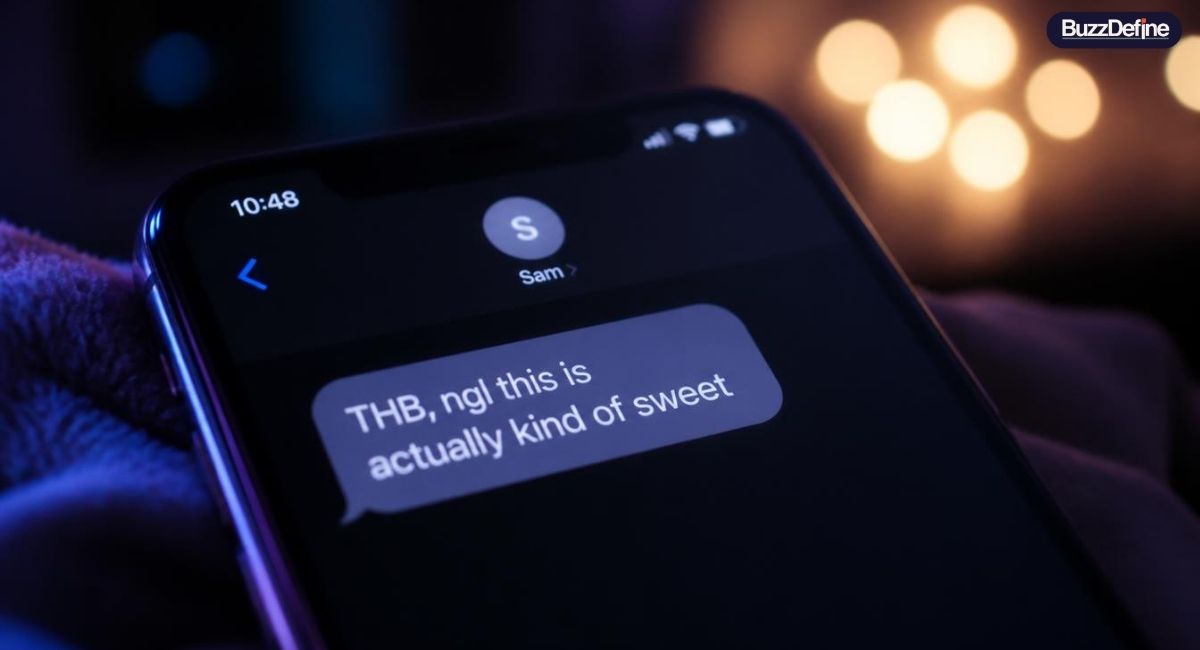
Someone just texted you “thb” and you’re stuck staring at the screen, not sure if that’s a compliment, a confession, or a typo. You’re not overthinking it, this three letter combo genuinely trips people up.
What does “THB” mean in text? Most of the time, it’s shorthand for “To Be Honest,” a quick way of flagging that what comes next is the real, unfiltered truth. But THB isn’t always about honesty.
Depending on where you spot it, those same three letters could point to Thai currency, a medical compound, or even an airport code halfway across the world.
This guide breaks down every meaning, shows you exactly how it’s used across WhatsApp, Instagram, TikTok, and beyond, and clears up the confusion once and for all.
Quick Answer
THB most commonly means “To Be Honest” — it’s used to introduce a candid, unfiltered opinion in casual texting and social media. Outside of slang, THB has three other widely recognized meanings depending on context: Thai Baht (currency), Tetrahydrobiopterin (a medical compound), and an aviation airport code.
| THB Stands For | Category | Where You’ll See It |
| To Be Honest | Internet slang | Texts, Instagram, TikTok, Snapchat |
| Thai Baht | Currency (ISO 4217 code) | Finance, travel, e-commerce pricing |
| Tetrahydrobiopterin | Medical/biochemistry | Clinical research, PKU treatment |
| Thaba-Tseka Airport | Aviation (IATA code) | Flight logs, airport documentation |
If you saw THB in a text from a friend, it almost certainly means “to be honest.” If you saw it next to a number or price, it’s Thai currency. Context is the fastest way to tell them apart.
What Does THB Mean? (Full Breakdown)
THB is a three letter abbreviation that changes meaning based on where you see it. In a text message from a friend, it almost always means “To Be Honest.” In a finance app or travel receipt, it’s Thai Baht. In a research paper, it could be Tetrahydrobiopterin.
Here’s the thing most guides skip: THB isn’t one term with one meaning. It’s three unrelated terms that happen to share the same letters. That’s why context matters more than the letters themselves.
The core breakdown:
- Slang use: “To Be Honest,” a verbal cue that signals sincerity before an opinion
- Financial use: Thailand’s official currency code, same category as USD or EUR
- Medical use: A compound your body produces naturally, tied to brain chemistry
- Aviation use: A code tied to a specific airport, rarely seen outside flight logs
You’ll notice THB behaves less like a fixed word and more like a placeholder that different industries picked up independently. Slang users didn’t borrow it from finance, and finance didn’t borrow it from medicine. Each field arrived at the same three letters on its own.
That’s also why typing “THB” into a search bar gets you wildly different results depending on who’s asking. A teenager googling a text from their crush and an accountant reading an invoice are looking for two completely different answers, even though they typed the same word.
Origin & History of THB/TBH
The abbreviation traces back further than most people expect. Long before smartphones, SMS character limits pushed users to shorten everything. LOL, BRB, and OMG became standard vocabulary on early flip phones and AOL Instant Messenger in the late 1990s and early 2000s.
TBH, the more established spelling, showed up on Urban Dictionary as early as 2003. It stayed a niche term for almost a decade, mostly used in forums and early instant messaging.
The real explosion happened between 2011 and 2013. Tumblr users popularized “TBH posts,” where someone would ask followers to comment “TBH” in exchange for an honest opinion about them. Early Instagram picked up the same trend shortly after, turning it into a genuine social ritual rather than just a texting shortcut.
THB, the flipped version, came later and spread differently. It didn’t emerge from a single cultural moment. Instead, it grew out of typos, autocorrect swaps, and regional texting habits on newer platforms like Snapchat and TikTok. Once enough people started typing it consistently, it stopped being a mistake and became its own recognized variant.
A quick timeline:
| Period | What Happened |
| Late 1990s to early 2000s | SMS abbreviations become mainstream (LOL, BRB, OMG) |
| 2003 | TBH first appears on Urban Dictionary |
| 2011 to 2013 | TBH goes viral through Tumblr and Instagram “TBH posts” |
| Mid 2010s onward | THB spreads as a variant, mostly through typos and TikTok/Snapchat usage |
| 2020s | Both terms coexist, with TBH remaining more universally recognized |
The underlying reason either term caught on says something about digital culture in general. As feeds became more curated and filtered, people wanted a quick way to flag when they were being genuine. THB and TBH became that flag.
THB = To Be Honest (Primary Meaning)
Tone and Usage Psychology
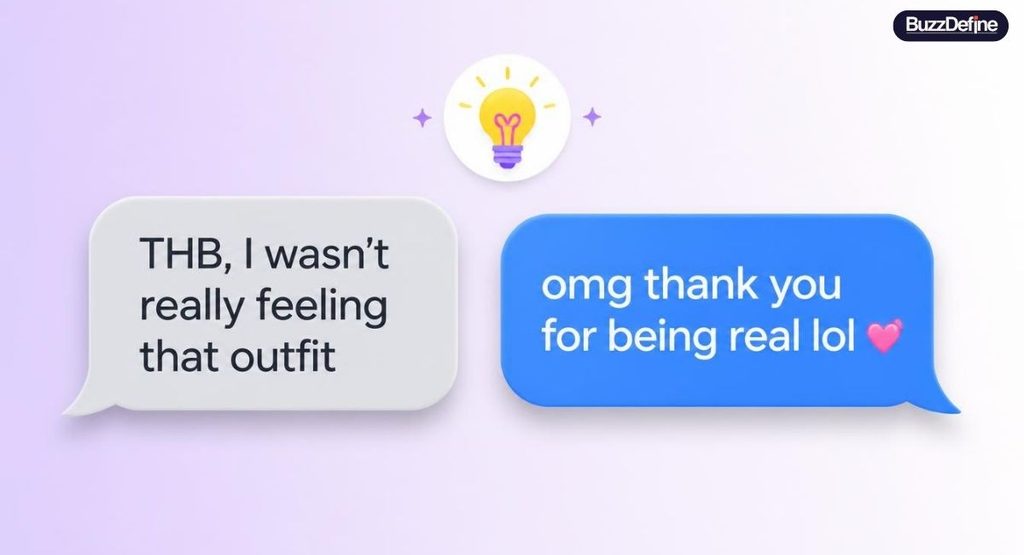
THB works as a social softener. Instead of just stating an opinion outright, which can come across as blunt or confrontational, adding THB in front of it signals intent. You’re telling the other person: what I’m about to say is real, not filtered, and I want you to take it that way.
This matters because tone is notoriously hard to read in text. A flat statement like “your outfit doesn’t work” can read as harsh. The same sentence with THB in front of it reads as vulnerable and direct instead of critical.
There’s also a trust element built into it. When someone uses THB, they’re implicitly asking for the same honesty back. It sets up a small contract: I’m being real with you, so don’t take offense, and feel free to be real with me too.
The tone can shift depending on placement:
- At the start of a sentence, it works as a warning that something honest is coming: “THB, I don’t think that’s a good idea.”
- At the end of a sentence, it works more like a stamp of sincerity after the fact: “That movie was actually pretty boring, THB.”
- As a standalone reply, it can function as agreement or confirmation: “THB.” (meaning, yes, genuinely, that’s how I feel)
Real Examples
Compliment:
Friend: “Did you like my new haircut?” You: “THB, it looks really good on you.”
Criticism, softened:
Friend: “What did you think of the restaurant?” You: “THB, the food was just okay. Wouldn’t rush back.”
Admission:
“THB, I was nervous about texting you first.”
Casual opinion:
“THB, this show got worse after season two.”
Notice the pattern across all four examples. THB doesn’t change what’s being said, it changes how the listener is supposed to receive it. That’s the entire function of the abbreviation in one sentence.
THB on Each Platform
The way THB gets used shifts slightly depending on the platform. The core meaning stays the same, but the context and format change.
On WhatsApp, THB shows up mostly in one on one chats and family or friend group threads. Since WhatsApp conversations tend to be more personal than public social feeds, THB here usually introduces something a little more candid than a public comment would be.
Example:
“THB, I don’t think we should invite him this time.”
Instagram took the concept further than most platforms. Beyond casual comments, Instagram Stories turned THB into an interactive feature. A user might post a sticker or caption saying “Like this for a THB,” then reply privately with an honest take about whoever engaged.
Example:
Story caption: “Comment THB and I’ll tell you what I really think 👀”
This gamified version turned honesty into a form of engagement bait, which is part of why THB spread so fast on the platform.
TikTok
TikTok creators use THB to add credibility in a feed full of polished, edited content. Dropping THB into a caption or comment signals that what follows isn’t performative.
Example:
Caption: “THB, this trend needs to end.”
It also shows up heavily in comment sections, where users respond to videos with quick honest reactions using the tag as a shorthand for “no cap, this is what I actually think.”
Snapchat
Snapchat’s disappearing message format makes THB feel lower stakes. Since nothing sticks around permanently, users feel freer using it for quick, off the cuff honesty about photos or life updates.
Example:
“THB, that photo isn’t your best one lol”
Discord
In Discord servers, THB often shows up during voice chat follow ups or in text channels where members are giving each other feedback, whether that’s about gameplay, art, writing, or general opinions.
Example:
“THB, your last build was way stronger than this one.”
On Reddit, THB tends to appear inside comment threads where someone is asked for a direct opinion, especially in advice focused or hobby focused subreddits.
Example:
“THB, I’d return it. Not worth the price for what you get.”
Across every platform, the underlying job of THB doesn’t change. What shifts is the format: DMs versus public comments, permanent versus disappearing, text based versus video based.
THB vs TBH: Detailed Comparison
These two get confused constantly, and for good reason: they’re built from the exact same four words, just rearranged. Here’s how they actually differ in practice.
| Feature | THB | TBH |
| Full form | To Be Honest | To Be Honest |
| Origin | Grew mostly from typos and newer platform usage | Established since early 2000s, went viral 2011 to 2013 |
| Recognition level | Growing, but still less universal | Widely recognized across all age groups |
| Common platforms | TikTok, Snapchat | Instagram, Twitter/X, Facebook, all platforms generally |
| Formality | Very informal | Very informal |
| Extra meanings | Thai Baht, Tetrahydrobiopterin, aviation code | Rarely carries other meanings |
| Safer choice for broad audiences | No | Yes |
The practical takeaway: if you’re texting someone who might not be familiar with newer slang variants, TBH is the safer, more universally understood choice. THB works fine among younger or more terminally online audiences, but it still occasionally reads as a typo to older users or anyone less immersed in current slang trends.
They are not different in meaning. They’re different in recognition and reach.
Other Meanings of THB
Thai Baht (Finance)
In finance and international trade, THB is the official ISO 4217 currency code for Thailand’s national currency, the baht. It functions exactly like USD, EUR, or GBP: a standardized three letter code used globally in banking, e-commerce, and currency exchange so there’s no ambiguity about which currency is being referenced.
Real world example: A product listed at 1,500 THB on a Thai e-commerce site converts to roughly 41 to 43 USD, depending on the current exchange rate. If you’re booking a hotel in Bangkok and see a price of 3,200 THB per night, that’s about 88 to 92 USD, again fluctuating with the market.
You’ll run into this meaning constantly if you travel to Thailand, shop on Thai retail platforms, or work in any role touching Southeast Asian markets. Currency converters, invoices, and pricing pages will show THB instead of a dollar sign to keep transactions clear across borders.
Tetrahydrobiopterin (Medical)
In biochemistry, THB stands for Tetrahydrobiopterin, a compound your body produces naturally. It acts as a cofactor, meaning it helps enzymes do their job, specifically in producing neurotransmitters like serotonin, dopamine, and norepinephrine. It also plays a role in processing the amino acid phenylalanine and in nitric oxide production, which affects blood vessel function.
Clinical relevance: THB deficiency is directly connected to phenylketonuria (PKU), a genetic condition where the body can’t properly break down phenylalanine. A pharmaceutical version called sapropterin has been approved in the US, EU, Canada, and Japan to treat PKU by supplementing the body’s natural THB levels.
Researchers have also studied its connection to mood regulation and cardiovascular health, though those applications are less established than its role in PKU treatment.
If you’re reading a medical journal, a lab report, or a pharmacology resource, this is almost certainly the meaning intended.
Aviation Code
THB also functions as an IATA airport code, specifically for Thaba Tseka Airport in Lesotho. This usage stays confined almost entirely to flight documentation, airline logs, and travel booking systems. You won’t encounter this meaning in everyday conversation unless you work in aviation or are booking a very specific flight route.
Physics and Technical Shorthand
Unlike the other meanings, THB doesn’t have a standardized definition in physics or general technical fields. Occasionally it shows up as a label inside a specific research paper, project code, or internal notation system, but it’s not tied to a universal formula or concept the way, say, “Hz” or “kg” would be.
If you see THB in a technical document, the meaning is almost always defined locally within that specific paper or project rather than being industry standard.
Urban Dictionary and Alternate Slang Meanings
Here’s a layer most guides skip entirely: Urban Dictionary hosts several unofficial, community submitted definitions of THB that circulate in specific pockets of internet culture.
These aren’t mainstream, and you’re unlikely to encounter them outside niche group chats or inside jokes, but they exist and occasionally cause confusion:
- One entry defines THB as shorthand for a flirtatious dare between friends, often used in a joking, lighthearted context around someone attractive nearby.
- Another defines it as a description of someone perceived as conventionally attractive, functioning almost like a compliment tag.
- A third defines it as a state of being, combining three unrelated moods into one exhausted sounding acronym.
- A fourth is hyper specific to one online community, referencing the typical behavior pattern of a particular named individual, essentially an inside joke that spread slightly beyond its original group.
None of these carry anywhere near the reach of “To Be Honest,” and you’ll rarely see them outside very specific, very casual friend group contexts.
They’re worth knowing about mainly so you’re not caught off guard if a friend uses THB in a way that clearly doesn’t mean “to be honest” or “Thai Baht.”
When that happens, it’s almost always a private joke specific to that friend group rather than a term you need to memorize.
THB in Professional and Workplace Chats
THB doesn’t belong in formal business writing, emails, reports, or anything client facing. It reads as too casual and can come across as unprofessional in contexts where clarity and polish matter.
That said, informal internal messaging is a different story. Slack channels, internal Teams chats, and casual workplace group threads often blur the line between personal and professional communication, especially among younger employees or in more relaxed company cultures.
When it’s generally fine:
- Casual banter in a team specific Slack channel with people you’re close with
- Quick informal feedback among peers at the same level (“THB, I think we should scrap this draft and start over”)
- Internal chats where the company culture already leans informal
When to avoid it:
- Any message involving clients, vendors, or external partners
- Communication with senior leadership you don’t have a casual relationship with
- Formal documentation, performance reviews, or anything that could be referenced later
- Emails, regardless of how casual the relationship is
A simple rule of thumb: if you wouldn’t use “lol” or an emoji in that same message, don’t use THB either. Match the formality level of the channel and the relationship, not just your personal texting habits.
THB in Dating Apps
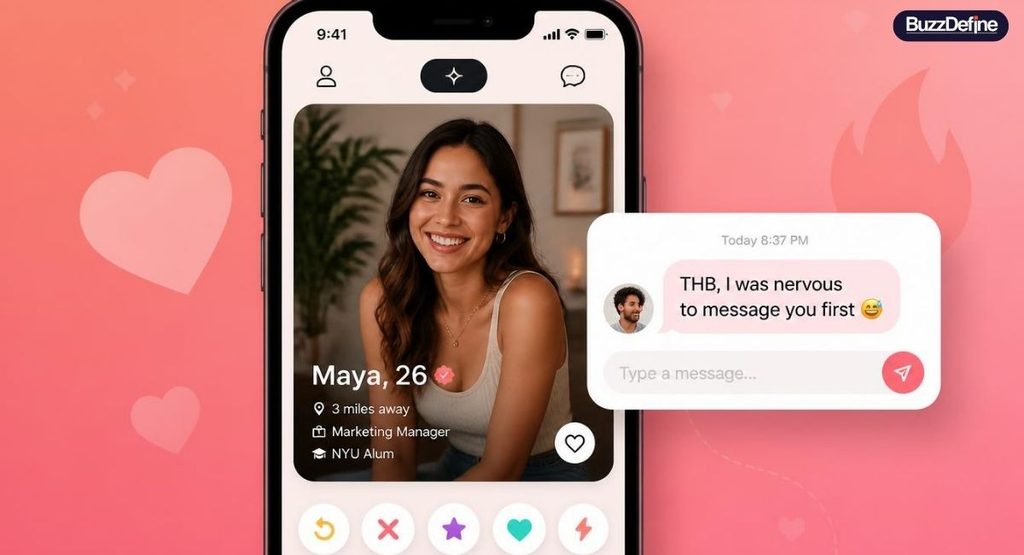
On dating apps like Tinder, Hinge, and Bumble, honesty carries more weight than it does in most other contexts, since both people are essentially strangers trying to build trust quickly. THB gets used to signal vulnerability without sounding overly intense or heavy for an early conversation.
Common examples:
- “THB, I was nervous to message you first.”
- “THB, your profile is one of the more genuine ones I’ve seen on here.”
- “I’m not really a big party person, THB.”
Green Flag Signs
Generally, when someone uses THB early in a conversation, it’s a positive signal. It usually means they’re trying to move past small talk and build a real connection rather than sticking to generic opening lines. People who default to honesty this early tend to be more interested in substance than in playing games.
Potential Red Flag Signs
Context still matters. If THB shows up attached to something that feels manipulative, like pressuring you into meeting up faster than you’re comfortable with, or if it’s used to soften an insult disguised as “honesty,” that’s worth paying attention to.
The phrase itself is neutral. What follows it is what actually determines whether it’s a good sign or a concerning one.
In broader online communities, not just dating apps, THB also gets used to build trust in deeper conversations.
Something like “THB, I’ve been struggling lately” inside a Discord server or a close friend group chat is typically read as an invitation for real support, and most communities respond to that kind of openness in kind.
Common Misconceptions
“THB and TBH mean different things.” Not true. Both stand for “To Be Honest.” The only real difference is which one is more widely recognized. TBH is the more established, universally understood version.
“THB always signals something negative or critical.” Also not true. THB gets used just as often for compliments as it does for criticism. “THB, you looked amazing at that event” is a completely normal use of the term.
“THB is only used in texting.” It crosses into finance (Thai Baht) and medicine (Tetrahydrobiopterin) as well, so the surrounding context always determines which meaning applies.
“THB only shows up on one specific platform.” It’s platform agnostic. You’ll see it on WhatsApp, Instagram, TikTok, Snapchat, Discord, Reddit, and beyond.
“Using THB automatically makes a message sound genuine.” Not necessarily. THB signals intent, but it doesn’t guarantee sincerity on its own. Plenty of people use it as a verbal habit rather than an actual marker of unfiltered honesty. Context and tone still matter more than the abbreviation itself.
Similar Terms and Alternatives to THB
If you want to express the same kind of directness THB conveys, several other abbreviations serve a similar function, each with a slightly different tone.
| Term | Meaning | Tone |
| TBH | To Be Honest | Casual, widely recognized |
| NGL | Not Gonna Lie | Raw, often more emotional |
| IMO | In My Opinion | Neutral, slightly more formal |
| IMHO | In My Humble Opinion | Polite, softened |
| FR / FR FR | For Real | Emphatic, very casual |
| LOWKEY | Quietly or secretly | Understated, subtle honesty |
| FYI | For Your Information | Informational, neutral (not opinion based) |
| HONESTLY | To Be Honest, spelled out | Works everywhere, no slang risk |
How they differ in practice:
NGL tends to carry more emotional charge than THB, often used right before admitting something slightly embarrassing or vulnerable. IMO and IMHO sound more measured and are safer for slightly more formal casual settings, like a work adjacent group chat.
FR is less about honesty and more about emphasis, confirming that something is genuinely true rather than exaggerated. THB and TBH sit right in the middle of this spectrum: direct, but not as raw as NGL and not as formal sounding as IMO.
How to Respond to THB
How you respond depends heavily on the context and who’s saying it.
In a personal or casual chat:
- Acknowledge it directly: “Appreciate you being real with me.”
- Match the energy: “THB, I felt the same way.”
- Ask a follow up if you want more detail: “What specifically didn’t work for you?”
In a group chat or public comment section:
- Keep your reply light if the original topic was casual and low stakes.
- If the honesty is aimed directly at you personally, it’s fine to take a beat before responding rather than reacting instantly.
When THB is used for a compliment:
- A simple, genuine thank you works best. Overexplaining or deflecting a compliment tends to undercut the moment.
When THB is used for criticism:
- Avoid getting defensive right away. Ask a clarifying question first: “Can you tell me more about what you meant?” This usually leads to a more productive conversation than reacting immediately.
In a finance context (Thai Baht):
- Respond factually and move on: “Thanks, noted. I’ll convert that from THB to USD before sending payment.”
In a medical or scientific context:
- Follow standard academic or clinical response conventions. THB here refers to a specific compound, not a conversational cue, so there’s no “tone” to manage.
Pronunciation and Usage Tips
Most people don’t say THB out loud as a word. Instead, it’s typically read letter by letter: T H B. You won’t hear anyone say it as a single blended sound the way some acronyms get pronounced (like “lol” sometimes gets said as “lawl”).
A few practical usage tips:
- Case doesn’t matter. You’ll see it written as “THB,” “thb,” or “Thb” interchangeably. Lowercase tends to appear more in relaxed, one on one chats, while uppercase shows up more often in captions and comments.
- Placement is flexible. It works at the start of a sentence, the end, or as a standalone reply, and the meaning stays consistent across all three.
- Don’t overuse it. Dropping THB into every other message dilutes its impact. It works best when it’s reserved for moments where you actually want to flag something as more direct or sincere than usual.
- When in doubt, spell it out. If you’re messaging someone unfamiliar with slang, especially in a professional adjacent setting, “honestly” or “to be honest” communicates the same thing without any risk of confusion.
Frequently Asked Questions
What does THB mean in text?
THB stands for “To Be Honest.” It’s used to introduce a candid or direct statement in casual digital conversations.
Is THB the same as TBH?
Yes. Both stand for “To Be Honest.” TBH is more widely recognized and has been around longer, while THB is a common variant that gained traction on newer platforms.
What does THB mean in finance?
THB is the ISO 4217 currency code for the Thai Baht, Thailand’s official currency, used in international trade, banking, and pricing.
What does THB mean in medicine?
In biochemistry, THB stands for Tetrahydrobiopterin, a compound that acts as a cofactor in neurotransmitter production and is clinically relevant to treating phenylketonuria (PKU).
What does THB mean on TikTok?
On TikTok, THB means “To Be Honest,” commonly used in captions and comments to signal an authentic, unfiltered opinion.
What does THB mean on Instagram?
On Instagram, THB means “To Be Honest” and frequently appears in Stories, DMs, and interactive posts like “Comment THB for an honest opinion.”
Is THB positive or negative?
Neither by default. THB is a neutral opener. It gets used just as often for compliments as it does for criticism, depending entirely on what follows it.
Should I use THB in professional emails?
No. THB is informal slang and isn’t appropriate for formal or client facing written communication. It’s better suited for casual internal chats among peers.
Does THB have any other meanings besides “To Be Honest”?
Yes. Depending on context, THB can also mean Thai Baht (currency), Tetrahydrobiopterin (a medical compound), or an aviation airport code for Thaba Tseka Airport in Lesotho.
Conclusion
THB carries more weight than its three letters suggest. In a text from a friend, it’s a small signal that something honest is coming next. In a price tag or invoice, it’s Thailand’s currency. In a research paper, it’s a compound tied to brain chemistry and a rare genetic condition.
The fastest way to decode it is always context. A message from a friend almost certainly means “To Be Honest.” A number attached to it points to Thai Baht. A clinical or scientific setting points to Tetrahydrobiopterin. Once you know the three main lanes THB travels in, you’ll never second guess it again.

Muhammad Kaleem is the founder and lead writer at BuzzDefine, where he covers internet slang, texting abbreviations, and digital communication trends. He actively follows how language evolves across WhatsApp, Instagram, and TikTok — tracking real conversations, group chats, and comment threads to keep definitions accurate and current. He writes to make modern slang easy to understand for readers of every generation.