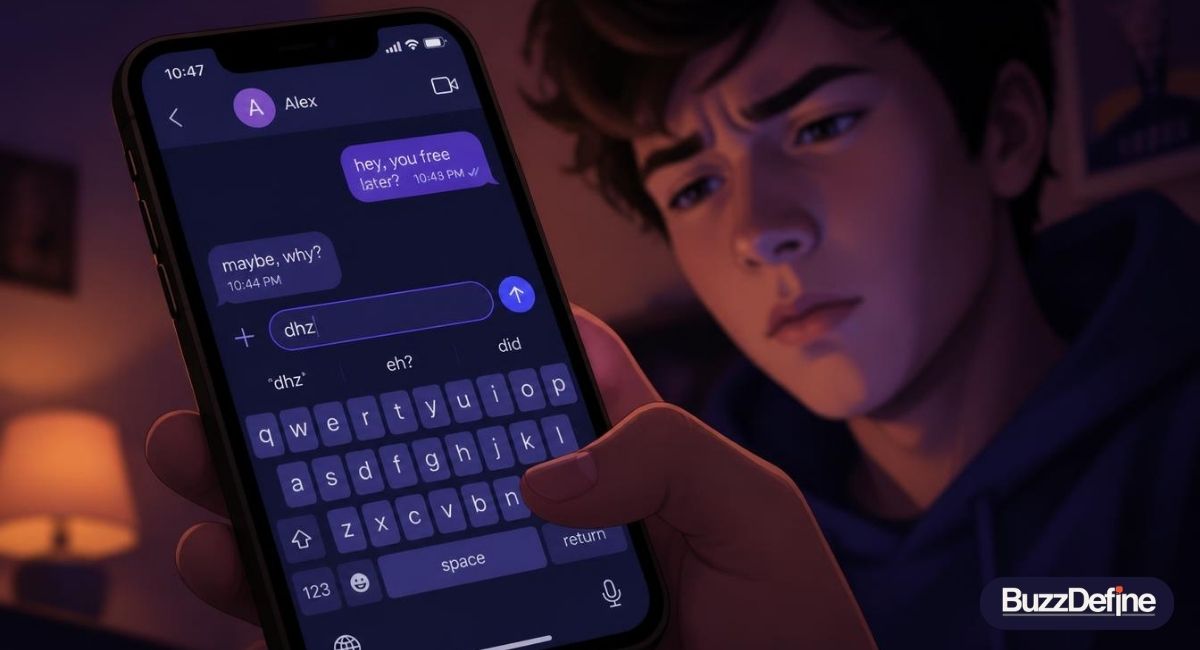
Quick Answer: DHZ most often means “Dead Homies,” slang from West Coast hip-hop culture used to swear at people who’ve passed. But it isn’t locked to one meaning, depending on the app or who’s texting you, DHZ can also mean “Don’t Hate Zone,” a kHz typo, or just meaningless filler.
That’s the short version. Here’s why nobody online can seem to agree on it, and how to actually figure out which one someone means.
Why Every Website Gives a Different Answer
Type “DHZ meaning” into Google and you’ll get at least six different answers: “Dead Homies,” “Don’t Hate Zone,” “Don’t Hold Zest,” “Dead Hard Zoom,” “Don’t Have a Clue,” even a claim that it’s just a typo for kHz. None of these sites are lying exactly. They’re just describing different corners of the internet.
Here’s the actual reason. DHZ was never coined by one person or one community with a single agreed definition, the way “LOL” or “BRB” were. Three random letters like D, H, and Z get picked up independently by completely unrelated groups, each one filling the gap with whatever phrase fits their own slang habits.
A gamer in a Discord server, a teenager on TikTok, and someone fat fingering “kHz” in a tech forum can all type the exact same three letters and mean three unrelated things. There’s also no dictionary, no governing body, and no verified original source tracking how DHZ actually spread.
Unlike acronyms that come from a specific show, meme, or influencer moment that’s easy to trace, DHZ seems to have grown quietly across group chats and comment sections, which means every site writing about it is reconstructing the meaning after the fact instead of reporting a confirmed origin.
So which one is right? Based on how widely and consistently it’s reported across slang references, one meaning shows up more often and with more specific backstory than the rest. That’s the one worth starting with.
Most Likely / Most Sourced Meaning: “Dead Homies”
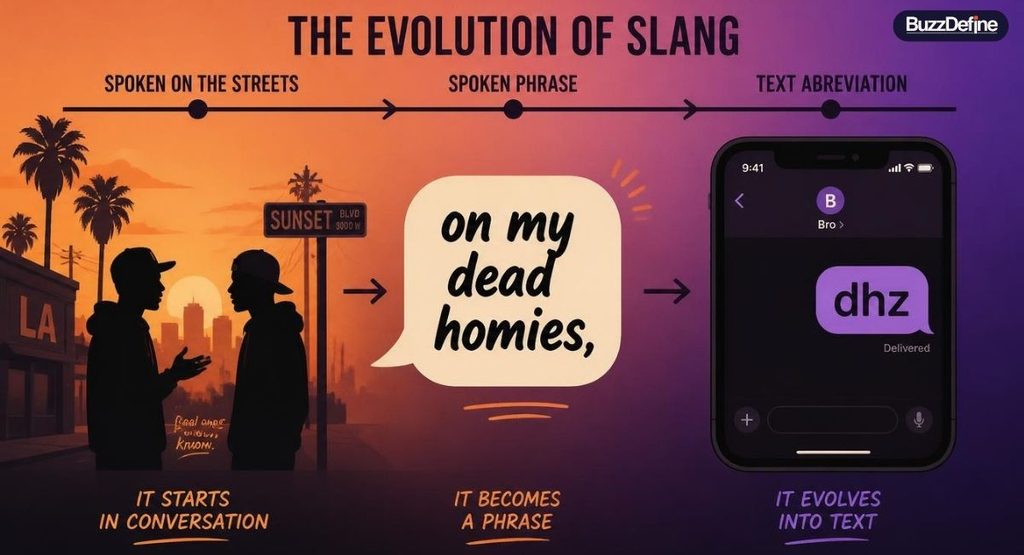
The version with the most consistent backstory across slang references ties DHZ to “Dead Homies,” short for the phrase “on my dead homies.” It’s an oath, a way of swearing something is true by invoking people who’ve passed away, similar in function to saying “I swear on my life.”
This usage is commonly traced back to West Coast street and hip hop culture, particularly around Los Angeles. Swearing on deceased loved ones or friends as a way to back up a statement has deep roots in that culture, and shortening the phrase to a fast, typeable acronym fits how slang naturally compresses over time as it moves from spoken language into texting.
The connection some sources draw to a 1993 film about gang life adds cultural context for why the phrase existed at all, though that specific link is repeated across slang sites rather than independently confirmed, so it’s worth treating as commonly cited background rather than a verified fact.
How the meaning likely evolved:
| Period | What Was Happening |
| Early 1990s | “On my dead homies” used as a spoken oath in West Coast street culture, a way to swear something is true |
| Late 1990s to 2000s | Phrase gets referenced in hip hop lyrics and regional slang, staying mostly within that community |
| 2010s | Texting culture shortens the phrase to DHZ, and it starts appearing outside its original context as social media spreads regional slang faster |
| 2020s | DHZ shows up more loosely online, sometimes still as an oath, sometimes just as a regional identity marker or intensifier that’s lost its literal meaning |
In its original sense, “dhz” works as emphasis. “That fight was crazy, dhz” reads like “I swear that’s true,” not unlike how people say “no cap” today. But like a lot of slang that travels far from its origin, plenty of people now type it without knowing (or caring) what it originally stood for, which is exactly why the other meanings below keep showing up too.
All Other Possible Meanings (Comparison Table)
Because DHZ isn’t standardized, different corners of the internet have landed on their own expansions. None of these are wrong exactly, they’re just what specific communities or writers have attached to the letters. Here’s every version currently in circulation, side by side.
| Claimed Meaning | Typical Context | How Common |
| Dead Homies | Oath/emphasis, West Coast slang origin | Most consistently cited, backed by a specific cultural origin story |
| Don’t Hate Zone | Requesting a judgment free space before sharing something personal | Fairly detailed usage pattern, mostly self reported by one source |
| Don’t Hold Zest | Telling someone not to overthink or stress | Appears on a small number of slang sites, thin supporting detail |
| Dead Hard Zoom / Dead Heat Zone | Intense focus (gaming) or a tied, high pressure moment | Niche, mostly gaming and Discord communities |
| Don’t Have a Clue | Quick way of saying “I don’t know” | Simple, plausible as a keyboard shortcut, limited sourcing |
| Don’t Hate, Just Zone | Encouraging someone to stay calm instead of judging | Overlaps heavily with “Don’t Hate Zone” |
| Designated Hazard Zone | Safety or engineering documentation | Formal/technical, rarely seen in actual texting |
| kHz typo | Frequency unit (kilohertz) mistyped | Common explanation in technical and physics contexts |
| No fixed meaning | Pure context dependent filler or inside joke | The most cautious take, and arguably the most honest one |
The honest takeaway: if someone sends you “dhz” with zero context, there’s no way to know for certain which one they mean. The safest move is always to read the rest of the message, or just ask.
DHZ Meaning by Platform
DHZ doesn’t behave the same way on every app. The tone of each platform shapes which meaning is more likely to show up.
Snapchat
Snapchat streaks and quick replies lean casual, and DHZ here usually functions as filler or a vague “whatever, it’s fine” response rather than a specific claim.
Example: “You still coming to the party tonight?” “dhz, we’ll see.”
On Instagram, DHZ shows up most in captions and comment replies, often as a tone setter before someone shares an opinion or a personal thought, closer to the “Don’t Hate Zone” usage than a literal translation.
Example caption: “dhz but I actually think the remake was better than the original 😭”
TikTok
TikTok comments treat DHZ as meme style shorthand, added more for rhythm and vibe than for a literal meaning. It often appears in reaction comments under emotional or relatable videos.
Example comment: “dhz this video got me in my feelings fr”
WhatsApp usage skews toward closer, more private conversations, where DHZ is more likely to carry an inside joke meaning specific to that friend group or family chat, since it’s rarely a stranger sending it.
Discord
In gaming servers, DHZ shows up attached to usernames, clan tags, or as shorthand tied to being “locked in” during a match, closer to the gaming specific meanings than the emotional ones.
Example: “dhz mode activated, muting everyone until this round’s over”
X (Twitter)
On X, DHZ tends to appear in fast, casual replies and quote tweets, functioning as a tone marker (usually signaling “don’t come at me for this opinion”) rather than a fixed definition.
DHZ Meaning From a Girl / In Flirting Context
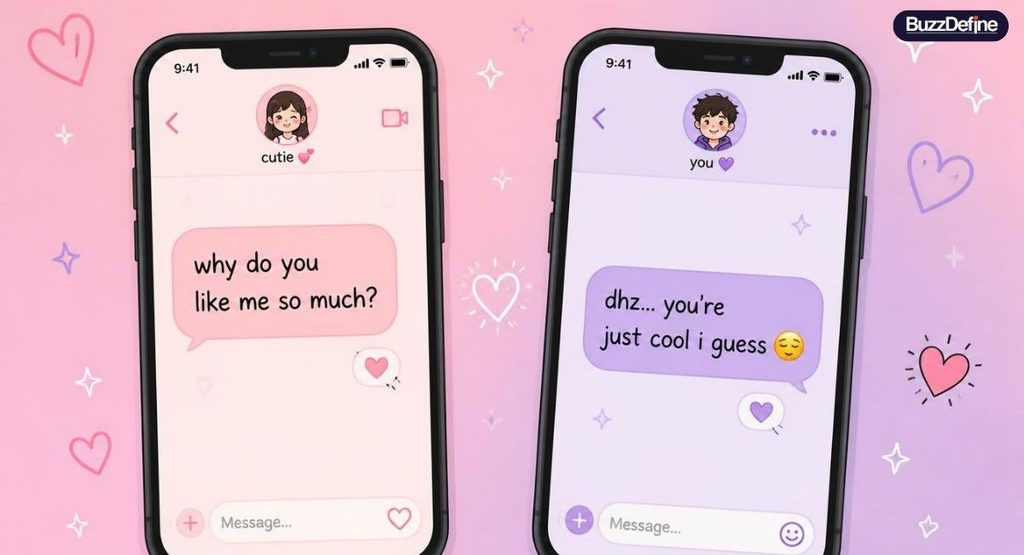
When DHZ shows up in a flirty or romantic text exchange, it’s almost never meant literally, whichever expansion you go with. In this context, it usually works as a soft, low pressure way of keeping things playful without committing to a clear answer.
Example: “Why do you like me so much?” “dhz… you’re just cool I guess 😌”
Here, DHZ isn’t really answering the question. It’s deflecting with charm, similar to saying “I don’t know, I just do” in a way that feels teasing rather than dismissive.
If a girl (or anyone) sends DHZ in a conversation that already has flirty energy, reading it as “I’m being playful, don’t push for a serious answer right now” is usually more accurate than trying to decode a literal meaning.
It’s also common as a response to a compliment or a slightly loaded question, where a straight answer would feel too intense for the moment. Responding with equal playfulness rather than demanding clarification usually keeps the tone intact.
DHZ Meaning in Gaming/Technical/Physics Context
Outside of texting slang entirely, DHZ shows up in a few technical corners, almost always by accident.
The most common technical explanation is a simple typo. kHz, the abbreviation for kilohertz, a unit that measures frequency, gets mistyped as DHZ fairly often because the K and D keys sit close together on a standard keyboard layout, especially when typing fast.
You’ll see this in electronics forums, audio equipment reviews, or engineering notes where someone meant to type a frequency value and the letters got scrambled.
In gaming communities, DHZ occasionally functions as a clan tag fragment or a private team label rather than an expansion of anything, similar to how gaming tags often use random letter combinations that only make sense to the people using them.
In professional or safety documentation, if DHZ appears at all, it’s more likely a facility specific internal code or, again, a typo, rather than a recognized industry term. There’s no standardized professional or scientific definition tied to those three letters.
Related Slang Cluster
DHZ doesn’t exist in isolation. A handful of similar looking or similarly used abbreviations show up in the same conversations, and knowing the difference helps avoid mixing them up.
| Term | Meaning | How It Differs From DHZ |
| DHMZ | Usually a typo or stylized variation, sometimes read as “don’t hurt me” | Even less standardized than DHZ, almost always context dependent |
| DHS | Department of Homeland Security in formal contexts, occasionally joking slang elsewhere | Has one dominant, widely recognized formal meaning, unlike DHZ |
| DHO | Slang term that can carry an offensive connotation depending on context | Different tone entirely, worth reading the full message before assuming intent |
None of these are interchangeable with DHZ, but they tend to get typed by similar audiences (fast texters, group chats, gaming servers), which is part of why they show up in the same searches.
Emoji Usage with DHZ
Emojis attached to DHZ usually do more work than the letters themselves, since they signal the tone the sender actually means.
DHZ 😂 Used when the message is a joke or a lighthearted exaggeration, closer to the meme or filler usage than any literal claim.
DHZ 💀 Signals something shocking, dramatic, or “I can’t believe this happened,” often paired with the “dead homies” style emphasis.
DHZ 🥺 Suggests sincerity or emotional weight, more likely to show up alongside the “Don’t Hate Zone” style usage before someone shares something personal.
DHZ 🔥 Common in gaming or hype contexts, closer to “I’m locked in” or celebrating an intense moment.
Reading the emoji next to DHZ is often a faster way to guess the intended tone than trying to decode the letters on their own.
Real Examples (Chat, Social Media, Dating App)
In a chat:
Friend 1: “Are you actually mad at me or nah?”
Friend 2: “nah dhz, I was just tired earlier”
Here DHZ reads like a shrug, softening the reply and signaling “don’t read too much into it.”
On social media:
Comment under a controversial post: “dhz but I don’t think that take was that deep”
This usage sets a tone before disagreeing, asking readers not to escalate the reply.
On a dating app:
“Haven’t figured out what I’m looking for yet, dhz”
Used here to keep the message casual and low pressure, avoiding a fully serious answer to a fully serious question.
How to Respond to DHZ
The simplest approach is matching the tone, not the letters. If the message feels playful, reply playfully. If it feels like it’s carrying real weight (especially in a “Don’t Hate Zone” style message before something personal), lead with reassurance instead of jumping straight to a reaction.
If you genuinely can’t tell what someone means, just ask. Something like “wait what do you mean by that” works fine, since DHZ isn’t universally understood even by people who use texting slang regularly. Most people won’t be bothered by the question, and guessing wrong is usually worse than asking.
Common Misconceptions
A few assumptions about DHZ show up constantly and are worth clearing up directly.
It’s not an officially recognized abbreviation the way “ASAP” or “FYI” are, so there’s no single dictionary definition to point to.
It’s not automatically offensive, though tone and context can shift how a specific use lands.
It’s not tied to one brand, show, or influencer moment that explains its spread. And it’s not always intentional, plenty of instances really are just typos, particularly the kHz mix up in technical writing.
Treating any single claimed meaning as the universally correct one is the biggest misconception of all. Context does more work here than the letters themselves.
Quick Quiz: Do You Know Your DHZ?
1. Someone texts “dhz but I actually cried during that movie 😭” What’s the most likely tone?
A) They’re stating a fact with zero emotion
B) They’re being playfully vulnerable and asking you not to judge
C) They mistyped kHz
Answer: B
2. In a Discord gaming server, “dhz mode on” most likely means:
A) A request for a judgment free zone
B) Intense focus or being locked in
C) A frequency measurement
Answer: B
3. Which explanation is most likely if DHZ shows up in an engineering document?
A) An inside joke
B) A typo for kHz
C) Dating app slang
Answer: B
FAQ Section
What does DHZ mean in text?
DHZ doesn’t have one official meaning. The most commonly cited version ties it to “Dead Homies,” a West Coast slang oath, but it also shows up as “Don’t Hate Zone,” gaming shorthand, or simply a kHz typo depending on the conversation.
Is DHZ a real abbreviation?
Not officially. There’s no dictionary or standards body behind it. It functions more like informal, community driven slang than a recognized acronym.
What does DHZ mean from a girl?
In a flirty or casual exchange, DHZ usually isn’t literal. It works as a playful, low pressure way to avoid giving a fully serious answer.
Is DHZ Cali slang?
The most sourced origin points to West Coast, specifically Los Angeles, street and hip hop culture, tied to the phrase “on my dead homies.”
What does DHZ mean on Snapchat?
On Snapchat, it’s mostly casual filler, similar to saying “lol” without literally laughing.
DHZ vs DHMZ, what’s the difference?
DHMZ is generally read as a typo or stylized variation, sometimes standing in for “don’t hurt me.” It’s less standardized than DHZ and even more context dependent.
Can DHZ be used in professional messages?
It’s too casual and ambiguous for formal or workplace communication. If it appears in professional documents, it’s almost always accidental.
Is DHZ a typo?
Sometimes. It’s a documented typo for kHz in technical contexts, though in casual texting it’s more often intentional slang.
Does DHZ mean the same thing on every platform?
No. The tone shifts depending on the app, from filler on Snapchat to focus mode in gaming servers to a more emotional tone setter on Instagram.
Conclusion
DHZ isn’t a term with one clean answer, and pretending otherwise is exactly why so many articles about it contradict each other. The version with the most consistent backstory ties it to “Dead Homies” and West Coast slang, but “Don’t Hate Zone,” gaming shorthand, and the kHz typo all show up often enough to matter too.
The real skill here isn’t memorizing one definition, it’s reading the platform, the tone, and the person sending it. Next time DHZ shows up in your messages, you’ll actually know how to figure out which version you’re looking at instead of guessing.
Related Reads: LCR Mean in Text | DC Mean in Text| More Texting Abbreviations Explained

Muhammad Kaleem is the founder and lead writer at BuzzDefine, where he covers internet slang, texting abbreviations, and digital communication trends. He actively follows how language evolves across WhatsApp, Instagram, and TikTok — tracking real conversations, group chats, and comment threads to keep definitions accurate and current. He writes to make modern slang easy to understand for readers of every generation.