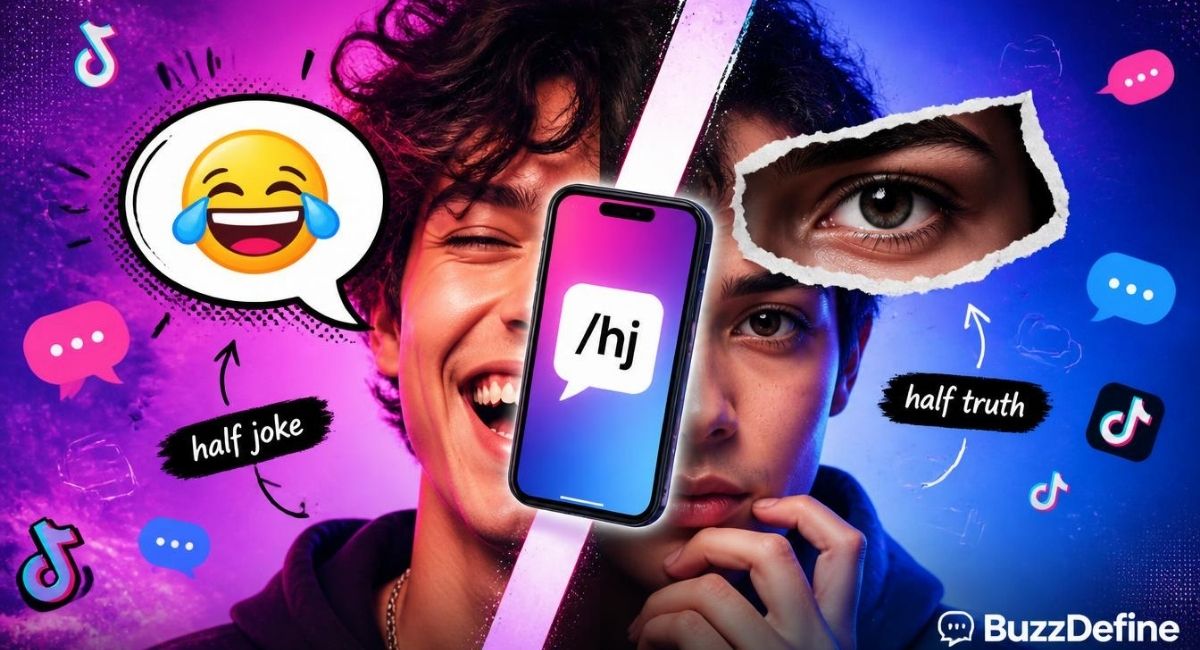
HJ meaning in text is simple once you know what to look for, but it trips a lot of people up the first time they see it. Your friend texts you: “I might drop out /hj.” You stare at it for a second. Joke? Not a joke? Somewhere in between?
That’s exactly what /hj is for. It’s a tone indicator, a small tag people add to a message so you know how to read it. In texting, HJ (usually written /hj) means half joking.
It shows up in TikTok comments, Discord messages, group chats, and casual conversations across social media, especially in Gen Z online communities that care about getting tone right in instant messaging.
This guide covers what HJ actually means, where the slash comes from, every other meaning the abbreviation carries, and how to use, or reply to, it the right way.
What Does HJ Mean in Text?
HJ means half joking. It’s a texting abbreviation that tells the other person a message is part joke, part serious.
Why It’s Written /hj, Not HJ
Online, HJ is almost always written with a slash: /hj. That’s not random formatting, it follows the same style as /s (sarcasm), one of the earliest tone indicators used online.
The slash marks it as a tone tag, not a regular word or abbreviation. Drop the slash, and HJ can mean something else entirely (more on that below).
What “Half Joking” Actually Signals
“Half joking” means exactly what it sounds like: the statement isn’t a full joke, and it isn’t fully serious either.
It sits in the middle, playful on the surface, with some real feeling or intent underneath. Someone adds /hj when they want to say something true without sounding too heavy about it.
HJ vs /hj: Is There a Difference?
Yes, and it matters. HJ without a slash and /hj with a slash don’t always mean the same thing.
When you see /hj at the end of a message, it’s a tone indicator. It’s telling you the sentence right before it is half joking. That’s the case almost every time you spot it online.
Bare HJ, sitting in the middle of a sentence or written on its own, doesn’t work the same way. It’s more likely to be an initial, a name, or one of the other meanings covered in the disambiguation table below. Context decides which one you’re looking at, but the slash is your first clue.
If you only remember one rule, remember this: /hj at the end of a message means half joking. HJ without the slash could be something else entirely.
All Meanings of HJ (Disambiguation Table)
HJ isn’t a one meaning word. Depending on where you see it, it can point to five different things.
| Meaning | Context | How common |
| Half joking (/hj) | Texting, tone indicator | Most common online |
| Adult slang term | Referenced neutrally here, no graphic detail | Appears in some UGC dictionaries |
| Hic jacet, “here lies” | Latin, formal or gravestone use. This is Merriam Webster’s only listed meaning | Formal, rare |
| Highway Junction | Maps, UK transport | Technical |
| Initials or names | Personal names, fandom contexts | Contextual |
The slash is the tell. If it’s there, it’s almost always the tone indicator.
Most people searching for HJ have already seen it somewhere and want to know which meaning fits their situation. That’s why context matters more than the letters themselves.
A text from a friend, a comment on TikTok, or a caption almost always points to half joking. A dictionary entry, a road sign, or a historical text points somewhere else entirely.
If you’re still unsure after checking the context, the safest move is simple: ask the person what they meant. Slang shifts fast, and even close friends read tone differently.
Where You’ll See /hj Used (Platform by Platform)
/hj shows up differently depending on where you’re texting. Here’s what it looks like on each platform.
TikTok
On TikTok, /hj mostly appears in comments and captions, right where a joke could easily be read as a genuine complaint or a genuine compliment. A comment like “you post way too much and I love it /hj” reads as playful, not passive aggressive, once the tag is there.
Discord
Discord is where /hj feels most at home. Servers built around fandoms, gaming, or neurodivergent communities use tone tags constantly, since text only chat leaves a lot of room for misreading someone’s intent. A typical message: “I will fight you over this ship /hj.”
Twitter/X
On Twitter/X, /hj softens takes that could otherwise start an argument. Something like “this show peaked in season one /hj” tells followers you mean it, but you’re not looking for a fight.
Snapchat and Instagram DMs
In one on one chats on Snapchat or Instagram, /hj usually shows up between friends who already know each other’s humor. A message like “you better text me back this time /hj” reads as a nudge, not a threat.
Gaming and Roblox chats
In gaming chats, especially on Roblox and similar platforms, /hj softens competitive trash talk. “You always throw the last round /hj” keeps the mood light while still making the point.
Across every platform, the pattern stays the same. The joke carries the message, and the /hj carries the honesty underneath it.
Real Examples of /hj in Conversation
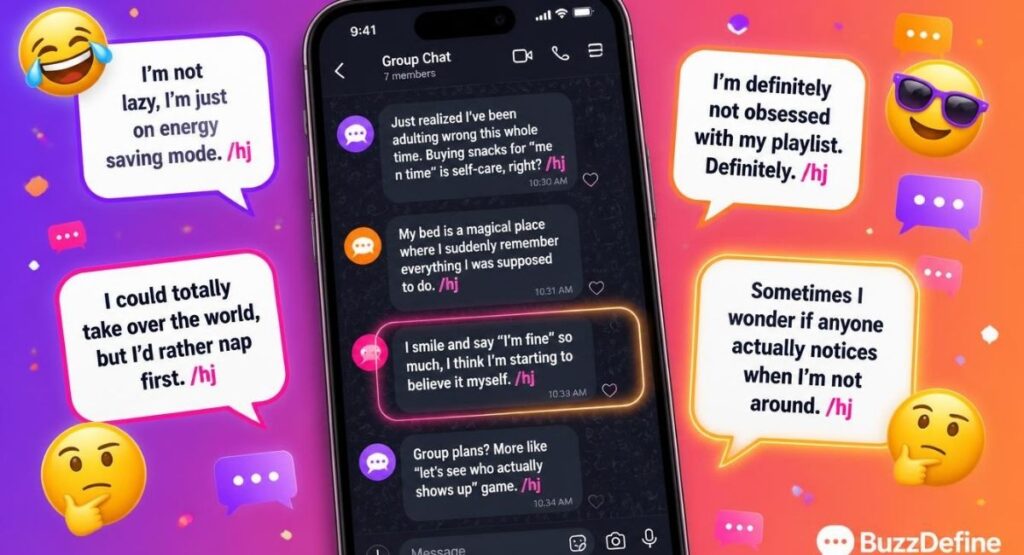
Seeing /hj in action makes the meaning click faster than any definition. Here are some real style examples, each with what the sender is actually saying underneath the joke.
- “If I get one more assignment I’m becoming a boat captain /hj” What it actually means: the stress about the workload is real. The boat captain plan is the joke.
- “I hate this update /hj” What it actually means: the irritation is real. “Hate” is the exaggerated part.
- “I might actually cry if it rains on the trip /hj” What it actually means: they really care about the weather being good. “Cry” is the exaggeration.
- “You’re lucky I love you /hj” What it actually means: mild annoyance, wrapped in affection.
- “I’m never speaking to you again /hj” What it actually means: they’re a little upset, not actually cutting contact.
- “This is the best thing that’s happened to me all year /hj” What it actually means: genuinely excited, but keeping it casual instead of sounding too intense.
- “I will absolutely fight you over this /hj” What it actually means: a strong opinion, said playfully instead of aggressively.
- “I’m dropping out /hj” What it actually means: real frustration with school or work. Dropping out isn’t the actual plan.
The pattern across every example is the same: something true sits underneath the joke, and /hj is what points you to it.
Where Did the /hj Tone Indicator Come From?
Tone confusion in writing isn’t new. The first known attempt to fix it dates back to 1580, when printer Henry Denham designed a mark called the percontation point, meant to flag when a sentence was ironic rather than literal. It didn’t catch on, but the problem never went away.
The modern version started with /s for sarcasm. Once that caught on, people extended the same slash format to cover other tones, including /j for joking and /hj for half joking.
/hj went mainstream around 2020, mostly on Twitter and TikTok. It spread fast in neurodivergent and fandom communities, where getting tone right in text actually matters, not just as a joke format but as a genuine way to communicate clearly.
According to Wiktionary, /hj follows directly from the /s pattern, with “half joking” as its core meaning to this day.
Complete Tone Indicator List (/j, /s, /lh, /srs & more)
/hj is one piece of a much bigger system. Once you know a few of these, reading tone online gets a lot easier.
| Tag | Meaning | Used when |
| /j | Joking | The whole statement is a joke |
| /hj | Half joking | Part joke, part true |
| /s | Sarcastic | You mean the opposite of what you said |
| /srs | Serious | No joke at all, take it literally |
| /nsrs | Not serious | Similar to /j, lighter framing |
| /lh | Lighthearted | An insult or comment isn’t meant to sting |
| /gen | Genuine | A real question or a real opinion |
| /nm | Not mad | You’re annoyed but not actually angry |
| /nbh | Nobody here | No one in the conversation is at fault |
| /hyp | Hyperbole | You’re exaggerating on purpose |
| /li | Literal | Take the statement exactly as written |
Most of these follow the same rule /hj does. They sit at the end of a sentence, right after the part they’re clarifying. Learn a handful of them and tone stops being a guessing game, even in group chats with people you don’t know well.
HJ vs JK vs /j vs LOL: What’s the Difference?
These four get mixed up a lot, but each one carries a different level of seriousness.
| Term | What it means | Tone |
| /j | Fully joking | The whole statement is a joke, no hidden truth |
| /hj | Partly joking | Half joke, half true |
| JK | Fully joking | Same as /j, but with no tone nuance, it’s just “just kidding” |
| LOL | A reaction | Shows you found something funny, doesn’t say anything about intent |
/j and JK both mean the message isn’t serious at all. The difference is style: /j is part of the tone indicator system, JK is older, plainer texting slang.
/hj is the odd one out. It doesn’t cancel the statement out as a joke, it tells you part of it is true.
LOL isn’t really about intent at all. It just reacts to something funny, whether the sender meant it seriously or not.
Is /hj Rude or Confusing to Use?
In casual conversations, /hj is generally safe. Friends use it constantly without any issue.
Where it gets tricky is right after criticism or a pointed comment. Adding /hj there can come across as passive aggressive, like you’re trying to soften a jab without actually taking it back.
There’s also a real debate about whether /hj works as well as people think. A widely shared critique that circulated on Tumblr made the point that “half joking” doesn’t actually say which half is the joke.
If someone tells you “you’re so annoying /hj,” you still don’t know if the annoying part is real or the whole comment is exaggerated. The tag flags that something’s off, but it doesn’t fully clear up the confusion it’s meant to solve.
Supporters push back on this by saying tone in text will never be perfect, and /hj still gets you closer than no tag at all. Both points are fair.
It works well between people who already read each other’s humor, and works less well as a stand in for an actual clear conversation.
How to Reply When Someone Says /hj
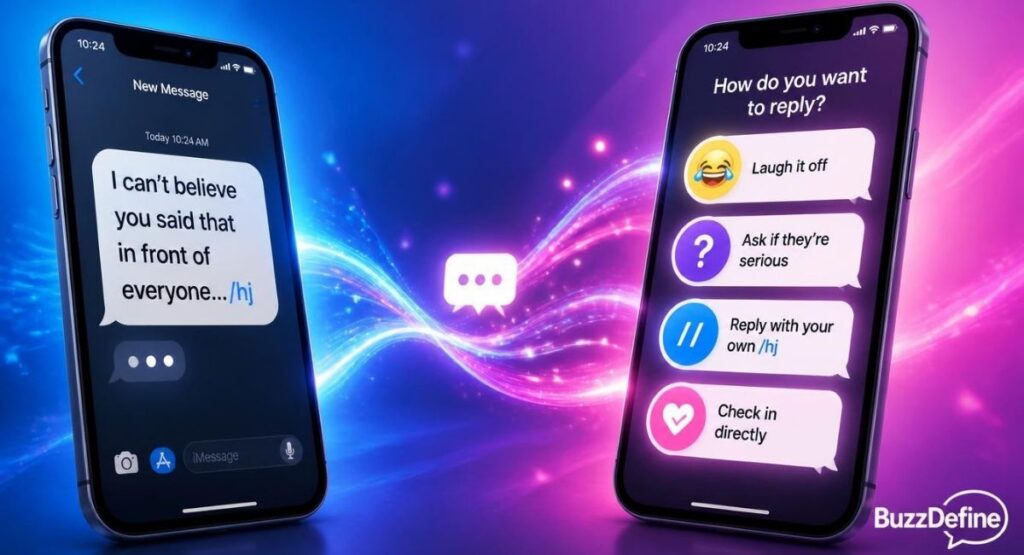
Nobody covers this, but it’s the actual question people have once they understand what /hj means. Here’s how to respond, depending on how the message lands.
- Laugh it off. If the message reads as mostly playful, a simple laugh or a light reply keeps the tone matched. This works for most everyday /hj messages.
- Ask if they’re being serious. If something about the message feels heavier than usual, it’s fine to ask directly: “wait, are you being serious?” This isn’t awkward, it’s exactly what tone indicators are meant to open up.
- Mirror it back. Replying with your own /hj keeps the exchange balanced and shows you caught the tone without making it a bigger deal than it needs to be.
- Check in directly. If the /hj doesn’t fully cover your worry, skip the guessing and ask them straight. A quick “is everything okay?” says more than trying to read between the lines.
There’s no wrong way to reply, as long as the response matches how serious the message actually felt.
When NOT to Use HJ or /hj
Casual doesn’t mean universal. Some situations call for skipping the tag entirely.
- Work email or professional Slack. Tone indicators read as unprofessional in most workplaces, even casual ones. Say what you mean plainly instead.
- Academic writing. Slang and tone tags don’t belong in essays, reports, or anything meant to be formal.
- First time conversations. Someone who doesn’t know you yet won’t necessarily know what /hj means, so it can confuse more than it clarifies.
- Customer support chats. Clarity matters more than tone here, and most support teams expect straightforward language.
- Talking to people unfamiliar with tone tags. Parents, older relatives, or anyone outside internet culture may just see it as a typo.
When in doubt, write the sentence in full instead of relying on the tag to carry the tone.
Common Mistakes People Make With /hj
A few habits make /hj less effective than it’s meant to be.
- Dropping the slash. Writing plain HJ instead of /hj changes what the letters signal, and readers might not catch that you meant the tone indicator at all.
- Putting it at the start instead of the end. /hj works because it follows the statement it’s clarifying. Placed at the start, it loses that connection and just reads as random.
- Overusing it. Adding /hj to every message wears out its meaning fast. It works best when saved for moments that actually need the clarification.
- Using it to avoid a real conversation. If something genuinely needs to be said seriously, /hj can end up hiding the point instead of softening it. Some things are better said without a tag at all.
FAQs
What does HJ mean in text?
HJ usually means half joking, written as /hj at the end of a message. It signals a statement that’s part joke, part true.
What does /hj mean on TikTok?
On TikTok, /hj works the same way, in comments and captions, to show a comment isn’t fully serious even if part of it is true.
Is /hj the same as /j?
No. /j means the statement is entirely a joke, while /hj means it’s only half a joke.
What does HJ mean on Snapchat?
On Snapchat, /hj carries the same meaning, half joking, and mostly appears in DMs between friends who already know each other’s humor.
Where do you put /hj in a sentence?
/hj goes at the end of the message, right after the part it’s clarifying, not at the beginning.
Does HJ have another, non-slang meaning?
Yes. Without the slash, HJ can mean “here lies” in formal Latin use, or refer to initials, names, or other technical terms.
Who uses /hj most, Gen Z, Gen Alpha, or specific communities?
It’s most common among Gen Z, and especially popular in neurodivergent and fandom communities that use tone indicators regularly.
Is it okay to use HJ in professional messages?
No. It reads as unprofessional in work emails or formal chats, where plain language works better.
What’s the opposite of /hj?
/s (sarcastic) or /srs (serious) are the closest opposites, since both remove the “half joking” middle ground.
How is /hj different from JK?
JK means the whole statement is a joke, while /hj means part of it is true. JK also carries no tone nuance beyond that.
Final Takeaway
/hj means half joking, and the slash matters. Check for it, read the context, and if you’re still not sure what someone meant, just ask.
Read Next: What Does “PM” Mean in Text? Complete Guide to Its Meanings Across Contexts

Muhammad Kaleem is the founder and lead writer at BuzzDefine, where he covers internet slang, texting abbreviations, and digital communication trends. He actively follows how language evolves across WhatsApp, Instagram, and TikTok — tracking real conversations, group chats, and comment threads to keep definitions accurate and current. He writes to make modern slang easy to understand for readers of every generation.